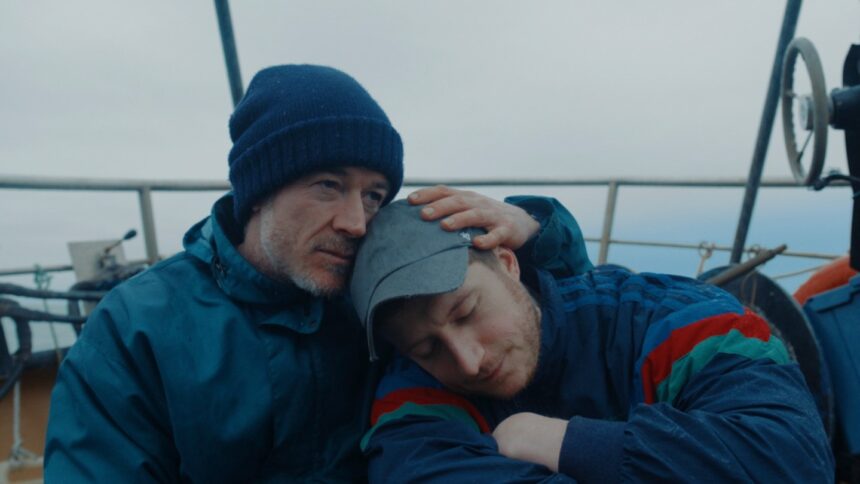
It’s tempting to describe the delicate gay love story of English novelist turned filmmaker Helen Walsh On the sea As another version of God’s own countryexchanging Yorkshire farmland for the coastal waters of North Wales. But that would be an unfair reduction. Like Francis Lee’s 2017 debut film, this is a powerful, racist drama whose slow-burning power plays out against a landscape that’s as bleak as it is beautiful, where men of few words are chained to restrictive masculine codes set in stone generations ago.
A palpable sense of place, environment, and working-class life where pleasure, passion and desire run through this film as atmospheric as the icy seawater and the turbulent currents of the fjords. The unerring restraint of their leads never obscures the raw emotions of their sensitively drawn characters.
On the sea
Bottom line A distinctive drama steeped in sensuality and melancholy.
place: Provincetown Film Festival (novels)
He slanders: Barry Ward, Lorne Macfadyen, Liz White, Henry Lovell, Celyn Jones, Danny Webb, Lisa Gwenllian
Director and screenwriter: Helen Walsh
1 hour and 51 minutes
Middle-aged protagonist Jack (Barry Ward) and his younger brother Devan (Celyn Jones) co-own a mussel farm, a difficult enterprise under pressure from larger commercial fisheries. Jack and Devan are the third generation of men in their family who endure the backbreaking work of hand-picking mussel beds and placing them in boxes every day in the frigid winds. The interest in daily labor in sometimes harsh conditions calls to mind Luchino Visconti’s 1948 neo-realist classic docudrama about impoverished Sicilian fishermen, La terra trema.
The friction between the brothers has been present under the surface from the beginning. The three Devan boys are involved in the work, unlike Jack’s strict teenage son Tom (Henry Lovell), who is frequently absent. When Jack sends his youngest brother home because his hands are too frozen to use, Devan criticizes his masculinity by saying he’s too nice with boys, no more so than Tom. Devan later showed displeasure at keeping the business afloat on his own while Jack was undergoing treatment for cancer, and is now in remission. Their brotherhood is not easy.
When an accident for which Tom is indirectly responsible results in the amputation of the leg of old Bernie (Danny Webb), who makes a living from his scallop rig, Jack takes on the responsibility of caring for the veteran fisherman. He gets help – at first through his own strong insistence, then later voluntarily – from itinerant deckhand Daniel (Lorne Macfadyen); They chop wood to heat Bernie’s house and take his boat out to earn money to pay his bills.
The attraction between the two men is initially so veiled as to be almost undetectable, though Daniel is more evident through his looks and the hints he drops in their terse conversations. Irish actor Ward (who played the main character in Jimmy Hall For Ken Loach) expertly conveys the unease of a man who reads and responds to a stranger’s signals even as he feigns indifference, for fear of disrupting his life in a society suspicious of any deviation from ancient mores.
Ironically, it takes Daniel hitting Jack in the mouth after he allows the younger man to be insulted at the bar to motivate Jack to act on his desires. Their sex was stuttering, nervous, almost wild at first, then became increasingly tender and unrestrained as they began stealing time together in Daniel’s trailer. As their relationship intensifies, Daniel becomes dissatisfied with the secret relationships and wants more, while Jack’s self-denial and wariness of potential exposure are habits that are difficult to break.
“This is my city,” Jack says to Daniel by way of explanation. “I live here.” But no less poignant is Daniel’s frustration when he asks about their relationship: “What is this?” The emotional inarticulacy of both men is quietly painful.
There are a million conflicts on Ward’s face, most notably Jack’s longing for a more fulfilling life and the sudden reminder that if he had made braver choices, this could have been a choice. In a scene of crushing sadness, he sees Daniel playing pool in a bar with another man, and their intimate body language is unmistakable.
However, Jack’s greatest regret is the harm he might cause to Maggie (Liz White), the wife he has truly loved since they were high school sweethearts. This mischief becomes increasingly inevitable once Devan starts making pointed comments about Jack’s younger friend helping him take care of Bernie despite not knowing the old man, or Jack and Daniel taking Bernie’s boat out for the day, with no evidence of any fishing being done.
The homophobic Devan chooses to drop these insinuations over dinner with his brother and their wives, which makes his behavior particularly toxic, not to mention that his spite is motivated in part by his maneuvers to buy out Jack’s stake in the company.
Walsh is a confident storyteller, aided in large part by the bold textures and searching close-ups of DP Sam Goldie’s camera, which form an alternate landscape of Jack’s hard-lined face, calloused hands, oversized sweaters, and water-filled rubber waders. Overcast skies cast much of the film in shadow, the main exception being a rare patch of sunlight seen from underwater while swimming off Bernie’s boat. Or is it a memory of a very early time while on vacation with Maggie, when she first learned of her husband’s secret?
Unfolding on the regional sounds of Felix Roche’s delicate score, On the sea It takes some unsurprising turns, drawn in foreshadowing, but also less expected developments, especially when Maggie overcomes her anger and her steely personality kicks in. Tom also, after maintaining a hostile distance from his father, makes a belated display of loyalty that silences his uncle. The scene in which Tom’s girlfriend (Lisa Gwenlian) exchanges friendly words with Jack while he is in isolation is a beautiful scene.
Walsh is too good of a writer to concoct a happy ending in which everything falls into place. But there is comfort and even a kind of peaceful redemption in the film’s stirring closing images that stay with you.