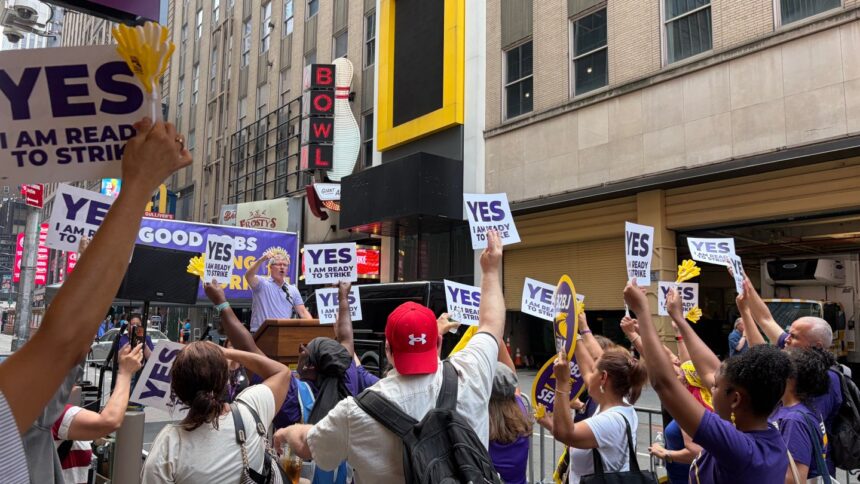
Broadway sanitation workers voted to strike Tuesday amid negotiations over a new contract.
The strike vote marks the first time more than 250 sanitation workers, part of 32BJ of the Service Employees International Union, have voted to authorize a strike in 18 years. Talks with the Broadway League, which represents employers and theater owners ATG, Nederlander, Shubert and Circle in the Square, are ongoing, but Broadway cleaners say the two parties remain far apart on many issues, and the current contract has expired.
The union demands an increase in wages in line with the cost of living, improved retirement and health care benefits, improved working conditions and paid leave, and strengthening anti-discrimination measures. A vote to authorize a strike does not necessarily mean that a strike will occur, but it does give the union the option to call a strike if necessary, and is often used as a show of force amid negotiations.
Speaking before the vote and a rally in front of the Shubert Organization’s offices, 32BJ SEIU Executive Vice President Dennis Johnston said the two sides, who have been negotiating since early June, are at odds over wages, in particular. This is of particular importance to union members, who were out of work while theaters were closed during the pandemic, then did not see wage increases for several years afterward, and face a rising cost of living.
“With the high cost of inflation in the city, and the high cost of housing, our members are struggling hard, as are many other working people, and we have to provide a very strong wage settlement for our members,” Johnston said.
Another negotiating session is scheduled for Wednesday, and Johnston said he expects it to continue next week. The Broadway League did not immediately respond to a request for comment.
At the march, where workers chanted “Share the wealth” while holding signs expressing support for the strike vote, the theme of the Broadway industry’s success was also at the forefront. In the 2025-2026 season, Broadway generated a total of $1.91 billion in ticket sales, largely matching the previous season’s historic earnings.
“We’re the ones who have to collect the $7 bottles of water and $20 boxes of popcorn at every show,” says Chris Repollet, a janitor at the New Amsterdam Theater (home of the New Amsterdam Theater). Aladdin) and a member of the negotiating committee, on stage at the rally. “We see the success of the industry. It depends on us.” (Repollet is also covered under the terms of the contract, although its theater owner is not included.)
Likewise, the Musicians Union, Local 802 AFM, and the Actors’ Equity League cited gross revenues at last fall’s parades during their contract negotiations with their employers, the Broadway producers (who in turn faced the rising costs of producing the shows). The two unions have said they will strike if an agreement is not reached, and are approaching strike deadlines, before new contracts are reached.
Tuesday’s march included dozens of 32BJ union members and a handful of AFM and IATSE members, all of whom chanted about the union and the need for a new contract to the backdrop of pop songs. Speaking before the event, Repollet noted that this was the first time he had seen many of the other Broadway cleaners together, and that there was a general lack of knowledge about the group within the industry.
Martha Aristizabal, who has worked at the Ambassador Theater for 17 years (her native… chicago) sits on the negotiating committee, and described the job, through a translator, as physically demanding, requiring more than 40 hours a week for some janitors, who are tasked with carrying supplies and playing bills to the stage, and cleaning cups, food and more found in the seating areas. The job also includes cleaning up scraps used at the end of many shows, as well as stage decorations, such as pebbles, that have gotten into the audience.
“It’s very important because we’re like the engine that runs Broadway. Every show starts with the essential workers, and that’s us,” Aristizabal said. She added that current wages are not sustainable due to the high cost of living in the region.
“The landscape of the city is changing,” Repollet said. the Hollywood Reporter Before assembly. “You want a second job because you need it, but at the end of 40 hours a week you just want to recover and get back. So it’s tough. We just hope the league honors our offer, respects us, and treats us like the people we are.”
“What this fight boils down to is respect,” he continued on stage. “Everyone looks down on us, but we do it with pride because we care about the theaters. We care about the shows.”