like Collapse (Aldashilo) Old news footage begins revealing a strange but true sight of something being recovered from the frozen sea. It’s a massive chunk of an Antarctic iceberg, on its way to becoming the centerpiece of Chile’s pavilion at the 1992 World’s Fair. As a symbol of national ingenuity and know-how, the frosty specimen kind of exists. However, for a country emerging from 17 years of military rule and intent on redefining itself, it represents an understandable leap of faith. It’s also a fitting starting point for a film in which obscure things come to light, if only briefly — a coming-of-age story where the primary lesson is to keep what you know to yourself.
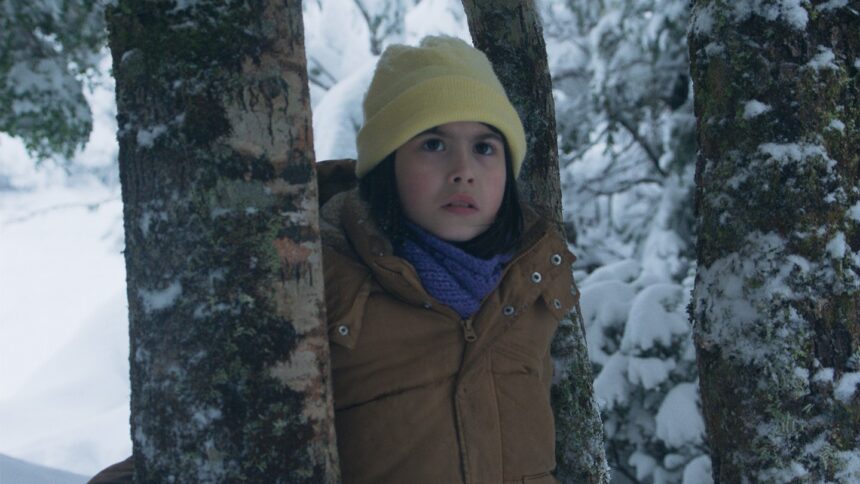
Manuela Martelli’s debut was very well received 1976 (aka Chile ’76), a selection from the 2022 Directors’ Fortnight, set during the Pinochet era in Chile. The writer-director sets her sophomore film just two years after the country had shaken off the tyrant’s iron grip. Inés, the main character, was born in the last years of the dictatorship. An angel-faced 9-year-old with an old soul, she watches the adults around her adjust their actions to a changing world. She discovers that the truth is less important than the ability to predict people’s reactions to it.
Collapse
Bottom line Haunted and haunted.
place: Cannes Film Festival (What Look)
ejaculate: Maya O’Rourke, Saskia Rosendahl, Maya Rae Domagala, Jakob Gerzal, Paulina Urrutia, Mauricio Bisutich
Director and screenwriter: Manuela Martelli
1 hour and 48 minutes
Alert, precocious, and utterly uncool in Maya O’Rourke’s convincing performance, Ines moves freely around her grandparents’ mountain ski resort during her mother and father’s absence. It is not clear whether they are bureaucrats, scientists, artists or entrepreneurs, but they are in Spain as members of a Chilean delegation to deliver icebergs at Expo 92 in Seville. While her grandmother, Tica (Paulina Urrutia), and grandfather, Ricardo (Mauricio Bisutich), are busy entertaining potential investors, Inés essentially runs the place, a tightly managed hotel with an interesting history in a remote corner of the Andes, near a ski lift. Ines is friends with the two powerful dogs who watch over the hotel, and she moves easily among the hotel staff and, later, when she is in detective mode, between the guest rooms. She hangs out with receptionist Sonia (Paola Zuniga) at the front desk, exchanges greetings with Sonia’s brother, waiter Gennaro (Luis Uribe), and, against Tica’s wishes, slips into housekeeper Patty’s (Daniela Pino) room when she doesn’t want to sleep alone.
Ines is fascinated by one of the guests, a German skater about five years her senior. Hannah (Maya Rae Domagala), the only girl on her coaching staff, is also the film’s star, but her waning drive frustrates her coach Alexander (Jakub Gerzal), whose relationship with Hannah seems more complicated and troubling every time the screenplay brings them together.
Ines introduces the teenager with a homemade gift, and despite their age difference, they bond easily, as two girls separated from their parents, and English becoming their common language. Hannah shares her upbeat music and dark nail polish, and alludes to her strained relationship with her single mother, a former ski champion from East Germany, or as Hannah calls it, “a country that doesn’t exist anymore.” Germany was reunified within a few months of replacing Pinochet as president, and Martelly’s scenario was sensitive to dramatic geopolitical events from a child’s perspective. Inés, wise beyond her years, realizes that Sonia and Gennaro’s brother is one of Chile’s sisters. com. desaparecidosIt is assumed that he was killed by the government.
While exploring the snow-capped mountain, the girls jump stones onto its frozen lake and wander past its defunct military outpost, a plot of land that Inés’s grandparents intend to sell to a couple from Madrid. With visions of an upscale skier’s destination and a big payday, Tika warns her granddaughter: “Behave while the Spaniards are here.”
But troubling events punctuate the Spaniards’ visit: One morning, after an eventful evening involving separate and overlapping periods with Alexander, Inés, and Sebastian (Lautaro Cantilana), Enés’s teenage cousin, Hanna is gone. A disappearance, a far away place – it’s a classic plot engine, fueled by turmoil and dark secrets, given new life in this novel. Benjamin Echazarreta’s cinematography captures the daily energy of the hotel as well as the eerie beauty of the place, with its mixture of fairytale wonder and profound dread. Bernard Herrmann’s dissonant blasts of Maria Portugal’s rich music heighten the suspense and foreboding.
The film’s second half places Ines alongside Hanna’s distressed mother, Lena, brought into a fierce, guilt-ridden life by Saskia Rozendaal. After being excluded from the local authorities’ search for her daughter, Lena conducts her own search. The optimistic but cautious Inès rides shotgun with her and acts as translator when necessary, a role that puts her in an uncomfortable and painfully useful position when official excuses are pathetic or civic indifference is acute. Among the various aspects of the film that its English title refers to, not least is the turbulent rampage that Lina unleashes on two schoolgirls. Gringa loca On a razor’s edge.
The Spanish film title can also be translated to Dissolutionsuitable and binomial like Collapsebut with a slightly different slant, such as in Lena’s relationship with Ennis at the end. It’s the kind of motherly attention that should come with a warning sign.
Martelli, an accomplished actress herself, attracted compelling and involving performances from her international cast. The production design of Nohemi Gonzalez and Carolina Espina’s costumes are standout contributions that never overshadow the action (although the hand-stitched embroidery on one of Ennis’ sweaters may break your heart a little with its brightness and innocence).
In some cases, the director overestimates the size of her hand. The opening scene contemplates a long, slow swirl of blood down the bathroom sink—from one of the baby’s missing teeth, no less—that seems to presage overdrive. Later, a long close-up of a broken glass of milk serves neither as visual rhyme with the snowy setting nor as dramatic vision. It’s just distracting.
But these are quibbles when a film conjures up a world as painful and mediocre as the one in the film. Collapse. Confused communications, patriarchal agents, colonial histories—Martelli weaves these narrative threads with skill and artistry. Through the mystery of one person’s fate, the young hero awakens to certain ground rules and discovers a haunted place. You could call it a place of things that “you don’t think about but are still there,” as the unfortunate teenager in the story wrote in the diary she left behind.