
The first half of 2026 has delivered something the Indian film industry has been waiting for since the pandemic: a sense of stability. While headlines have dominated the conversations, trade experts believe the bigger story is that audiences are returning to theaters in steady numbers, mid-budget films are starting to operate again, and the second half of the year could be stronger.
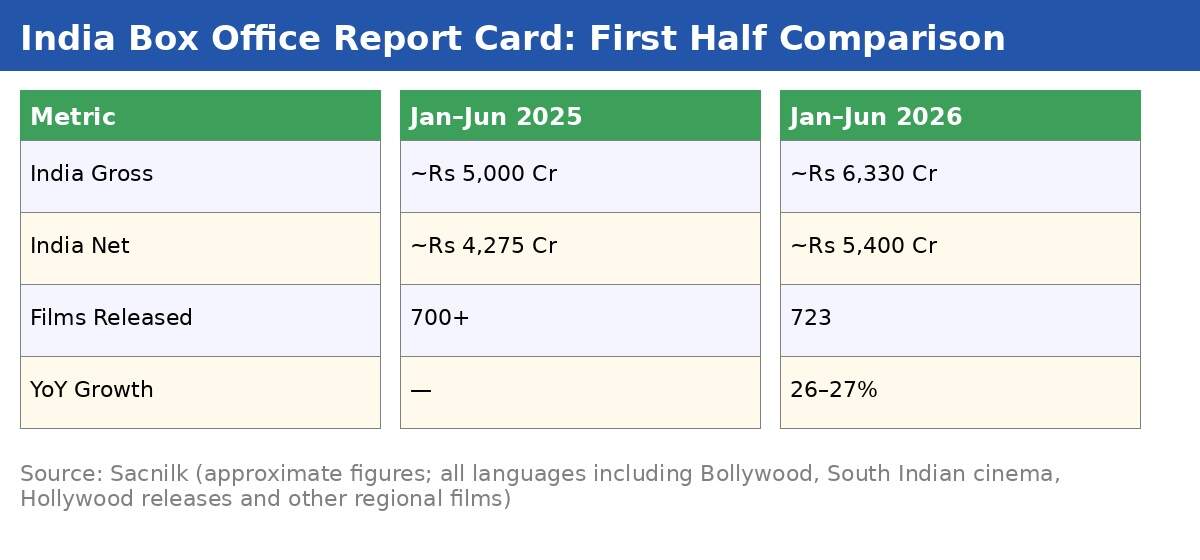
It’s a strong sign and one expects the momentum to remain intact even into the second half of 2026 with some big budget films waiting.As per data calculated as per figures from Sacnilk, the first half of 2026 (January 1 to June 30) generated approximately Rs 6,300-6,350 crore in gross Hindi collections (across Bollywood, Telugu, Tamil, Malayalam, Kannada, Punjabi, Hollywood and other languages). The net Hindi collection stands at around Rs 5,380-5,420 crore, with around 723 films released during this period of the first six months.
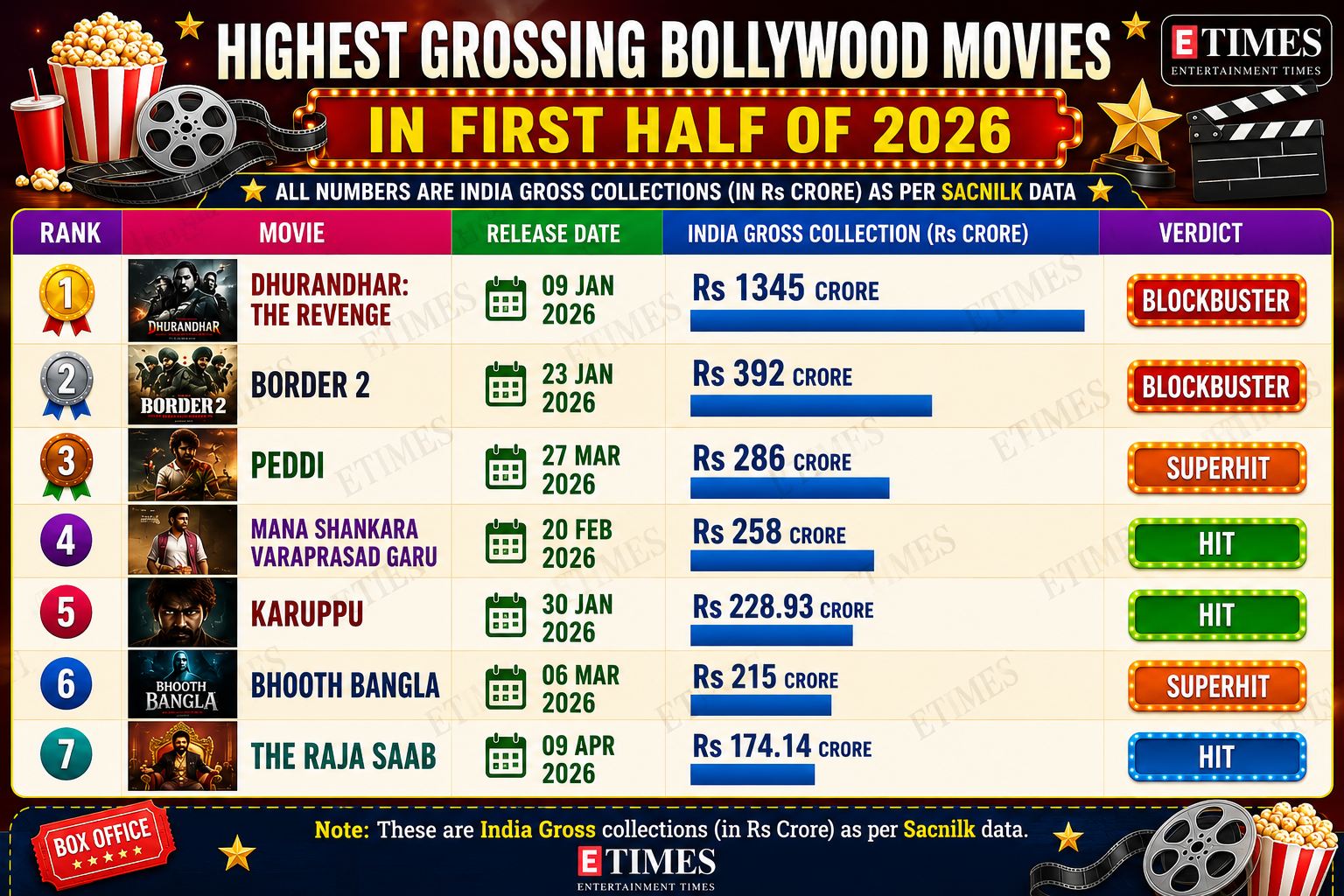
For comparison, the first half of 2025 generated around Rs 5,000 crore at the Indian box office across all languages, according to industry estimates by trade analysts.Trade expert Taran Adarsh says, “I think there was ‘Border 2’, ‘Dhurandhar’ and of course ‘Dhurandhar: The Revenge’. ‘Dhurandhar’ was released in 2025, but its run extended to 2026 as it ran from December to January. That’s why, along with ‘Dhurandhar: The Revenge’, films like ‘Border 2’, ‘Bhooth Bangla’ and ‘Mardani 3’ have done well at the box office.
Now, Welcome to the Jungle is also gaining good traction in Tier 2 and Tier 3 centers and group pockets.
I think that’s where the work really is. People have slowly realized that you need to think beyond the metro as well.A film like ‘Dhurandhar’ has raised the bar of filmmaking, not just for the world of espionage, but for every filmmaker. You have to be very quality conscious now because the audience won’t accept anything you give them.
I think that’s the biggest lesson we’ve learned over the years.”Producer and film business expert Girish Johar estimates that the Indian box office across languages has registered at least 10-15% growth in the first half of this year, compared to the first six months of 2026. He says this is very encouraging. “Two English-language films also performed well. “Project Hail Mary” did well, “The Devil Wears Prada” also did well, and “Obsession” was great.
So, overall, if you look at the box office in India for the first six months across languages, we were quite confident. I think we’re looking at 10 to 15% upside compared to the same time last year.” Johar says.According to trade experts, success was not limited to one or two support releases. Films like ‘Dhurandhar’ led the charge, while ‘Border’ and sleeper hit ‘Pati Patni Aur Woh’, which grossed around Rs 60 crore, contributed to the success of theatrical business.
‘Dhurandhar’ resets the standard
Showrunner Akshay Rathi believes that one film has radically changed the conversation about the Indian box office this year – ‘Dhurandhar: The Revenge’, which has overtaken the first part, which was released in December 2025. “The impact that ‘Dhurandhar’ made in the first half of this year has lifted almost everything that came after it. Not only was this film a massive hit, it also showed us the true potential of the Hindi speaking market,” He says.Every era has redefined success, from Rs 100 crore to Rs 500 crore, and now Indian cinema has entered another phase, says Rathi. “Now, we suddenly see that a Hindi film can fetch Rs 1,000 crore at the domestic box office. This creates a paradigm shift in the way we conceptualize and produce our films because the new challenge is to know how to go beyond this standard.”
Mid-budget films like Bhooth Bangla and Hai Jawaani Toh Ishq Hona Hai are back
While blockbusters often dominate the headlines, Rathi believes one of the biggest positives of 2026 is the revival of mid-range theatrical performers.
He points to films like “Hai Jawaani Toh Ishq Hona Hai”, which grossed Rs 60-70 crore net, and “Bhoot Bangla”, which crossed Rs 150 crore, as evidence that audiences are once again ready to support films beyond event cinema.“Consistency in audience consumption is a huge relief to all of us at work. It’s no longer just a scenario where films arrive and disappear on the first afternoon. Audiences have rebuilt the habit of going to cinemas and are turning to watching good films.”
Taran Adarsh feels there is room for more. “There has been growth here, but I wouldn’t necessarily say that in terms of collections. What happens is that when some films succeed and others don’t, we’re back to square one.”
Hopefully, with time, we will get back on track.I still remember the 80s and 90s, when we had a lot of silver jubilees and golden jubilees, and they were achieved purely on merit. Nowadays, of course, you can’t expect a silver jubilee and a golden jubilee, because films are widely released.
Having said that, I think the quality of movies should improve and the content should always remain at the forefront.
The Indian film industry is one with the booming regional cinema
Trade experts also believe that post-pandemic audiences have permanently changed the way they consume cinema. Language barriers have weakened significantly, as audiences accept films from multiple industries.“Today, when we look at the top theatrical releases of the year, we don’t just count Hindi films.
We count Hindi, Telugu, Hollywood and regional films that have the potential to make a pan-India impact,” Rathi says. This year, Riteish Deshmukh’s ‘Raja Shivaji’ has been one of the films that has largely stood out and achieved the highest level as far as regional cinema is concerned. Language is definitely no longer a barrier.
Rathi also argues that the health of an industry cannot be measured solely by blockbuster openings. “On average, about 15 to 20 films are shown in theaters every week.
While each of these films may not post big individual numbers, their cumulative contribution over the year is actually quite significant.” Thus, focusing on one or two big releases often overshadows the meaningful contribution made by dozens of smaller films throughout the year.
Lessons to be learned: Big cinematic clashes should be avoided
However, Johar believes that the box office could have been stronger if the release had been better planned. He points to several weeks in which four or five films competed for the same audience.“I would suggest that there were some clashes between them. There were weeks when four or five films were released together. If these releases had been distributed over separate periods, we could have achieved better results than expected.” He says.He explains that theatrical viewing is largely an impulse-driven activity. When audiences are presented with too many choices at once, many put off watching movies altogether, which ultimately affects collections.Despite this, Jawhar remains optimistic about what is to come. Although there are many major versions He believes that the next six months can boost the industry’s momentum. Talking about learning, Taran Adarsh says, “I think we are still in the debugging phase, where things will gradually be simplified and improved. Hopefully, content will eventually take over. Actors also need to lower their fees or join as partners in a film and make profit through back-end profits.
If you ask me, I think this is a much better model.
“
Can the second half make history?
The second half of 2026 has some important films lined up with high hopes – be it Ranbir Kapoor’s Ramayana, Shah Rukh Khan’s King or Sunny Deol’s Batwara. “If you look at the lineup for the second half of the year, there is a strong possibility that it will outperform the first half,” Rathi says. He points to major releases like ‘Ramayana’, ‘Matrubhoomi’, ‘Toxic’ and ‘Batwara’, as well as a busy December calendar.“Even if a few of these films perform to their full potential, the second half of the year could be historic,” Akshay says.
Judgment
If the first half of 2026 proves anything, it is that theater business in India has moved beyond just recovering from the pandemic. The industry is witnessing healthier audience habits, stronger offerings across languages, the return of commercially viable mid-budget films, and a renewed faith in theatrical release.While the crowd of releases remains a challenge, the early report card suggests that Indian cinema is back on the growth trajectory. If the upcoming tentpole releases live up to expectations, 2026 could end up being one of the strongest years at the Indian box office in recent memory.