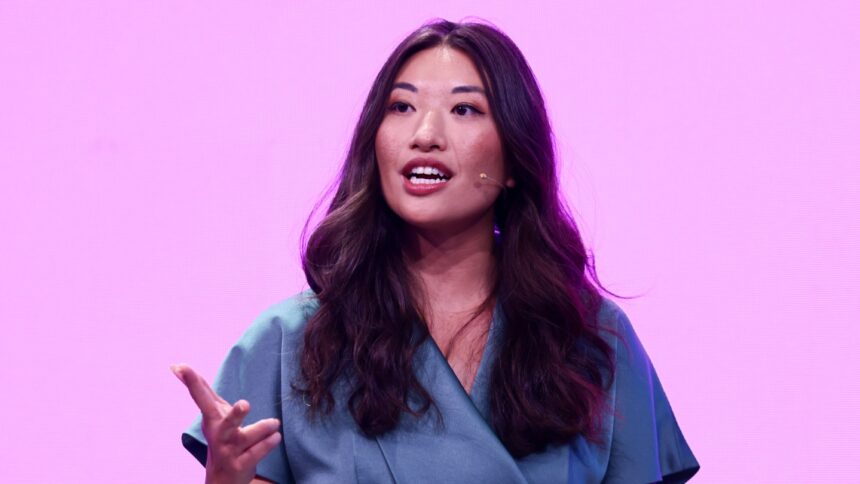
Bluesky’s COO stresses that not all hope is lost on social media.
Rose Wang was hosted by SXSW London in a friendly conversation with journalist Amit Katwala on Monday afternoon, where the platform’s chief operating officer covered a wide range of topics, including how Bluesky amassed over 44 million users in two years, the value of community-led communication, and why Facebook and X made a huge mistake. The session was titled “Who is the Social Network For, Anyway?”
The executive, who said Bluesky is currently just a 40-employee company, began by saying that social media is “controlled by a few companies.”
“They control what information is in front of you and what they send you,” she said. “In short, they control speech all over the world, and we have seen the consequences of that.” Wang and Katwala did not mention Meta’s Mark Zuckerberg or X’s Elon Musk by name, but were referring to the latter platform using its pre-Musk name, Twitter.
Bluesky’s sudden growth explosion — many of whom joined from [when] “One person controls the entire platform,” Wang said.
“When a new owner comes in, they can change the culture and rules of that platform overnight and make it inhospitable to a lot of people,” Wang continued, in a veiled reference to Musk’s purchase of X in 2022. “What happened with Bluesky is that the growth came from, yeah, people call them ‘leftists.’ We have to look deeper into, well, who are these leftists? [They’re] Journalists and scholars [and] People who want to rely on actual, verified information. “They fled because none of that was available anymore.” She added that Plosky wants to give power back to social media users: “So they can know what rules they need for their own feeds; [so] That they can only create their own feed, and that if we don’t like a piece of content, we can’t take it down.
“They should be able to decide what information is out there and what information they want to take from their communities, rather than relying on billionaires to make that decision.”
Over the past few years, since Bluesky went public in February 2024, Wang and her colleagues have noticed “there is a world hunger for people.” [who want] To know what is actually real, what is actually human, and what was actually created by creators and not other AI agents.
She continued: As a platform still in its infancy, Bluesky still has the ability to quickly adapt to the growing needs of its users. “Facebook and Twitter are huge, they have a lot of users, so changing that shift is very difficult for them. They are also essentially AI companies at this point.”
Wang is keen to rebuild the relationship between the content creator and the person viewing the content, as well as the communities, audiences and other small groups that social media has historically united.
Other topics Wang and Katwala covered at London’s SXSW conference – which took place in Shoreditch from June 1-6 – included rethinking the profitable advertising model so that money is invested back into society, not just used to attract attention, as well as artificial intelligence. Because of course.
“AI is in every conversation, and I think it’s really important because in some ways,” Wang said. “People compare it to electricity, right? It’s the thing that feeds everything else, and I think it’s really important for us to talk about AI in a more nuanced way, rather than this general set of ‘AI’. And right now, people are using AI to create content, and then they’re also using it to build apps. So, I think it’s really important for me to say that Bluesky, we very much believe that AI is not interesting in terms of using it to create content, but we think it’s really interesting in terms of leveling the playing field for builders.”
Bluesky’s newly launched AI tool, Attie, is designed to help users curate their personalized and personalized feeds based on their specific interests – once again, to help drive the community-first ethos that Bluesky prides itself on.
Wang acknowledged that AI is an extremely useful moderation tool, prompting Katwala to question Bluesky’s approach to moderation in an age when much of social media feels outlawed in this regard. “In social media platforms today, I think moderation is essentially court systems, right? They judge any person or content that could be on the platform, and the way they currently operate is there is one court system on every platform with one set of rules that governs the entire world’s audience, and they have like 10,000 writers making those decisions. I think that’s a very broken model,” she said.
SXSW London runs through Saturday.