I suppose one can’t complain too much about over-reliance on exposition Deus Ex Machine Plot developments when seeing God’s fingerprints in every revelation or development is literally the main point. However, it’s hard not to wish Fox well Believers: Women of the Bible It offered something more fundamental to cling to than the feeling that everything we see is being directed by the hands of higher powers—God, but also history, and the creator René Echevarria.
Ostensibly an attempt to reconsider the female perspective on some of the most famous tales from the Book of Genesis, the three-part miniseries treats its characters like paper dolls pushed around at the whims of a story set in stone thousands of years ago. In the end, it offers little actual knowledge about these women, the men around them, or even the God who willed all their destinies into existence.
Believers: Women of the Bible
Bottom line In numbers.
Broadcast date: Eight o’clock on Sunday evening, March 23
ejaculate: Minnie Driver, Jeffrey Donovan, Natasha Karam, Tom Mason, Alexa Davalos, Tom Payne, Ben Robson, Blue Hunt, Millie Brady, James Purefoy, Will Stevens, Taylor Napier
creator: Rene Echevarria
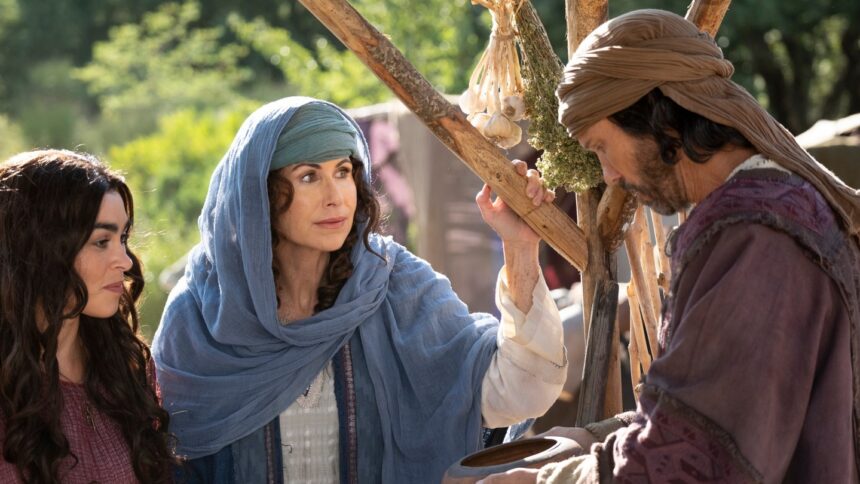
The first and only installment sent to critics tells the story of Sarai (Minnie Driver) and Abram (Jeffrey Donovan) — or Sarah and Abraham, as they eventually became known. (Future installments will focus on Sarah’s daughter-in-law, Rebecca, who will be played by Alexa Davalos, and Rebecca’s sisters-in-law Leah and Rachel, who will be played by Mellie Brady and Blue Hunt.) In theory, their story should contain enough drama to satisfy both religious and secular tastes.
After decades of marriage, Sarai and Abram remained happily in love; The only note of regret between them is not being able to have children. Then one day, God spoke directly to Abram. God commanded Abram to leave his homeland in search of a new one. God also told Abram that he would be the father of many children. Abram may not know how or why any of this is happening, but deep down he feels he must do what God says. With barely a moment’s notice, he ordered his entire family to pack up and head off to parts unknown.
This is exciting stuff, or it should be: Abram’s absolute and inexplicable certainty, the bewilderment with which Sarai is greeted, and the rippling consequences that have on the society he leads. instead of, Believers She is allowed only a minute of confusion (“God? What God?”) before she decides to side with her husband. The speed and ease of her decision only makes sense in the context of the fact that we already know that’s what has to happen, because that’s what happened in this story every time it’s told by millions upon millions of people over centuries and centuries.
The rest of the 84-minute double-episode (two hours with commercials), directed by Danny Cannon, follows in this manner. Each scene appears like the most general version of itself – unfolding along pre-determined story beats and against a simple desert backdrop rather than growing organically from specific individuals in a given environment. Each character is painted with a very broad brush to make them almost featureless. (Here, “likes blue” is a feature.)
If anyone finds themselves in real trouble, such as imprisonment at the hands of a vengeful pharaoh or life-threatening thirst, God appears long enough to get the story back on track. As for why God needs certain results to happen the way He does, Believers He doesn’t pretend to know. He just does.
There are enough flashes of potential to suggest it didn’t have to go this way. Sarai’s marriage to Abram may be too unilaterally nice to be interesting, and Abram himself is too passive (well, apart from the whole “we have to move” thing) to think much. But Sarai has a more thorny relationship with Hagar (Natasha Karam), the Egyptian slave who, in a BC version of surrogacy, convinces her to become pregnant with Abram so Sarai can raise the child as her own.
Over the course of years and then decades, the relationship between the two women oscillates between fierce sisterhood, bitter jealousy, and an unstable mix of the two. At the same time, Sarai finds herself in a poignant dilemma. She places her complete trust in her husband, but not necessarily in God, whom her husband, in turn, placed in everything. for him Faith in.
All of these mixed emotions are great to play with, and Driver does a job of being able to put them on her face whenever she’s asked to. But it is not called often enough. while Believers He makes some effort to humanize these characters, ultimately being more interested in celebrating them as heroines. Instead of following these feelings to darker or more difficult places, he keeps them at arm’s length, acknowledging them only with a glance before moving on to the next big shift or time jump.
This noble, straightforward approach certainly has some uses. One can imagine Believers Play well in Bible study classes, or unobjectionably religious content that can be gathered around with the family during the holidays. (In fact, the final episode of the series has been timed to land on Easter.) It’s hard to imagine it will capture the attention of a channel surfer just looking for something interesting to watch. For all its godly ambitions, the series falls victim to the same old pitfalls that have sunk the resumes of many lesser mortals. He places too much faith in the inherent appeal of his subjects, and not enough in the power of back-to-basics storytelling.