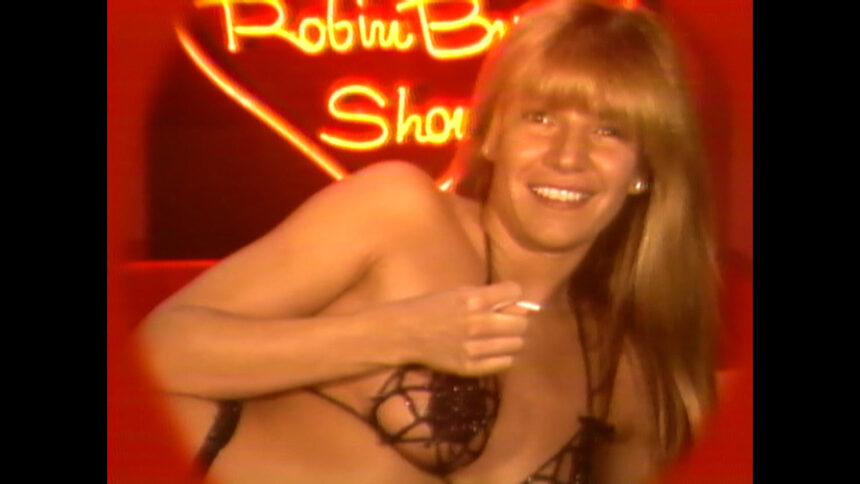
Understandably, at the age of 70, Robin Byrd momentarily shows a rare sad side as he contemplates the inevitable spreading and sagging of a body he once wore on television in only a black crochet bikini. But it is triumphantly true that she almost immediately shrugs off those concerns and clothes with them. She strolls on Fire Island Beach, sharing her generous curves with the wind before taking the stairs to her deck and blowing kisses to the Birdwatchers, as her fans are known.
Bang My Box: The Robin Byrd Story (Surely it’s a contender for this year’s title?) It pays homage to a woman who, for multiple generations of New Yorkers, has been as much a part of the city’s iconography as the Chrysler Building. For 21 years, from 1977 to 1998, the self-described “orgy queen” shared her vocal endorsement of nude bodies, sex positivity, esoteric erotica, free speech and the full gay spectrum on the pioneering New York City call-in show that bears her name and can still be seen in reruns.
Bang My Box: The Robin Byrd Story
Bottom line Joyful banger.
place: Tribeca Film Festival (Documentary Film Competition)
release date: Tuesday 30 June
with: Robin Byrd, Shelley Byrd, Sandra Bernhard, Lou Cass, Marjorie Hines, Heather Hunter, Michael Mosto, Sherry Oteri, Annie Sprinkle
Managers: Gillian Gunter, Stephanie Schwam
1 hour and 19 minutes
Perhaps the most important factor captured by co-directors Stephanie Schwamm and Gillian Gunter in their celebratory HBO doc is that this unique late-night host, who has drawn up her guest list of strippers, porn stars, and sex workers, has no time for shyness.
The frankness, enthusiasm, and unapologetic foolishness with which Beard dealt with her subjects made her a most useful hedonist. A joyful product of the sexual revolution, she was always upfront about enjoying sex and advocating for others to share that pleasure. She was never ethical, and the only deal breaker was that no one should get hurt.
In a recent interview conducted mainly in her apartment, cluttered with shelf upon shelf Robin Byrd Show tapes – “my babies” as she calls them – Bird navigates her way from teenage runaway to entertainer model, exotic dancer and porn actress, most notably in Debbie does DallasIn which she played Mrs. Hardwicke from the Candle Shop. She earned her GED and put herself through college along the way.
Pre-Giuliani Street, 42nd Street and Times Square were a hub for strip joints and hook-up venues like the Gaiety Theater, a male burlesque house that operated for 30 years, until 2005. Byrd broke out of that environment into television when she worked as a guest host on a show called Hot legsthen in 1977 she parlayed that into her own show, where she also worked as a producer, talent writer, and sometimes chauffeur, picking up guests and driving them to the studio. It took a decade for the show to start making money, which was mainly achieved through phone sex lines.
One surprising revelation here is that Bird, who identifies as bisexual, has been married for more than 50 years, although viewers of the show have remained unaware of her husband Shelley. His transition to dementia leads to moments of reflection and legacy, as Robin – prompted by a letter from theater artist Annie Sprinkle – begins to consider how and where to put her vast archive of tapes and other materials from the show.
Her playful presence at late-night parties attracted a gay fan base early on, and this intensified when the stigma of AIDS brought so much shame, isolation, and loss to the gay community. Frustrated by the Reagan administration’s slowness to address—or even name—the epidemic, Byrd began using television as a platform to share information about safe sexual practices and became a staple of the protests. But on a more fundamental level, she has provided a lifeline to a traumatized community, a “beacon of acceptance and openness,” as her program is described here.
On a particularly sweet note, one interviewee recalls the omnipresent red glow from the windows of her West Village apartment building at a certain hour, the result of Byrdwatchers tuning in to catch Robin in her bright red ensemble, with the name of the show in heart-shaped neon. Its popularity continued to spread when Cheri Oteri began playing it frequently SNL fee.
Byrd’s sex-positive feminism may not have aligned with all factions of the feminist movement, since much of her pornography was comprehensively labeled as degrading to women. But as the first woman to bring adult entertainment to television, she became an important advocate for freedom of choice and expression.
One of the most interesting chapters is Bird’s struggle with Time Warner Cable, which wanted to shuffle all the adults-only content and force subscribers to submit written requests for access. This was a direct result of the moral panic spread by Reagan and religious right televangelist Jerry Falwell, who pushed for crackdowns on material deemed “obscene.” The resulting anti-censorship lawsuit reached the Supreme Court, which ruled that the federal government should keep its nose out of the cable content business.
Such a victory seems inconceivable under today’s Supreme Court, which is what conservative conservatives undoubtedly want. That makes this a short and sweet doc tribute to the woman I once described New York Times As “the kitsch-lady freedom of the city that never sleeps,” it is a refreshing call for a more open era. As Bird says, her only goal was to make people happy, “and give them the love I wanted.”