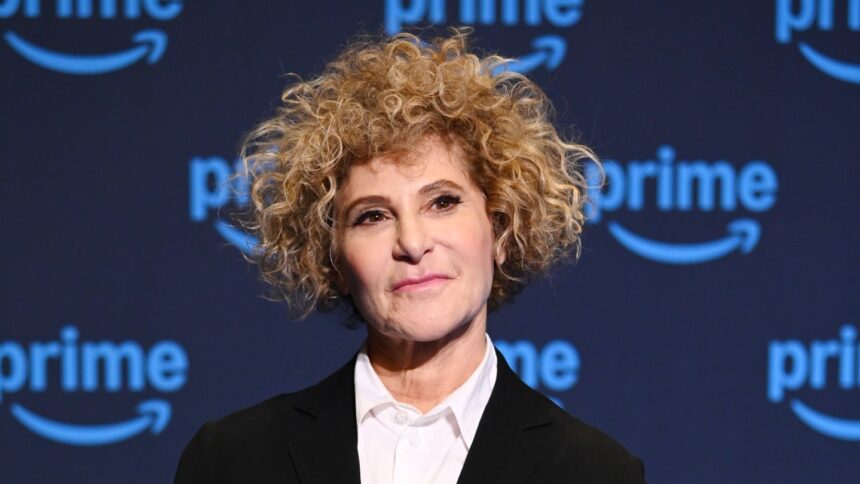
“It’s easy to get lost,” Amy Pascal says of being a film producer. “There are a lot of voices and a lot of people. But if you know why something is important, and you stick to that, that’s the job.”
The job earned Pascal — a onetime Sony Pictures president turned three-time Academy Award nominee — a David O. Selznick received the Producers Guild of America Award for Achievement, joining recent recipients such as Tom Cruise and Martin Scorsese.
Pascal’s indirect path into production began by working under BBC producer Tony Garnett, after which she jumped into life as a studio executive, rising to become co-president of Sony Pictures Entertainment. After the 2014 Sony cyberattack, she left the executive suite and turned to producing, working with Aaron Sorkin, Luca Guadagnino, Steven Spielberg, and Greta Gerwig on titles like Little women and Unitedwhile under Tom Holland’s care Spider-Man Franchise and animation Spider verse films.
After that, projects begin in a whole series of science fiction epics Hail Mary project To Gerwig’s point Narnianot to mention the relaunch of Hollywood’s favorite (and much speculated) spy, James Bond.
What was your first reaction when you learned that you had received this award?
I said: How do I get out of it?
ok (He laughs.)
I’m not even kidding! I’m not someone who likes to be in front of people or talk or any of that, but this is an incredible honor. There was no way I could say no. I’m really impressed and kind of surprised.
How do you think your time as studio head has been helpful to your focus on production?
Being a producer is very different from being a studio executive. It’s going to be a lot different than I thought. I worked for the most amazing producer in the world for the first six years of my life [in Hollywood]A man named Tony Garnett. He taught me all the important things, and then I remembered them. It was basically: working with great people and taking care of the book.
I first met Greta Gerwig before she made her first film, Lady Bird. How do you intuit when a director is someone you’d eventually want to work with as a producer?
Greta is a very special case. She came up with the idea for Little women It knocked my socks off, and I learned that she co-wrote a lot of stuff with Noah [Baumbach]. I didn’t really know her at all, but when someone walks into your office like that and says something amazing, what do you do?
You’ve alluded to this before, but when you were making the jump to becoming a producer again, what were some of those lessons — whether from Tony Garnett or elsewhere — that were helpful to you?
I spoke to a group of directors I respect and asked them, “What do you look for in a good producer?” One of them was really funny, and I won’t say who, but he said, “Well, the most important thing is that I’m the only one who has feelings.” “The thing I need is a producer who really knows how to make a movie, so it’s all about me,” he says. I thought that was a great thing to say. And as you learn how to be productive, this is really true. The way out is the whole ball game.
Was there one movie in particular, where you were sitting at the premiere and watching it, and you kept thinking, ““I can’t believe we pulled this off.”
To be honest with you, I think about that every time. Whether it’s a movie I loved when I was running Sony, or something like that now [as a producer]You can hardly believe it all came together. It’s a daunting task and requires a lot of people swimming in the same direction for anything to succeed. You also work hard on things that aren’t what you wanted them to be. The thing is, it has to be about the process of doing it, because if it’s just about the result, you might be very disappointed.
If you’re doing your job, you’re there at the beginning, and you’ll be there at the end. You are there every day. You’re there to help people find the movie in the first place. You’re there to remind the director why they wanted to do something in the first place. Sometimes the day can be so busy, sometimes you forget why you wanted to tell the story the way you wanted to tell it.
There are more and more conversations now about how working producers, especially young working producers, are facing increasing difficulties when it comes to producing a sustainable job.
I don’t envy anyone starting at this stage. But, on the other hand, there are many different companies that make films, all kinds of films, not just theatrical films. There are opportunities out there. It may not look the same way it did to me when I started out 100,000 years ago. The most important thing is to know what you like and then work hard to achieve it.
You are a consistent creative force behind all things Spider-Man. As a producer, what is your responsibility to keep the intellectual property fresh and something audiences want to engage with again and again?
Well, there are a lot of people working on it Spider-Man Movies, you know. I wouldn’t call myself the only one. But what’s been important to me from the time we got the rights, when I was at Sony until today when I’m lucky enough to be on the ground making these movies, is that it’s a story about Peter Parker, and it’s never a story about anything else. It begins and ends with a human story, and everything else comes from there. Sometimes, people think of comic book movies as a genre in itself with different rules. I don’t think of them that way. I think they are dramas, comedies and movies that should touch your heart. The movie is just one character making a choice, and that should be as true for Peter Parker as it is for Jo March[who[fromLittle women]Or Katharine Graham[who[frommail]Or anyone else.
How do you personally make sure you stay true to that when you’re dealing with a million other voices?
You have to ask yourself all the time why you are doing something, and you have to make sure that you always choose your ambition and not your ego. You’re always doing something for the benefit of the movie, not for the benefit of how the movie is going to make you feel in that moment.
You’re no stranger to big IP. But when it comes to someone like James Bond, what are you most looking forward to as a producer, and what are you most concerned about?
I’m so afraid to mess with it, because it’s so easy to do. We have been doing this very well for many, many decades. I think you work really hard. This is how you do it. You really get into the weeds of something and study it to understand what makes it great, and what Ian Fleming meant. And try to learn from Barbara [Broccoli]who I watched produce a lot of Bond films, and I was lucky enough to be there for some of those films.
Where are you all in this process now? Is there a scenario?
We’re really early.
As a producer, do you have an “escape person”?
Oh my God, I won’t tell you that.
For you, when is the moment you feel happiest as a producer? Did he watch the final movie? Is it finding great material or a new creative partnership with the director?
All of these things, but I think she’s standing at the back of the movie theater, on the day the movie starts. I remember on No going home Going with all three Spider-Men [Tom Holland, Andrew Garfield and Tobey Maguire] And standing back and watching people realize that they were all in the movie together. That was very fun.
What kind of film have you not yet worked with as a producer and would you like?
I’d like to do a big crybaby love story, like Short meeting. Something where they definitely don’t end up together.
Where do they end up together?
This is the only kind of love story that really works. Otherwise, it is a romantic comedy.
After a career helping bring characters to the screen, what was it like to help inspire a character in a Seth Rogen film? studio?
I think the character played by the wonderful Catherine O’Hara is probably a combination of a lot of people, but she made me smile.
For our last question, I’d like to go back to the beginning. I read that when you were growing up you often went to the theater with your father. What is the movie? What made you want to make films?
I can tell you it was All about EveBut maybe it was Mary Poppins. I think I saw Mary Poppins 14 times [in theaters]. I love this movie with all my heart.
What about the film resonated with you?
It was so magical, and so powerful. I read all the books too. It took you to a whole other world. You know, it wasn’t nice, but it was great.
She knew exactly what to do.
And I did it.
Which is what being a producer is like, if you’re romantic about it.
You said that, not me!
This interview has been edited and condensed.