

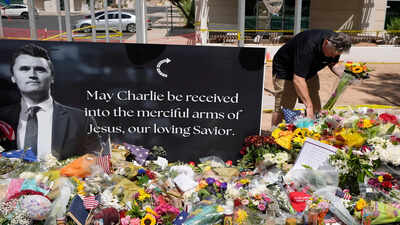
A well-wisher places flowers at a makeshift memorial set up for Charlie Kirk at Turning Point USA headquarters, Sept. 11, 2025, in Phoenix. (AP photo)
Not every educational debate in the United States begins in the classroom. Some begin in state legislatures, where ideas about expression, history, and values are translated into policy.
What is unfolding now across multiple states is one such moment. It does not come as a single reform, but rather as a pattern.A set of laws, linked by name and intent, has begun to reshape how freedom of expression is defined on campuses and how history can be taught in schools. At the heart of this transformation is Charlie Kirk.According to an Associated Press analysis using bill tracking software Plural, more than 60 Kirk-related bills have been proposed in more than 20 states.
These range from symbolic gestures such as road naming and days of remembrance to substantive changes in education policy.
A policy change framed as a tribute
Laws are introduced in the name of a political figure whose influence has been built through activism and debate on campus. Proponents present these measures as a continuation of that work.“It shows how deeply his influence is felt,” Matt Shupe of Turning Point USA told the AP, referring to the legislative push.
But the form this effect takes is not uniform. In some states, it’s centered around campus discourse. In other cases, it extends to the school curriculum.
Tennessee: History, Religion, and the Classroom
In Tennessee, a new law allows schools and colleges to teach what it describes as the positive role of religion in American history. The legislation notes the influence of Judeo-Christian values and lists historical examples ranging from the Pilgrims to George Washington and Benjamin Franklin.Proponents argue that this reflects historical context rather than religious education. Students who spoke in favor of the bill linked it to a broader understanding of national origins.Opposition has focused on the implications for public education. “Our public schools are not really the place to push one debt over another,” Senate Democratic Leader Romesh Akbari said, according to the Associated Press.The discussion is not limited only to content, but also to focus. What is included in the curriculum often determines what is treated as central and what is treated as peripheral.
KS: Redefining Free Speech on Campus
In Kansas, lawmakers took a different tack. A new law allows students to sue universities for free speech violations and limits how institutions can organize campus events.The legislation designates outdoor campus spaces as open forums for expression. It also limits security fees and removes designated free speech zones.Supporters link the law directly to Kirk’s legacy. The measure “will protect the free speech rights of all college students,” Kansas State Senate President Ty Masterson said, according to the Associated Press.Critics, including Democratic Gov. Laura Kelly, have raised concerns about its implementation, warning that it could create confusion for institutions and courts.The shift here is procedural but important. It changes not only what kind of speech is allowed, but how disputes over speech are resolved.
A growing legislative pattern
Beyond Tennessee and Kansas, similar proposals are moving through other states. In Louisiana, the bill would require schools to teach a “success sequence” tied to education, work and family structure.
Lawmakers debated whether such policies should bear the name of a political figure.The proliferation of these bills indicates a coordinated approach rather than isolated initiatives. They operate at different points in the educational system, but share a common trend: linking policy design to a specific ideological framework.
What could this mean for students?
The effects of these laws are unlikely to be immediate. Classrooms will not change overnight.
But over time, the cumulative effect may become more noticeable.On campuses, expanded definitions of freedom of expression may lead to more legal disputes and less institutional control over events. In school curricula, the permissible focus on the role of religion may shape how history is framed for students.These are not headline-grabbing disturbances. They are adjustments in rules, incentives and priorities. These modifications tend to emerge gradually in how institutions operate.
What are you watching next?
The course of these laws will depend on how widely they are adopted and how they are implemented.One signal would be replication. If more states introduce similar bills, the pattern may move from the regional to the national level. Another reason is lawsuits, especially regarding freedom of expression provisions. The third question is how schools interpret the broad legislative language in practice.For now, the changes remain sporadic but connected. Together, they indicate a shift that is less about a single reform and more about redefining how education policy is used to shape public life.