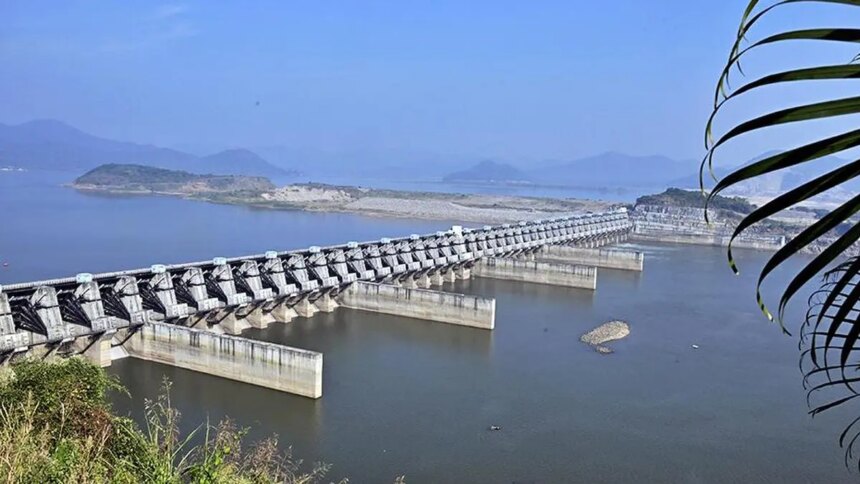

Polavaram, Andhra Pradesh: View of Polavaram road spill at Polavaram project in Andhra Pradesh | Image source: Rao GN
The Polavaram irrigation project is expected to be completed by June 2026, as around 90 per cent of the works have already been completed with water stored up to minimum withdrawal level (MDDL), the Ministry of Jal Shakti said in a report.
As of October 2025, the project has achieved an overall progress of 81.45 percent, including important physical and financial milestones such as excavation (90.2 percent), concrete (85 percent) and structures (55 percent), the minister said in his annual report for 2025-2026.
“A significant portion of the main work (81 per cent), right main canal (92 per cent) and left main canal (73 per cent) work has been completed,” the report said.
However, land acquisition, resettlement and rehabilitation (R&R) remains pending, with 13,082 acres of land yet to be acquired, 335 dwellings relocated, and 91,621 displaced families from the project (PDFs) still needing to be relocated.
The total expenditure incurred on the project till October 2025 was Rs 25,263 crore, with the Central government releasing Rs 21,221 crore after declaring it as a national project.
Polavaram Irrigation Project (PIP) is a multi-purpose irrigation project located across the Godavari River near Ramayapetta village in Eluru district of Andhra Pradesh.
It was declared a national project under the Andhra Pradesh Reorganization Act, 2014, with the central government funding 100 per cent of the remaining cost of the irrigation component with effect from April 1, 2014.
The project provides irrigation to an area of 2.91 lakh hectares under the Left Main Canal (LMC) and Right Main Canal (RMC), with an annual irrigation of 4.36 lakh hectares.
It also generates 960 megawatts of hydropower, supplies 23.44 million tons of drinking and industrial water to Visakhapatnam, and provides domestic water to about 28.50 thousand people in 611 villages.
In addition, it stabilizes the Godavari delta, diverts 80 TMC of water to the Krishna river basin, and shares water with Odisha and Chhattisgarh.
Posted on February 22, 2026