Read for 3 minutesUpdated: February 20, 2026 01:03 PM IST
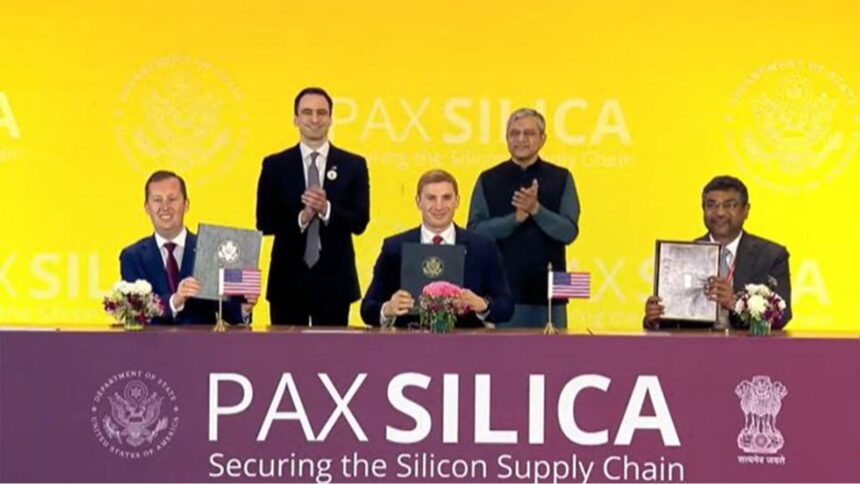
India and the United States Pax signed the Silica Declaration Friday was a major step in bringing New Delhi into the US-led initiative aimed at strengthening their technology partnership and securing AI and critical technology supply chains.
US Under Secretary of Economic Affairs Jacob Helberg has arrived in New Delhi for the India AI Impact Summit. IT Minister Ashwini Vaishnav was India’s representative at the signing event.
The agreement comes in the wake of US Ambassador Sergio Gore’s announcement last month of inviting India to join the initiative. India’s inclusion in Pax Silica An important step in cementing partnerships in new frontiers of technology, including AI and semiconductors. This comes with significant investment commitments from US companies to support India’s AI infrastructure.
Overall, it is expected to power India’s late start and growth in the semiconductor mission and AI race.
The presence of top American CEOs and entrepreneurs, including Sundar Pichai and Sam Altman, at the ongoing India AI Impact Summit 2026 is an indication of Delhi’s value in the overall AI and semiconductor landscape, sources said.
Cornering China
According to the US State Department, Pax Silica aims to bring together “friendly and trusted” countries to ensure that key technologies are secure, reliable and not controlled by hostile actors.
The strategic initiative, which is seen as a counter to China’s grip on the global manufacturing supply chain, was launched on December 12, 2025 to “reduce force dependence” and build a “secure, prosperous and innovation-driven silicon supply chain” – covering key minerals, productive AI carriers, manufacturing, energy infrastructure and logistics.
The story continues below this announcement
At launch, the US, to the surprise of many here, He left India from the initiativementioned “allies” such as Japan, the Republic of Korea, Singapore, the Netherlands, the United Kingdom, Israel, the United Arab Emirates and Australia. This has led to concerns that the uncertainty surrounding the trade deal is creating wider rifts between the two countries.
Since Gore’s arrival in India, tensions between the two countries have eased significantly and a framework for an India-US trade agreement has been agreed.
The initiative, according to the US State Department, aims to protect sensitive technologies and critical infrastructure from undue access or control by countries of concern and to build trusted technology ecosystems, including information and communication technology (ICT) systems, fiber-optic cables, data centers and foundational models of applications.
India is concerned about China’s involvement in key infrastructure such as telecom.

Shubhajit Roy, Diplomatic Editor at The Indian Express, has been a journalist for over 25 years. Roy joined The Indian Express in October 2003 and has been reporting on foreign affairs for over 17 years now. Based in Delhi, he headed the National Government and Politics Bureau at the Indian Express in Delhi — a team of reporters covering national government and politics for the newspaper. In 2016, he received the Ramnath Goenka Journalism Award for excellence in journalism. He received the award for his coverage of the Holi Bakery attack in Dhaka and its aftermath. He also received the IIMCAA Award for Journalist of the Year, 2022, (Jury’s Special Mention) for his coverage of the fall of Kabul in August 2021 — he was one of the few Indian journalists in Kabul and the only mainstream newspaper to cover the Taliban takeover in mid-August 2021. … read more
© The Indian Express Pvt