

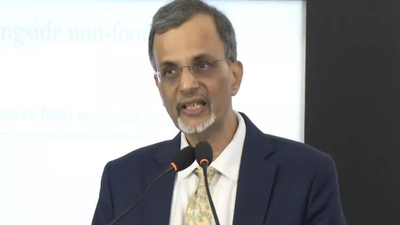
Defending the credibility of India’s GDP statistics, Chief Economic Advisor Anantha Nageswaran said the country does not use revisions in methodology or base years to artificially boost economic growth figures.In an interview with news agency ANI, Nageswaran responded to concerns raised by some economists over India’s GDP estimates, saying that measuring GDP is a country-by-country estimate and India follows internationally accepted statistical practices.“GDP is just an estimate. No country can pretend that it has an accurate way to measure GDP,” he said.Nageswaran claimed that India’s recent GDP recalibration itself shows that the government is not trying to inflate economic output through statistical revisions.“If they had said that India’s GDP is no longer 354,000 crore but 384,000 crore, people would have accepted that. This is what many countries are doing. In fact, we are the only country that has dropped it,” he said, referring to the review that followed the change in the base year and methodology.“So we’re not trying to use any of these systemic changes to increase our numbers,” he added.CEA said India’s statistical framework focuses on producing reliable data rather than numbers that support any particular narrative.
“We produce reliable statistics. We follow internationally accepted methods and do not use systematic reviews of GDP to artificially inflate the numbers,” he said.“Our philosophy is to let the statistics speak for themselves.”Referring to the observations made by international institutions, Nageswaran said that the questions raised by organizations like the IMF are largely related to methodology and not the credibility of Indian data.“The IMF, for example, asked us not only about reliability, but about the fact that some methodologies need to be improved,” he said, adding that such improvements have been made since then.Nageswaran also argued that criticism of GDP estimates often stems from expectations about the economy rather than concerns about data quality.“I think the problem with some of these critics is that if the number doesn’t meet their expectations, they’re willing to call it, ‘I don’t have confidence in this number,'” he said.Pointing to the sharp economic downturn during the Covid-19 pandemic, he noted that India’s GDP numbers were widely accepted when they reflected a sharp decline.“In the first quarter, from April to June 2020, Indian GDP fell by 25 percent year-on-year. At that time, no one said that this was a much exaggerated decline. I do not trust Indian GDP numbers,” he said.“If the statistics do not confirm my belief or desire that the Indian economy is indeed in bad shape, then the statistics are not reliable. So I find it difficult to accept this contradiction,” Nageswaran added.