

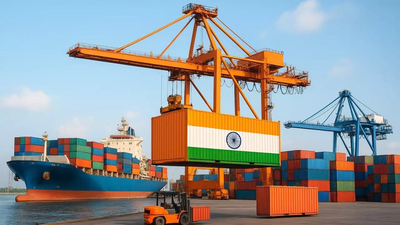
With tensions rising in West Asia following US and Israeli strikes on Iran and retaliatory attacks by Tehran, the commerce ministry held a meeting on Monday with exporters, shipping lines and freight forwarders to assess the potential impact on Indian trade flows, PTI reported, citing officials.The United States and Israel launched joint military strikes on Iran on Saturday, prompting Iran to launch drones and missiles at Israel, US military installations in the Gulf and the World Business Center in Dubai.
US-Iran War: Why closing the Strait of Hormuz is India’s worst nightmare | He explained
The ministry has called the meeting in a hybrid format to assess the evolving situation and its implications on shipments, freight rates and logistics corridors that are important for Indian exports, an official said.Exporters have raised concerns that the conflict could disrupt trade routes through the Strait of Hormuz and Bab al-Mandab Strait, both major sea lanes linking India to the Gulf, North America and Europe.
Federation of Indian Export Organizations (FIEO) president SC Ralhan said the hostilities have already started impacting existing global logistics networks.“Air routes are being changed, and sea trade through the Red Sea and major Gulf straits is facing increased uncertainty. If diversions are prolonged, shipments may increasingly have to be rerouted via the Cape of Good Hope, adding an estimated 15 to 20 days to the transit time for Europe and the United States,” Ralhan said earlier.
Exporters warned that prolonged disruption could lead to higher shipping rates and marine insurance premiums, increasing trade costs. Industry representatives said it may take a few days to get clarity on shipping capacity, alternative routes and revised insurance and shipping fees.The West Asia region hosts major sea lanes through which a large portion of India’s exports pass to its major markets. India’s exports to the United States amounted to US$86.5 billion, US$98.4 billion to Europe, and US$58.8 billion to West Asia.
Together, these regions account for nearly 56 per cent of India’s merchandise exports.During the 2023-2025 Israel-Hamas conflict, freight rates rose sharply as shipping lines avoided the Red Sea route and diverted ships via the Cape of Good Hope, increasing transit time between India and Western markets by 15-20 days.Industry participants said that unlike the previous episode, the current situation appears broader in scope and could pose deeper risks if tensions persist.Shipping rates are typically reviewed at the beginning of each month by major shipping lines, and new rates are expected to be published on Monday. At the beginning of 2026, prices were shrinking, exporters said.The outcome of Monday’s meeting is expected to determine whether additional policy support or trade facilitation measures are needed to mitigate the impact on exporters.