

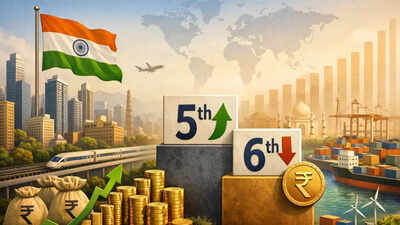
While India will be the sixth largest economy in FY27, it is likely to overtake both the UK and Japan to take fourth place in FY28. (Amnesty International image)
In April 2025, when the International Monetary Fund (IMF) released its global economic outlook, India was seen overtaking Japan to become the world’s fourth-largest economy by the end of 2025-26.
One year later, India fell to sixth place in the rankings of largest economies, with the United Kingdom regaining its position as the fifth largest economy.In fact, the IMF’s latest World Economic Outlook report (April 2026) sees India sitting at sixth position this fiscal as well. This forecast comes despite India experiencing better-than-expected growth in fiscal year 2026, and is expected to maintain its position as the world’s fastest-growing major economy.What led to the sudden fall? Why has India fallen to sixth place, lagging behind the United Kingdom, instead of overtaking Japan to become the fourth largest economy? What does this setback mean for its dream of becoming the third largest economy by the end of this decade? We decrypt:
Data Engine: India was expected to rank 4th, but has fallen to 6th
Let’s first take a look at some IMF data to see how things play out Indian economy It was headed in April 2025, and what the forecast data indicates is April 2026According to IMF estimates in April 2025, the Indian economy would have reached $4,187.017 billion at the end of fiscal year 2025-26, surpassing Japan’s $4,186.431 billion.
The United Kingdom, in sixth place, was expected to have a nominal GDP of $3,839.18 billion.
However, as per April 2026 estimates, the nominal GDP of the Indian economy stood at $3,916 billion at the end of fiscal year 2025-26, with the UK surpassing it with a nominal GDP of $4,003 billion. Japan’s GDP is expected to reach $4.435 billion.As the above estimates show, India’s GDP estimates declined over one year, while the UK’s nominal GDP grew better than expected.
Japan was steady.So, what went wrong? Blame the rupee and the GDP data itself!
Decrease in the value of the rupee New strike and GDP series
The first thing to understand is that IMF data on the size of a country’s nominal GDP is in dollar terms. Hence, with global rankings based on dollar-denominated GDP, these countries are very sensitive to exchange rate movements. The biggest reason for the failure of India’s dream of becoming the fourth largest country in the world was the devaluation of the rupee. The Indian currency has depreciated more than expected over the past year, falling from 84.57 to the US dollar in 2024 to 88.48 in 2025, according to International Monetary Fund data.
The International Monetary Fund estimates it at 92.59 this year.Several factors have contributed to the rupee’s decline, including capital outflows, uncertainty related to the India-US trade deal until February, and the recent conflict in the Middle East that has pushed up crude oil prices and India’s import bill. Additionally, the Reserve Bank of India (RBI) while actively managing volatility in the forex market, does not target any particular level of the rupee.
India’s recent decline to sixth place in global GDP rankings does not reflect a weak economy, but is largely due to currency conversion effects and a one-time statistical revision, says Arun Singh, chief economist at Dun & Bradstreet India.The rupee devaluation from 2024 to 2026 has put mechanical pressure on India’s GDP in dollar terms, effectively halving apparent growth despite strong domestic expansion, says Arun Singh.According to Ranen Banerjee, partner and leader in economic advisory services at PwC India, GDP in US dollars will decline as the rupee depreciates. “We have seen a decline of about 7-8% over the past few months due to conflict and portfolio outflows.
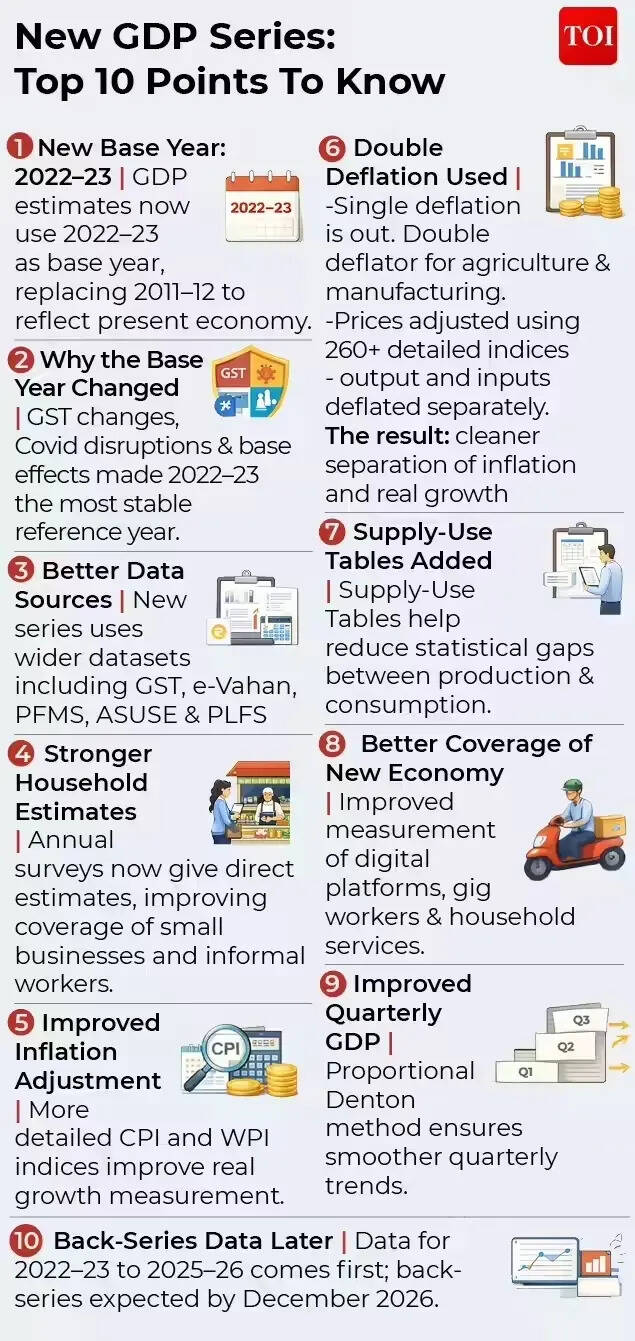
Thus, in US dollar terms, it is close to roughly one year’s nominal GDP discount.And it’s not just about the Indian economy. The UK, which has overtaken India to take fifth place once again, also has economic factors working in its favour. UK GDP growth of 0.5% recently beat expectations of 0.1% by a wide margin. Not only that, but its currency – the pound – has actually appreciated against the US dollar.The second factor that influenced the rankings is India’s adoption of a new base year for its latest GDP series. According to the new data, which also uses a more precise methodology, the size of India’s nominal GDP in rupee terms has declined. Sample this: As per the older base year 2011-12, India’s GDP at the end of 2025-26 was Rs 35,713,886 crore. But under the new series, it is estimated to be Rs 34,547,157 crore.
The new calculation methodology and revision of the base year provide a more accurate picture of the size of the Indian economy.The currency impact was thus exacerbated by the one-time downward revision following India’s shift to a new base year for GDP, which brought down reported nominal levels without impacting real activity.
Does India’s drop to sixth place indicate fundamental weakness?
Experts are confident that India’s growth story is fundamentally sound and strong, a fact reflected in forecasts that India will continue to be the world’s fastest-growing major economy.
They see technical factors behind the current slide, rather than any deterioration in economic fundamentals.It is also interesting to note that although India will be the sixth largest economy in FY27, in the next fiscal year it is likely to overtake both the UK and Japan to occupy the fourth position.Arun Singh of Dun & Bradstreet India explains this flexibility in numbers:IMF World Economic Outlook data (April 2026) indicates that India’s GDP at current local currency prices rose strongly from INR 318 trillion in 2024 to INR 346.5 trillion in 2025, and then to INR 384.5 trillion in 2026, translating into strong nominal growth of about 8.9% in 2024-25 and onward. Nearly 11% in 2025. 2025–26, among the fastest globally. In contrast, other major economies recorded more moderate nominal domestic growth – about 5% in the United States, about 4% in China, 3% to 5% in the United Kingdom, 3% to 3.5% in Germany, and lower or volatile growth in Japan – which underscores India’s strong momentum. and In times of global economic turmoil, while GDP growth is expected to take some hit, most agencies and experts have pegged India’s growth as strong. Incidentally, the International Monetary Fund marginally raised its GDP growth forecast for fiscal year 2027 to 6.5% despite the ongoing conflict in the Middle East.
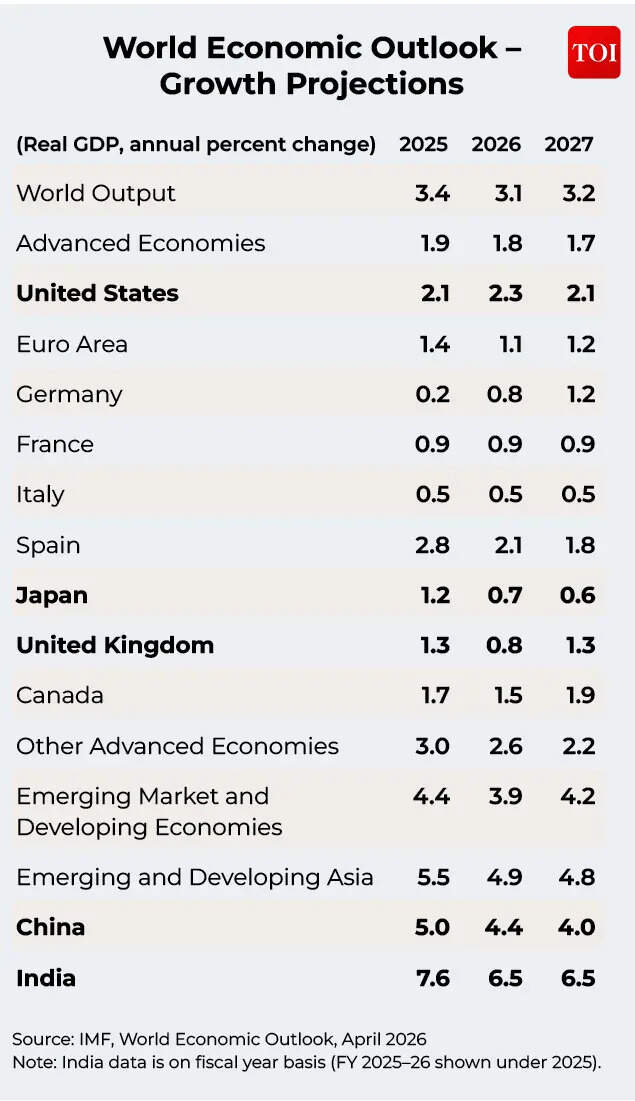
“In India, growth for 2025 was revised up by 1.0 percentage points from October, to 7.6%, reflecting better-than-expected results in the second and third quarters of the fiscal year and continued strong momentum in the fourth quarter,” the IMF said in its latest forecast. “For 2026, growth was revised moderately upward by 0.3 percentage points (0.1 percentage points compared to January) to 6.5%, led by positive contributions from the carryover of strong 2025 results and a reduction in additional US tariffs on Indian goods from 50 to 10%, outweighing the negative impact of the conflict in the Middle East.
Growth is expected to remain at 6.5 percent in 2027.
Will India become the third largest country anytime soon?
The devaluation of the rupee and revision of nominal GDP have also pushed back India’s dream of becoming the third-largest economy by the end of this decade. In its October 2025 estimates, the IMF said India would overtake Germany to become the third-largest country by FY30. However, the April 2026 forecast sees it only reaching third place by FY 2030-31.Experts point to the depreciation of the rupee against the dollar, noting that the road ahead is likely to be uncertain.
Madan Sabnavis, chief economist at Bank of Baroda, is confident that India will continue to perform well in the coming years.“We will definitely improve in terms of GDP growth which will be higher than that of other countries especially the UK and Japan which are right above us. However, the value of the rupee will finally determine how India positions at the global level,” he told TOI.Ranen Banerjee, of PricewaterhouseCoopers India, says the rupee is starting to gain support as the conflict is contained, oil prices are relatively low and portfolio flows are reversing, with valuations becoming attractive recently. “Hence, we should not see any further sharp depreciation of the rupee in the near term provided the conflict does not escalate and oil prices relatively ease from their highs and decline to the $85-90 per barrel range,” he says.Arun Singh of Dun & Bradstreet argues that looking ahead, India’s relative position in US dollar-based GDP rankings will remain highly sensitive to currency movements rather than to domestic growth dynamics. “Continued global dollar strength or capital flow volatility could cause a cyclical slide in the ratings despite strong fundamentals. Maintaining external macro stability and limiting unwarranted rupee volatility will be critical to fully translate India’s strong growth performance into higher global economic ratings,” Arun Singh told TOI.The Indian economy, driven largely by domestic fundamentals, is not immune to external shocks. High US tariffs of 50% from August 2025 to early February, and the ongoing war between the United States and Iran, have led to successive shocks to the economy. Even as experts stress the resilience of the growth story, exposure to rising crude oil prices and other global supply chain disruptions is a reality. In such a scenario, India may have to contend with volatile global rankings, while relying on its strong GDP growth to weather the turmoil.