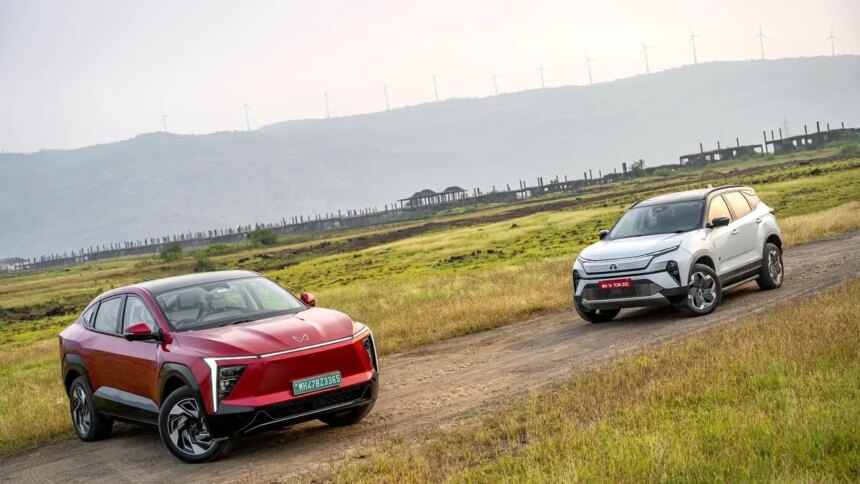

XEV 9e and Harrier.ev | Image source: Kizad Adil Darukhanawala
Electric SUVs today are at a fascinating crossroads. Brands are still navigating the ‘visual identity’ of electric: should they embrace a ‘full spaceship’ aesthetic or simply evolve what already works? Tata and Mahindra stand on opposite sides of this debate, both trying to define the future of Indian electric vehicles in vastly different ways. The Harrier.ev feels like a familiar friend who’s learned some impressive new tricks, while the XEV 9e is Mahindra’s bold statement of intent.
At first glance, the XEV 9e looks like a sleek, futuristic version of the XUV700. It’s lower, wider, and has the distinctive coupe look that automakers usually reserve for concept studies. A full-width light bar gives it a clear EV identity, while the main headlights are located lower, flanking a closed grille topped with the latest Mahindra infinity logo. In profile, its massive size is undeniable. 19-inch wheels convincingly fill the arches, flowing door handles add a premium touch, and the roofline tapers elegantly to a clean backdrop featuring another striking light strip and massive road presence.
Underneath, the XEV 9e uses Mahindra’s INGLO skidpad platform, a born-electric setup rather than an internal combustion engine (ICE) conversion. Although it is currently rear-wheel drive, the design has been designed to easily accommodate a front engine for future all-wheel drive iterations.
Harrier.ev takes a noticeably different approach. She doesn’t scream for attention, and that’s exactly her charm. The familiar muscular look remains, now combined with a new closed grille, precise lines, a reshaped bumper and a more tidy air intake design. From the side, 19-inch aero alloys and a discreet EV badge are the standard giveaways. The side steps are a practical addition, aiding entry while neatly concealing the battery pack located under the chassis. At the rear, the absence of a tailpipe and a quietly enhanced EV badge indicate the switch to electric power. Unlike the XEV, the Harrier.ev is an evolution of its sibling, the ICE. However, it has been significantly reworked under the skin with a new floor, updated suspension and advanced Tata Acti.ev electric engineering.
Step into Harrier.ev and Tata’s evolutionary philosophy continues. The centerpiece is the massive 14.53-inch Samsung Neo QLED touchscreen, one of the sharpest displays in its class, paired with a crisp 10.25-inch digital display. The illuminated Tata logo on the four-spoke steering wheel looks suitably distinctive, and the dual-layered dashboard adds a sense of richness. Generously appointed, it features touchscreen HVAC controls, ventilated seats, a panoramic sunroof, a master position for the rear passenger and a 10-speaker JBL sound system enhanced with Dolby Atmos.
Meanwhile, the XEV 9e’s cabin looks as if Mahindra has raided a European luxury car boardroom. The doors open at about a 90-degree angle, although passengers will need to navigate across a wide sill. The triple-screen design stretching across the dashboard is pure theater, the kind of technology one would expect in a luxury SUV. The new two-spoke steering wheel looks futuristic and has touch controls for regeneration, boost and single-pedal modes. The seats are spacious, airy and supportive, while the back seat is very roomy and can seat three adults comfortably.
On the practical side, Harrier.ev offers a 502-litre boot and a small box for charging cables. The XEV 9e measures a massive 663-litre boot and a large 150-litre boot. Both suffer from relatively high loading lips, and the choice of light-coloured upholstery paired with glossy black trim will no doubt test the owner’s patience in dusty Indian conditions.
Road test
On the road, the range-topping Harrier.ev QWD uses a dual-motor setup. Its 75 kWh battery produces 313 hp and 51.39 kg-m of torque. In Eco and City modes, delivery is smooth and relaxed, but switching to Sport or Boost wakes the car up sharply. Torque arrives instantly, providing a constant “smile factor.” Despite its heft, the Harrier.ev feels poised. The steering is light in town and gains reassuring weight at speed, while the independent suspension with frequency-dependent dampers does a great job of isolating the cabin from rough roads. Even on 19-inch wheels, ride quality remains supple. Real-world range during our testing was between 420km and 450km, and DC fast charging can replenish the battery from 20 to 80 percent in about 25 minutes.
The XEV 9e takes a simpler, sportier route. A single rear-mounted motor produces 282 hp and 38 kg-m from a 79 kWh battery. It feels very fast. Acceleration from 0 to 100 kilometers per hour is done in just 6.8 seconds. Power delivery is linear and clean, making the car feel much lighter than its proportions suggest. Driving modes; Range, Everyday, and Race, vary the throttle response and steering, with Race mode proving most attractive to enthusiasts. Ride quality is well judged, handling poor surfaces with ease, although sharp bumps occasionally make themselves felt. Although stable at high speeds, the steering lacks some sense of communication, although NVH levels are excellent. In the real world, the XEV 9e manages to offer a range of around 550 kilometres. As for charging, with 175 kW DC fast charging, the XEV 9e charges from 20 to 80 percent in about 20 minutes.
Both SUVs showcase the incredible strides Indian automakers have made in electric vehicles, but the XEV 9e steps forward, not through gimmicks, but through character. Harrier.ev is sophisticated, competent and easy to live with, seamlessly integrating into a sophisticated lifestyle. However, the XEV 9e feels truly new – confident, exciting and unapologetically ambitious. If Harrier.ev is the professional you can rely on, the XEV 9e is the risk taker with the talent to back it up. In this silent duel, it is the Mahindra that makes the strongest impression.
© World of Cars
Posted on January 30, 2026