

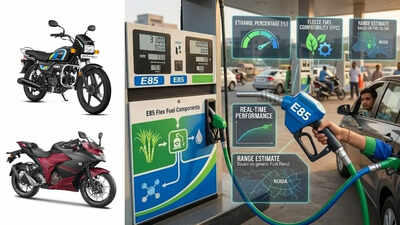
The image generated by artificial intelligence is used for representational purposes.
India’s move towards alternative fuels has taken a big step forward with the launch of E85 fuel in Delhi. The new ethanol-blended fuel was introduced on World Environment Day at Rs 82.12 per liter in the national capital, making it about Rs 20 cheaper than regular E20 petrol, which is currently sold at Rs 102.12 per litre.The first E85 fuel dispenser in Delhi is at the Indian Oil Port. It was inaugurated by Petroleum and Natural Gas Minister Hardeep Singh Puri. E85 fuel contains 85 percent ethanol and 15 percent gasoline.At first glance, lower prices seem attractive, especially at a time when fuel prices continue to rise. However, there is a big catch. Currently, only three vehicles in India are compatible with E85 fuel.
These include the newly launched Hero Splendor+ Flex Fuel, Hero HF Deluxe Flex Fuel and Suzuki Gixxer SF 250 FFV. No other production car or motorcycle on sale in India can officially run on E85 fuel at the moment.
Hero MotoCorp recently launched India’s first flex-fuel commuter motorcycles. The Splendor+ Flex Fuel is priced at INR 82,710 ex-showroom Delhi, while the HF Deluxe Flex Fuel is priced at INR 72,792 ex-showroom.
Both motorcycles use a 97.2 cc single-cylinder engine capable of running on ethanol blends up to E85.Meanwhile, Suzuki already sells the Gixxer SF 250 FFV in India. Priced at Rs 1.98 lakh, ex-showroom. Maruti Suzuki has also offered the E85 compatible Wagon R Flex Fuel several times over the past few years. However, the company is yet to officially launch the car or announce pricing details. Once launched, it could become India’s first flex-fuel passenger car.Rollout of E85 fuel will initially remain limited. The fuel is currently being offered at selected Indian Oil outlets across Delhi, National Capital Region (NCR) and Maharashtra. The government plans to expand this network significantly over the next two years. According to Hardeep Singh Puri, about 500 ethanol distribution stations will be operational by the end of 2026, while the goal is to reach 5,000 outlets by 2027.