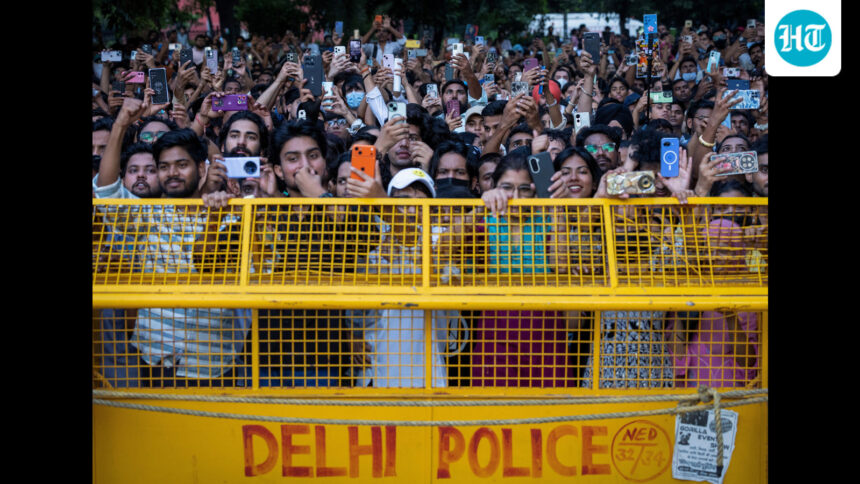
Delhi witnessed its longest internet shutdown during the Cockroach Janta Party (CJP) protest demanding the resignation of (now former) Education Minister Dharmendra Pradhan. On Saturday morning, the government issued a seventh order extending the suspension of mobile internet services around Jantar Mantar until 12 midnight.
However, people in and around the affected area said mobile internet services were restored soon after Pradhan announced his resignation, and the CJP called off his protest, saying the BJP government agreed to his demands.
The recall came before the scheduled midnight comment deadline. Despite the restoration, telecom service providers had not received any formal order to lift the suspension as of late Saturday evening, people familiar with the matter said.
In the past five days, the government did not issue a suspension order until July 21. With the seventh extension that came on Saturday, mobile internet in the district remained repeatedly suspended for five days, making it the longest such outage recorded in the national capital.
Read also:CJP protest: A petition has been filed in Delhi HC against internet suspension
Timeline for closures
The lockdown began on July 20, when the government directed telecom service providers, including Airtel, Reliance Jio and Vodafone Idea, to suspend mobile internet services from 10 am to 6 pm in parts of central Delhi around Jantar Mantar. This was followed by a second order on July 22, directing operators to suspend services from 6pm until 6am the following morning.
On July 23, the government first extended the suspension from 9.3am to 4.30pm before issuing a further order extending it until midnight. On Friday, the authorities again suspended mobile internet service until noon before issuing a sixth order extending the closure until 12 midnight. On Saturday, the seventh order extended the suspension until 12 midnight.
The orders require telecom companies to suspend mobile internet services within a 1.5 km radius of the protest site. The affected areas include Janpath Market near Connaught Place, Le Meridien, Shangri-La Hotel, National Media Center and the office of the Women’s Press Corps of India.
Digital rights organization SFLC.in also challenged the internet shutdown orders before the Delhi High Court, arguing that the suspension of mobile internet services in parts of central Delhi during the July 2026 protests was unlawful.
History of closures
While Delhi has seen internet shutdowns before, they have been shorter and associated with specific law and order situations.
One such example was in December 2019, during the protests against the Citizenship (Amendment) Act (CAA), when mobile internet services were suspended for several hours in parts of the capital. The shutdown was ordered by the Delhi Police, which is empowered to direct telecom operators to suspend services under the Temporary Suspension of Telecom Rules.
Another instance of internet shutdowns occurred during the farmers’ protests in 2021. In January 2021, the government suspended mobile internet services in neighboring areas of Delhi. The suspension was later extended at some protest sites on Delhi borders, including Singhu, Ghazipur and Tikri, as farmers’ unrest continued.
Unlike the disruptions of 2019 and 2021, the current lockdown has been extended by multiple successive government orders over several days.
The frequent shutdowns of the Internet prompted demonstrators to search for alternative ways to communicate. Some have turned to applications such as Bitchat Mesh, which do not rely on mobile Internet. Instead, the app creates a Bluetooth-based network that connects nearby users, allowing messages to be exchanged without an Internet connection.
The Indian Cybercrime Coordination Center (I4C), under the Home Ministry, has also issued a notice to GitHub under Section 79(3)(b) of the Information Technology Act, directing it to remove URLs hosting BitChat, the messaging app’s founder Jack Dorsey said on Friday.