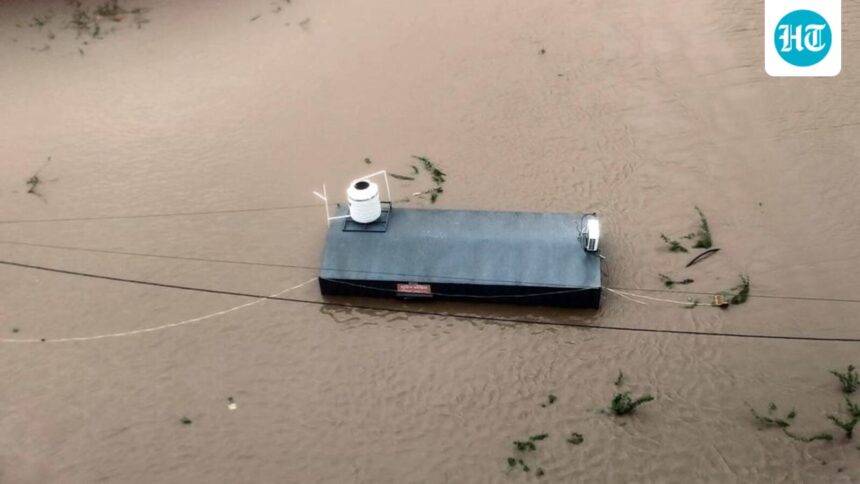
The India Meteorological Department (IMD) said the city of Umargam in Gujarat’s Valsad district recorded 1,064 mm, or nearly 42 inches, of rain in the 24 hours up to 8.30 a.m. on Thursday, the third highest ever recorded in India, even as floods and heavy rain forced the evacuation of 38,653 people to safer places across the state. As many as 12,554 people were transported and 1,826 people were rescued in Valsad, the state government said.
Sohra district in Meghalaya (1,563.3 mm) on June 16, 1995 and Lakshadweep’s Aminedevi (1,168.5 mm) on May 6, 2004, recorded higher 24-hour rainfall in India than Omirgam, the IMD said.
Heavy rainfall was also recorded elsewhere in Valsad district. In the same 24-hour period ending at 8.30 am on Thursday, Caprada received 794 mm, Dharampur 562 mm, Vapi 550.4 mm, Bardi 514 mm, Nanipalson 460 mm and Valsad 392 mm, according to the IMD.
Heavy rain continued after the record spell. Umergam received another 434 millimeters, or 17.09 inches, in the 24 hours ending at 6 a.m. Friday, according to the state Emergency Operations Center.
Rains were widespread across Valsad district. Between 6am and 4pm on Thursday, Umargam received 350mm, Bardi 285mm, Valsad 255mm, Nanabunda 255mm, Dharampur 228mm, Kabrada 211mm and Vapi 193mm.
The rainfall pushed Valsad’s seasonal total to 2,149 mm, or 84.61 inches, by Friday morning, equivalent to 90.25% of its seasonal average of 2,381 mm. Neighboring Navsari received 1,788 mm, or 94.09% of its seasonal average. Surat received 1,183 mm or 78.12%.
The army deployed relief and rescue columns, including engineering and medical teams, in Valsad, Navsari, Silvassa and Ahmedabad to assist the civil administration. Additional queues have been kept ready in Surat, Vadodara and Ahmedabad for immediate deployment as the case may be.
The army said relief operations were being carried out in coordination with the civil administration and other agencies. Rescue operations began late Thursday night in flood-hit areas of Navsari, with army teams evacuating 43 stranded people from flooded sites by Friday.
The rain also hit the electricity grid. As of 10 a.m. on Friday, 333 villages, 707 feeding lines, 187 electricity poles and nine transformer centers still needed to be restored. Of the 4,095 villages where power supply was affected, electricity has been restored in 3,762 villages.
Ten of Gujarat’s 206 tanks, excluding Sardar Sarovar, were full on Friday morning, while 15 were on high alert, five were on alert and 14 were under warning. The Sardar Sarovar reservoir reached 68.33% of its total storage capacity at 8 am on Friday, while the state’s other 206 reservoirs together stood at 43.37% capacity.