Artificial intelligence has fueled a global race to build faster chips, larger data centers, and more powerful computing systems, pushing companies like Nvidia into the spotlight.
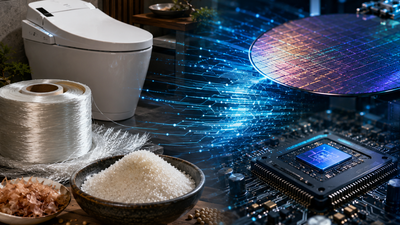
However, some of the biggest beneficiaries of the AI revolution are companies that few people would associate with cutting-edge technology. In Japan, manufacturers known for making toilets, fiberglass and food condiments have become indispensable to the semiconductor industry. Instead of designing AI chips or developing large language models, they produce specialized materials without which advanced processors cannot be manufactured or packaged.
As investment in AI increases around the world, these decades-old companies stand out as some of the industry’s most surprising winners.
Why Japanese Companies that make toilets, fiberglass and spices are winning the AI boom
The breakthrough in artificial intelligence is not limited to the design of advanced processors. Each AI chip goes through a complex manufacturing process that relies on specialized materials, precision engineering, and advanced packaging techniques. This has created opportunities for companies that offer niche products that are difficult to replace.
Japan has spent decades developing expertise in advanced ceramics, specialty chemicals, industrial glass and semiconductor materials, leaving many traditional manufacturers with important links in the global chip supply chain.
As demand for high-performance AI servers and semiconductors grows, investors are increasingly recognizing these companies as “second-tier AI beneficiaries,” companies that benefit from AI without directly building AI systems.
how Toto Hans’ expertise in ceramics has found a place in the chip industry
Toto is known worldwide for its premium washlet bidets and bathroom products. Few consumers realize that the company has also operated an advanced ceramics business since the 1980s. One of its most important semiconductor products is the electrostatic envelope, a highly specialized ceramic plate that securely holds silicon wafers during chip manufacturing.These components must withstand extreme heat, strong electric fields, and corrosive chemicals while maintaining microscopic precision.
Without electrostatic cartridges, manufacturers will struggle to produce advanced memory chips used in AI servers and high-performance computing systems. The growing importance of these products has prompted investors to look beyond Toto’s consumer business and recognize the value of its semiconductor materials division.
Netobo Fiberglass helps build AI infrastructure
Founded more than a century ago as a textile manufacturer, Nittobo has evolved into one of Japan’s leading producers of specialty fiberglass.
Its products are used in semiconductor package substrates, AI servers, and other high-performance electronic equipment.As AI processors become more powerful, they generate more heat and require increasingly sophisticated packaging materials. Nittobo’s glass fibers improve the strength, dimensional stability and thermal performance of semiconductor substrates, enabling chips to operate more efficiently under challenging conditions.
Although they are invisible to consumers, they are becoming essential as technology companies invest billions of dollars in expanding AI data centers around the world.
How the spice company became indispensable to modern AI chips
Ajinomoto is widely known as the company that produces monosodium glutamate (MSG) and a range of food seasonings, but it also holds a unique position in the semiconductor industry. Based on decades of research into amino acid chemistry, the company developed Ajinomoto Build-up Film (ABF), an insulating material used in advanced chip packaging.ABF allows manufacturers to create ultra-precise electrical connections between processors and their substrates while maintaining speed, reliability and heat resistance. Modern AI chips require increasingly complex packaging technologies, especially as high-bandwidth memory is combined with powerful graphics processors. Ajinomoto dominates the global market for ABF, making it one of the most important suppliers in the AI hardware ecosystem despite its reputation as a food company.
Why has advanced packaging become as important as advanced chips?
For many years, progress in semiconductors has focused primarily on shrinking transistors and increasing processing power. The era of artificial intelligence has turned attention toward advanced packaging, which defines how chips, memory and other components are connected within a single system.Today’s AI processors contain billions of transistors and consume huge amounts of power. They must transfer massive amounts of data at extremely high speeds while managing heat efficiently.
This has led to increased demand for specialty materials such as ceramic components, insulating membranes and high-performance fiberglass. As a result, the companies that supply these technologies have become as important to the AI industry as many of the companies that design the chips themselves.
Investors discover hidden winners in artificial intelligence
The success of Toto, Nitobo and Ajinomoto reflects a broader change in how investors view the AI economy. Rather than focusing solely on chip designers, they are increasingly looking to companies that supply the critical materials that underpin semiconductor manufacturing.
Activist investors have also encouraged some Japanese companies to highlight their technology businesses more clearly, arguing that these operations are undervalued because the companies are still primarily tied to consumer products.This shift has helped boost the share prices of many traditional manufacturers, with analysts describing them as hidden or second-tier AI winners whose fortunes are closely tied to the rapid expansion of AI infrastructure.
Decades of Japanese materials experience are beginning to bear fruit
Although Japan no longer dominates the global semiconductor industry as it did in the 1980s, it remains a world leader in the specialized materials used throughout the chip production process. Years of investment in ceramics, industrial glass, specialty chemicals and precision manufacturing have given Japanese companies an advantage that is difficult for competitors to imitate.The stories of Toto, Nitobo, and Ajinomoto illustrate how innovation often develops in unexpected ways. Expertise originally created for bathroom fixtures, textiles, and food production has become essential to powering the next generation of AI. As governments and technology companies continue to invest hundreds of billions of dollars in AI infrastructure, these traditional manufacturers are proving that some of the biggest winners of the AI revolution are not the companies that make AI chips, but those that quietly supply the materials that make those chips possible.