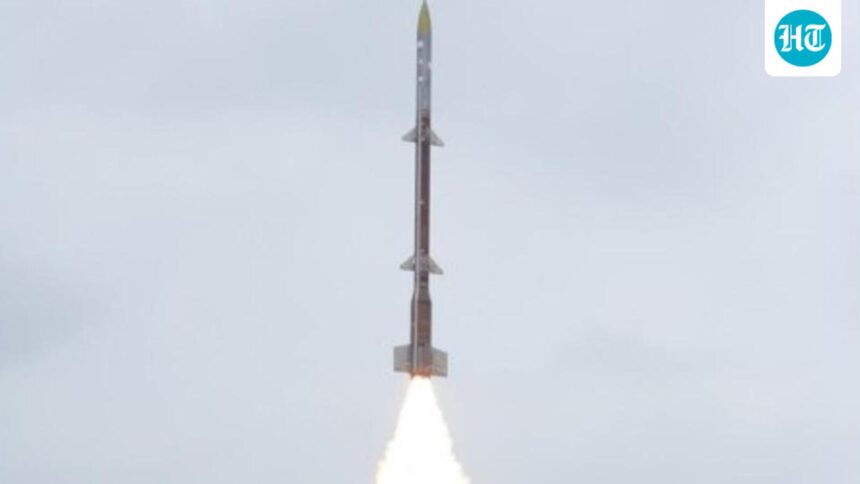
India on Thursday conducted the first test of its home-made long-range Kosha surface-to-air missile system designed to intercept air threats at distances up to 350 km, an important capability that will strengthen the country’s air defense network once the weapon is inducted into service, officials familiar with the development said.
The officials, who requested anonymity, said that the missile system is capable of responding to threats within a range of 150 to 350 kilometers, and is expected to be deployed within three to four years.
The Ministry of Defense said that the Defense Research and Development Organization conducted a test against an electronic target simulating a high-speed, high-altitude air threat, and the missile system succeeded in intercepting it. It was tested from Abdul Kalam Island APJ off the coast of Odisha.
The Kosha missile system is designed to neutralize a wide range of air threats, including combat aircraft, missiles, unmanned aerial vehicles (UAVs) and large enemy aircraft, over a wide range and altitude envelope. “All elements of the weapon system, including missiles, radars and command and control centre, have been developed by various DRDO laboratories and industry partners,” the ministry said.
Defense Minister Rajnath Singh said the successful flight test of the Kushha marks an important milestone and highlights the country’s prowess in developing a long-range surface-to-air missile system, which only a handful of countries possess. “This will also eliminate import dependency for such systems and represents a huge leap in the nation’s air defense capability,” Singh said.
Defense Minister Rajesh Kumar Singh, who holds additional charge of DRDO, monitored all the activities during the launch and congratulated the team members participating in the flight test.
India’s air defense arsenal includes the S-400 system imported from Russia. The country has ordered five S-400 units from Russia $39,000 crore in October 2018 under a government-to-government deal. The Israeli Air Force has already deployed three units of the air defense system, a fourth unit arrived in June, and Russia is expected to deliver the fifth squadron by the end of the year.
In March, the Defense Acquisition Council (DAC) approved the value of enhancing military capabilities $2.38 million crore to supply the country’s armed forces with more S-400 air defense systems, remotely piloted attack aircraft, transport aircraft, artillery guns and tank ammunition.
The proposed acquisition of five more S-400 missile units, which targeted Pakistani assets during Operation Sindoor in May 2025, will significantly enhance the IAF’s ability to detect, identify, track and engage hostile fighters, missiles and drones.
Other air defense systems operated by Indian forces include Akash, Samar (surface-to-air missile for assured retaliation), Israeli SpyDer, and Soviet-origin systems such as Pechora, OSA-AK, Tunguska, Strela and Shilka, Zu-23-2B anti-aircraft guns, upgraded L-70 anti-aircraft guns (obsolete weapon manufactured by Swedish arms company Bofors AB), and Igla (shoulder-portable) MANPADS. aerial).