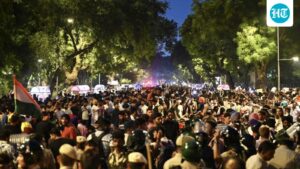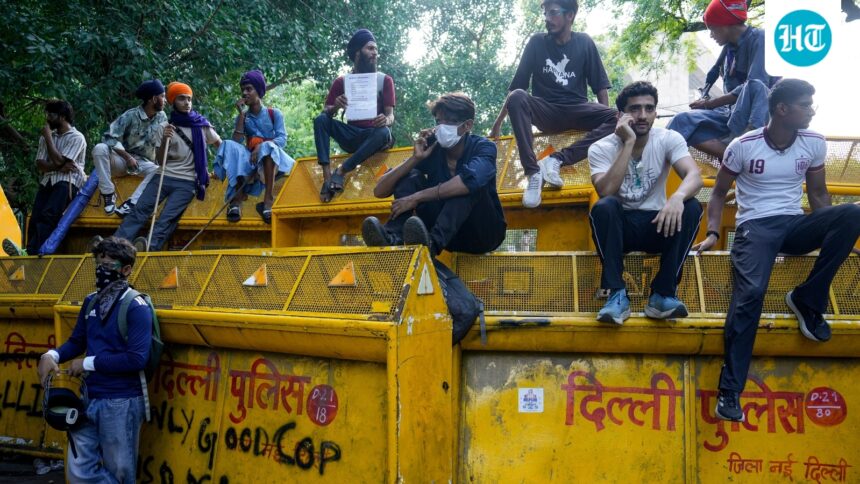
Anyone familiar with their memes will instantly recognize the Subway Surfers-inspired reels that came out of the Jantar Mantar protest – of Gen Z protesters running through the streets of central Delhi with a cop chasing them using a lathi machine, all set to the tune of a 2012 online game where the player runs endlessly dodging obstacles.
One such clip, written by a Delhi-based fitness influencer with the caption, “My bro thinks he can outdo me,” has garnered 2.3 million likes on Instagram. There are 129,000 videos of the theme song on Instagram, many of which were recorded and uploaded on July 20 when tens of thousands of protesters gathered in central Delhi as part of a planned but unauthorized protest march to Parliament.
The way Gen Z is interacting online — through memes, stickers and GIFs — is how they are participating offline in a protest that has seen a much younger demographic than any protest in recent history. Their posters and reels are funny, irreverent, creative and usually offensive. Walking around the protest site, which is littered with posters, is like scrolling on your phone late at night.
What began as anger over repeated leaks of examination papers and demands for the resignation of Union Education Minister Dharmendra Pradhan under the banner of the Cockroach Janta Party (CJP) has evolved into a clear mode of political expression for Generation Z – one designed as much for the algorithm as it is for the authorities.
On social media, the “Delhi Punks” are doing proper checks, “GRWM (Get Ready With Me)” videos with a dose of political messages on the side, they are even doing a “Viking Row” (like the Norwegian football fans a few weeks ago) with “Row! Row! Row!” Replaced with “Resign! Resign! Resign!”
Posters are flying – “Everyone is gangsters, until the cockroaches start flying”, “Kuchupuchu tum Dido na quit.” There are demonstrators dressed as cockroaches and dinosaurs, and there is also Spider-Man and Batman. There is also Gandhi and Ambedkar. There are videos of a protester shaving his head while others gather around him, pretending to cry and beating their chests loudly in front of the shroud – “The Education System.”
Michael Jackson’s ‘They Don’t Really Care About Us’, Boney M’s Rasputin, Delhi Belly’s Bhaag DK Bose, the title track of Rang De Basanti, Dub Sharma’s Azaadi and rapper DIVINE are the soundtrack to this protest and its social media presence. Generation Z isn’t just organizing a protest, they’re turning dissent into viral content in order to “break the internet.”
In contrast to traditional student demonstrations dominated by ideological banners and lengthy speeches, these protests were supported by short-lived humor. Like the viral audio clip of a young child: “Kuchupuchu… tum resignation from dido na,” political slogans are replaced by children’s sarcastic conversations.
But the messages are sharp, if unparliamentary.
After all, at the heart of the protests is deep concern over repeated paper leaks, most recently the NEET Medical Entrance Test, which was canceled and retested. “Our friends were beaten up over legitimate demands. We were ignored by everyone. Out of this frustration and anger, this creativity emerged. Memes and reels are our language of expression,” said Ritwik, 21, a student from Noida, who only wanted to be identified by his first name.
CJP did not respond to HT’s request for comment.
And over the past two days, this humor has also extended beyond Delhi. In Patna, as police were preparing to disperse the protesters, protesters were heard sarcastically asking officers, “Tear gas ka vyavasta nahi hai? Water cannon bhi nahi? (You haven’t made any arrangements for tear gas? You don’t even have water cannons?)” Moments later, when the water cannons were turned on, the protesters broke into dancing to the tune of the song “Paani Wala Dance” which went viral.
In Mumbai, videos showed detained protesters exiting a police car after someone quietly opened its latches, while Instagram reels covered the escape with the soundtrack of Subway Surfers, turning the police chase into a video game series with every detail – speed, distance traveled, steps.
The Internet has also become a second venue for protest, especially on Instagram and Reddit. “I love everything that is wrong with our generation” is the prevailing sentiment. Thousands of reels celebrate protesters who completed their daily goals or shared their Strava maps as they marched to Parliament, joked about running away from police barricades, or compared government accountability to a corporate culture of resignation. One banner at Sansad Marg read, “I understand, Dharmendra bhai, mujse bhi resign nahi ho ba raha (Dharmendra bhai, even I cannot resign).”
Another said sarcastically: “My ex-boyfriend did not ignore me as much as the government ignored me.” Even IKEA has found itself drawn into the discourse with a banner declaring “IKEA has a better cabinet,” as Taylor Swift did when a protester in Bengaluru carried a banner that read, “In India, there is one paper leak after another but not a single photo of Taylor Swift has been leaked yet.”
Tanveer Ejaz, associate professor of political science at Delhi University, said that in this movement, humor and sarcasm occurred in an earlier political conversation. “Instagram and [social media] The ecosystem is based on clear images and short messages. This generation does not give long speeches but they are clear in their minds about the messages. There is also a feeling that millennials have made a mistake that needs to be righted. “You may not agree with their methods but humor and sarcasm are all aimed at demanding accountability… The use of humor and memes creates a sense of fear among citizens,” Ijaz said.
Not every logo lands comfortably. Some signs and slogans are interspersed with profanity or overt sexual insults, indicating a generational desire to eschew traditional modesty and use language for its shock value – something older protest cultures largely avoided. The Gen Z protest at Jantar Mantar seems less concerned with moral rightness and more concerned with virality. They use sarcasm to confront authority as opposed to rhetoric. To be sure, the CJP core team has repeatedly issued statements from the stage asking people not to use offensive slogans. Till Wednesday, CPM spokesperson Ashutosh Ranka had instructed the protesters to strictly adhere to four approved slogans only to prevent opponents from creating a negative narrative. Negative slogans should be avoided during the demonstration, Ranka said, adding that the government was looking for an opportunity to use them in its rhetoric. He listed four specific slogans that would be allowed: “Bharat Mata ki Jai”, “Inquilab Zindabad”, “Jai Bhim” and “Dharmendra Pradhan Estiva Do”. But hardly anyone is listening to this advice. The protest has spread to a much larger area.
The main protest venue on Jantar Mantar Road also has a familiar layer below the memes. There are students carrying pictures of Bhagat Singh. Leftist organizations raise red flags and Che Guevara; Veterans of campus politics chant traditional slogans. Faiz Ahmed Faiz’s ‘Bol ke Lafz Azaad hai tere’ never gets old. The old icons have not disappeared but have gained new company. If Millennials and Boomers measure the success of a protest by columns or TV coverage, Generation Z measures it by shares, remixes and popular sound. And a government that was always ahead in the social media game suddenly finds itself falling behind.