

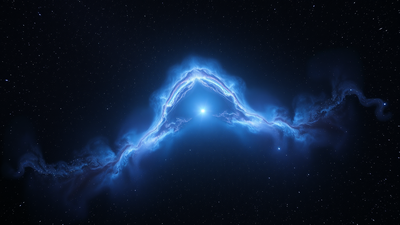
Located about 5,000 light-years away in the constellation Centauri, it is a much colder place than anything found on Earth. This dying star system, known as the Boomerang Nebula, holds the record for the coldest known natural object in the entire universe, lying just one degree above absolute zero, the theoretical point at which all particle motion stops.
That comes out to about minus 272 degrees Celsius, making it three times colder than the lowest natural temperature ever recorded on Earth, in East Antarctica, and even colder than the faint background radiation left behind by the Big Bang itself.
How did astronomers first recognize this extreme cold?
According to a paper published by astronomers Rajvendra Sahai and Lars Ake Niemann in 1997, and later confirmed and detailed in observations described by NASA’s Jet Propulsion Laboratory, the Boomerang Nebula was measured using a fifteen-meter Swedish ESO Submillimeter telescope in Chile, and found to be even cooler than the cosmic microwave background, the faint residual radiation that fills the entire universe at a uniform temperature near 2.7 degrees above Absolute zero.
Finding any object cooler than the background radiation is highly unusual, as most of deep space is gradually heated by the same aurora left over from the early universe.
A dying star produces its own ultracold gas
The nebula’s extreme temperature comes from its violent formation process. According to ALMA, the Boomerang Nebula formed from an ancient red giant star nearing the end of its life, expelling gas outward at speeds about ten times faster than the dying star would produce on its own.
Researchers using the Atacama Large Millimeter Array, known as ALMA, have found evidence suggesting that this intense outflow may have been caused by a smaller companion star diving directly into the core of the larger red giant, ejecting most of its outer matter into space in the process.
Why does rapid expansion create such extreme cold?
The nebula’s temperature drops dramatically due to a clear physics principle: the gas cools rapidly while expanding outward at extreme speed. According to a peer-reviewed study titled ALMA Observations of the Coldest Place in the Universe, the Boomerang Nebula, published in The Astrophysical Journal, the nebula consists of a central hourglass-shaped structure surrounded by a broader, patchy region of this ultra-cold flowing gas.
The unusually high expansion speed strips thermal energy from the gas much more efficiently than in a dying star, allowing the outflow to fall below the background temperature of space itself.
What ALMA revealed about her true form
Previous images taken by the Hubble Space Telescope showed the nebula with a distinct or double-lobed appearance, which is why it gained the name boomerang. However, according to NASA’s Jet Propulsion Laboratory, more recent and more detailed ALMA observations have revealed that this visible light structure only tells part of the story, as the twin lobes seen in optical images may actually be a kind of illusion created by how the light is scattered through the nebula’s material, rather than reflecting its true underlying shape.
A rare and short-lived phase in the life of a star
Follow-up research, described in a study titled “The Coldest Place in the Universe, Exploring the Ultracooled Outflow and Dust Disk in the Boomerang Nebula,” published in the Astrophysical Journal, found that the total star mass loss in this ultracooled outflow amounts to more than three times the mass of our Sun, with the mass of the parent star itself estimated to be at least four times the mass of the Sun before this process began. Objects like the Boomerang Nebula likely exist elsewhere in the universe, but they can only withstand such extreme cold for a relatively short period in cosmological terms, making this a rare opportunity to observe the phenomenon directly, noted astronomer Lars Åke Niemann, a co-author of the paper.
Why does this discovery continue to intrigue astronomers?
The Boomerang Nebula remains a valuable natural laboratory for understanding the final stages of a dying star’s life, providing insight into a short transitional phase, lasting approximately a thousand years, during which stars shed their outer layers before finally forming what is known as a planetary nebula. Its record cold, colder than the vacuum of space itself, continues to raise questions among astronomers about how common such extreme stellar events are throughout the wider universe, and how many similar cosmic freezes might be forming and quietly vanishing in other corners of the galaxy right now.