

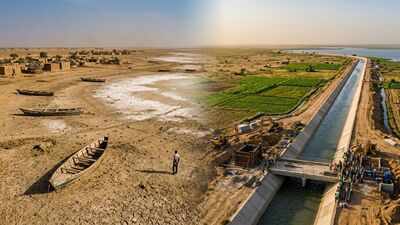
Lake Chad, once one of Africa’s largest inland bodies of water, has lost about 90% of its surface area since the 1960s, leaving millions of people facing the loss of their livelihoods from fishing, agriculture and livestock.
This decline has been linked to changing climate patterns, rising water demand, and expanding irrigation. Now, a decades-old proposal known as the Transaqua has drawn new attention to the lake’s future. The ambitious plan, first proposed by Italian engineers in 1982, proposes building a 2,400-kilometre-long canal to transport water from the Congo River Basin to Lake Chad at an expected cost of billions of dollars. Supporters see it as a potential revitalization project, while critics warn of environmental and practical challenges.
How did Lake Chad in Africa lose most of its water?
Lake Chad has experienced one of the most dramatic environmental changes in Africa. As the BBC reported, since the mid-20th century the lake has lost about 90% of its surface area, although the exact size has changed over time depending on rainfall patterns and seasonal changes.The decline did not come from a single cause. Increasing demand for water, expanding irrigation projects, growing population, and changing climatic conditions have all put pressure on the lake system.
The rivers that once regularly fed its waters became less reliable, while communities surrounding the basin continued to rely on shrinking resources.The impact has been felt across a region where millions of people depend on agriculture, fishing and livestock. Areas once known for productive fields and crowded fishing markets are now difficult places to make a living.“We were passing through cornfields on our way to the lake, and there were huge numbers of boats bobbing up and down on the water at that time, and there were huge fish markets,” said Bill Borah, who grew up on the lake in the 1970s and now works for the Lake Chad Fishermen’s Association.
The 2,400 km proposal that could reshape the future of Lake Chad
The proposal to revive Lake Chad through a massive water transfer project was first developed in the early 1980s by Italian engineering firm Bonifica SpA, according to reports.Known as Transaco, the plan includes building a canal extending approximately 2,400 kilometers from tributaries of the Congo River system toward the Chari River, the main water source that feeds Lake Chad.The project is designed to redirect part of the Congo Basin’s waters northward while creating a network of dams that could generate electricity along the way.
The engineers behind the proposal argued that the additional water could help restore the lake and create new opportunities for agricultural and infrastructure development.When these plans were circulated among African governments and international financial organizations in the 1980s, they received little response. The scale, cost and political challenges involved meant that the idea remained largely unchanged for decades.
For many years, Transaqua existed more as an engineering concept than a realistic proposal.
How the decline of Lake Chad led to a broader crisis
The shrinking lake has affected communities already suffering from poverty and limited opportunities. In many villages, young people have found fewer ways to earn a living, as agricultural acreage has decreased and fishing has become more difficult.Environmental changes have also occurred simultaneously with the rise of extremist groups in the region, including Boko Haram.
The disappearance of the lake is not the only cause of the conflict, but the loss of livelihoods has contributed to creating conditions in which armed groups can find recruits among frustrated and vulnerable communities.Reportedly, during a visit to northeastern Nigeria in 2014, signs of neglect appeared around settlements near Lake Chad. Abandoned projects, damaged buildings and communities living in fear reflect years of instability.
Residents spoke of the lack of jobs and opportunities for young people. For some, leaving home or joining armed groups seemed to be among the few options.
A costly vision to reshape Africa’s water landscape
At a conference focused on the future of Lake Chad, governments and engineers returned to the Transaqua proposal as a potential long-term solution.The estimated cost is enormous, with numbers reaching tens of billions of dollars, as reported by the British Broadcasting Corporation (BBC).
The proposed funding effort is intended to support a broader Lake Chad recovery programme, while engineering firms have been asked to study whether the project can realistically be built.The Italian company behind the concept worked alongside Chinese engineering expertise to evaluate the plan. Proponents claimed that the amount of water transported would represent only a small share of the Congo River’s total discharge and would not necessarily conflict with other major hydropower ambitions in the region.The proposed canal would be a major piece of infrastructure, likely including roads and railway lines alongside the waterway. Supporters suggested it could support agriculture, transportation, and industrial development along its route.Environmental groups have raised concerns about the change in the Congo Basin, one of the world’s most important river systems. Transferring water between ecosystems on such a large scale can lead to consequences that are difficult to predict.
Searching for a future for the lake
The controversy over Lake Chad reflects a broader challenge facing regions where climate pressures and human demand collide. Restoring the lake is not just a matter of moving water. It also involves managing existing resources, improving local economies and addressing conditions that have made local communities vulnerable.For people living around the basin, the changes have already become part of daily life. Farmers have seen farming areas disappear, fishermen have traveled farther to find catch, and communities have adapted to landscapes that no longer resemble those older generations remember.Whether Transaqua’s vision will become a reality remains uncertain. The project represents one of the most ambitious attempts ever proposed to reshape a large African water system, but its future depends on financing, cooperation and careful evaluation.For now, Lake Chad remains a symbol of environmental loss and the difficult search for solutions on a changing continent.