The Delhi High Court on Monday directed Safdarjung Hospital to register all pathology reports of activist Sonam Wangchuk prepared by Safdarjung Hospital, AIIMS and any private laboratory, along with all medical and health bulletins issued from time to time regarding his condition.
A bench of Chief Justice D K Upadhyaya and Justice Tejas Karia noted that it would consider Wangchuk’s wife Gitanjali’s request to seek his transfer to a hospital of her choice on Tuesday after examining the medical records.
The court also ordered the director-in-charge of AIIMS as well as the AIIMS emergency doctor treating Wangchuk to attend the hearing, and the doctor who was treating Wangchuk earlier to remain present in court for assistance on Tuesday.
“In view of the general circumstances, we direct that all pathological reports of the appellant’s husband based on the samples analyzed at Safdarjung Laboratory, AIIMS and the private laboratory shall be submitted vide affidavit performed by the Director of Respondent No. 4 (Safdarjung Hospital). The appellant shall also submit the pathology report on the job of the appellant said to have been done by her in some private laboratory,” the court said in the order.
“We direct that the Director-in-Charge AIIMS and Dr Akshay, Emergency Medicine tomorrow for assistance. The doctor whom the appellant was consulting will be present during the hearing tomorrow and respondent No. 4 will also place on record the medical/health bulletin issued from time to time regarding the health conditions of the appellant’s husband,” she added.
The court issued the order in a petition filed by Wangchuk’s wife against the single judge’s order on Sunday refusing to allow her to transfer him to a hospital of her choice.
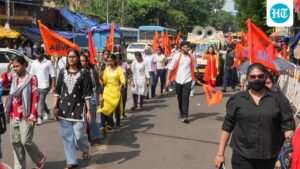
This was after Gitanjali’s lawyer, senior advocate Akhil Sibal, said the government’s decision to admit Wangchuk to Safdarjung Hospital, without any formal order of arrest or detention and against his express wish, amounted to a violation of his right to bodily autonomy. Sibal stated that Wangchuk was fully conscious and coherent, and noted that he had been writing letters personally, including one requesting permission to participate in the march that took place on Monday.
He further claimed that Wangchuk was removed from the protest site and taken to hospital without consulting his wife or obtaining her consent. Pointing out discrepancies in medical reports, Sibal pointed out that while the pathology report issued by Safdarjung Hospital recorded Wangchuk’s potassium level at 2.9 mg, a report from a private laboratory showed it to be 3.6 mg, which is within the normal range.
Opposing the petition, the Centre, represented by Solicitor General Tushar Mehta, Additional Solicitor General Chetan Sharma along with Standing Advocate Ashish Dixit, said that while the government usually has no role in interfering with the bodily autonomy of an individual, the situation is changing where deterioration of a person’s health or possible loss of life can have wider implications on public order, law and order.
“In normal circumstances, it is autonomous, but when the consequences of deteriorating health and possible loss of life have an impact on the law and order situation, then the state right comes in,” he said. “We are not dealing with the case of an ordinary person staying at home, but we are dealing with a person whose deteriorating health is likely to have some repercussions, and that is where the state comes into the picture. The right to life cannot be absolute.”
The general secretary also added that blood samples were tested not only at Safdarjung but also at AIIMS and a private laboratory, and the results were largely similar.
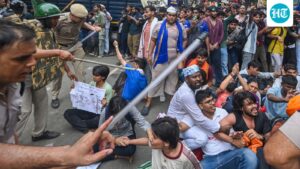
Wangchuk, who has been on an indefinite hunger strike in Jantar Mantar for 21 days over national examination irregularities, was taken to Safdarjung Hospital by Delhi Police on Saturday morning. While police said the move was aimed at monitoring his health condition in line with court directions, opposition parties accused the Center of using force against a peaceful protest and questioned the timing of the action, a day after the appointment of the New Delhi Police Commissioner.
The BJP defended the police actions, saying they were taken to protect Wangchuk’s health. Supporters said Wangchuk was forcibly removed, causing an uproar at the protest site.