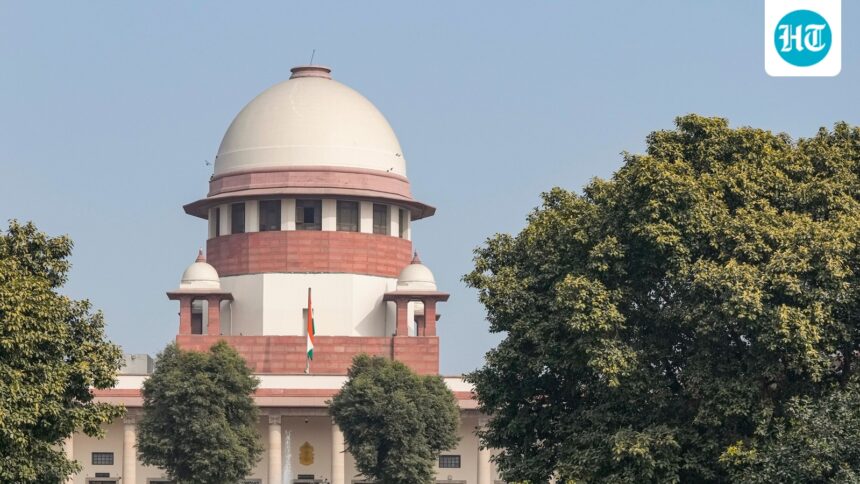
The Supreme Court stayed further proceedings before the Allahabad High Court in a long-pending Public Interest Litigation (PIL) related to the alleged death of a physically challenged man in custody in Mainpuri in 2009, and agreed to examine the Supreme Court order directing the Central Bureau of Investigation (CBI) to recover video evidence lost while conducting comprehensive observations against multiple institutions, including the Supreme Court itself and the National Human Rights Commission (NHRC).
A bench of Justices Vikram Nath and Sandeep Mehta issued notice on the appeals filed by the Uttar Pradesh government and Ajay Kumar Mishra, the then Chief Superintendent of Police, Mainpuri, who is currently posted as Inspector General of Police, Prayagraj Range. The court ordered that “further proceedings in the relevant public interest litigation be kept in abeyance” pending its consideration of the matter.
Read also: The Supreme Court acts after courtroom chaos, tightening rules for litigants in person
While appearing before the state during a hearing earlier this week, senior advocate and Additional Solicitor General Sharan Dev Singh Thakur asserted that the Supreme Court, while directing the CBI’s intervention, had made strong observations not only against the state police but also against the Allahabad High Court and the National Human Rights Commission, warranting scrutiny by the apex court. He urged the bench to examine the factual matrix and the legality of the order issued on May 18.
Accepting the application, the Supreme Court agreed to hear the matter in detail and stayed the proceedings before the Supreme Court.
The suit arose out of a PIL filed in 2010 by the Association for Advocacy and Legal Initiatives (AALI), an organization working for the rights of women and marginalized communities, seeking an independent investigation into the death of a 40% physically disabled man who died inside Dhanhar Police Station in Mainpuri on May 9, 2009.
According to the official version, Singh died by suicide after hanging himself with his belt inside the urinal part of the prison. However, in its May 18 order, a division bench of Justices Atul Sreedharan and Siddharth Nandan expressed serious doubts about the police version, stating that it was “almost impossible” for a person with 40% physical disability to hang himself unnoticed inside the police jail, which was kept under constant surveillance.
Terming the case a “reflection of institutional failures”, the Supreme Court observed that although the PIL has been pending for nearly 16 years, video footage and photographs of the scene and the autopsy are yet to come before it. It noted that the prolonged delay had enabled crucial evidence to disappear.
The Supreme Court criticized three institutions in particular.
She initially faulted herself, noting that the custodial death case should have been concluded within three months with constant monitoring to preserve evidence rather than remaining pending for more than 16 years.
Second, it held that the state police had failed to provide a satisfactory explanation for the disappearance of video evidence despite repeated judicial directions, and noted that the police appeared to be “passing the buck” to the National Human Rights Commission and that their unwillingness to produce the recordings “may” indicate an attempt to conceal a crime.
The bench also questioned the official version of suicide after noting that the autopsy indicated a knot mark behind the ear and fractures in the tracheal rings, features that, according to the court, seemed more consistent with strangulation than hanging with a leather belt. She noted that missing videotaping alone could conclusively determine whether a body was found in a manner consistent with suicide or otherwise.
The third institution criticized by the Supreme Court was the National Human Rights Commission, which closed the complaint in 2011 after accepting the police version. The bench observed that the Commission appeared to have conducted no independent investigation, recorded no statements of material witnesses and simply accepted police reports as “sacred fact”, questioning the very purpose of the institution if custodial death complaints were to be dealt with in this manner.
Read more: National Human Rights Commission registers Himanshu murder case; Karni Sena chief wants CBI or SIT probe under HC judge
The Supreme Court found the state’s explanation unsatisfactory and ordered the CBI’s anti-corruption branch in Ghaziabad to recover the missing video recordings within 60 days without registering an FIR at that stage and submitting it to the court.