
Annual floods in Assam are due to a combination of physical geography and human activities.

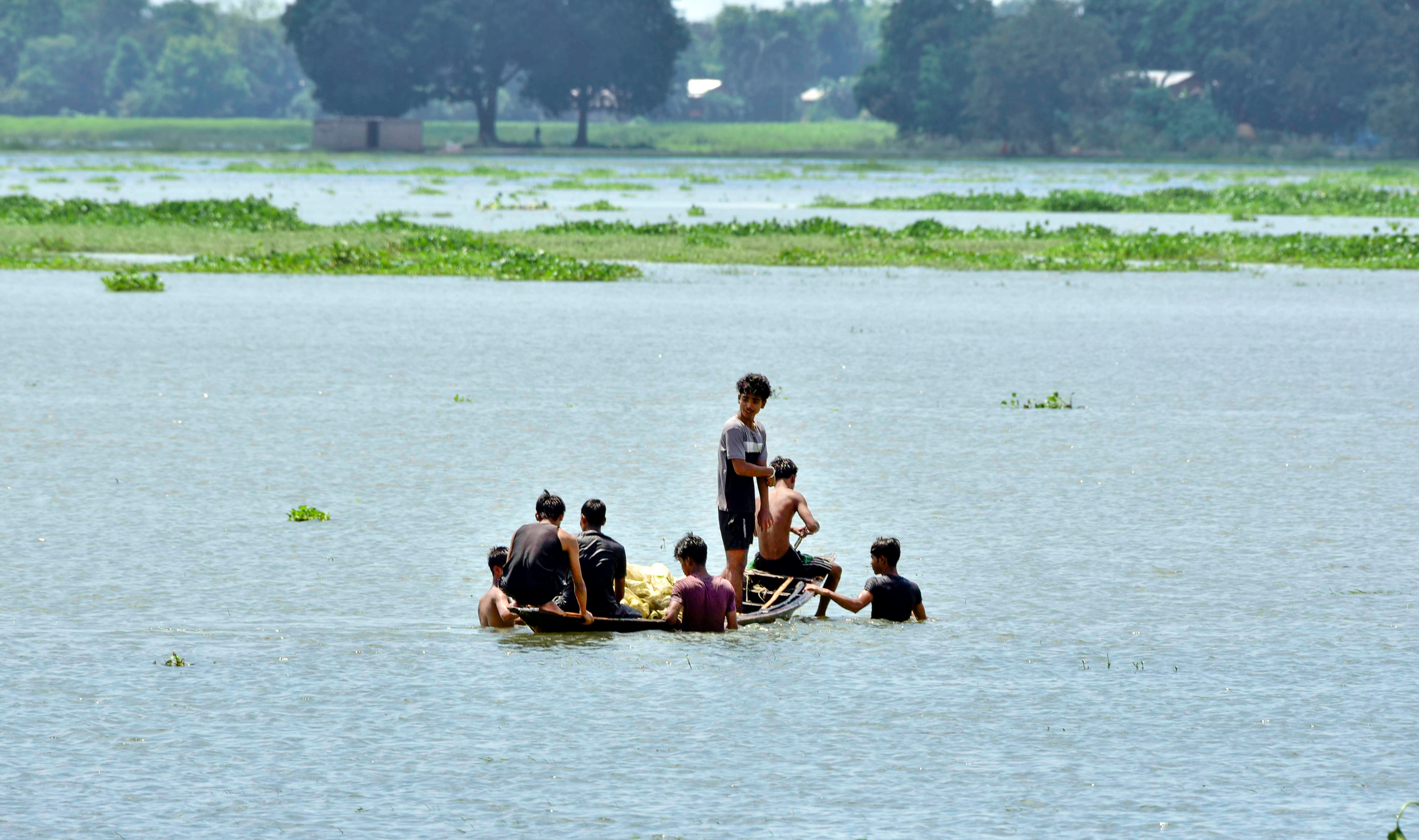
Every year, the same pictures come out of Assam. Underwater villages, roads cut off. Riverbank erosion swallows up homes. Even when the water is cut off, many families rebuild their lives from scratch.

The severity of the floods has subsided this year, with only Dhemaji district still affected according to the latest bulletin issued by the Assam State Disaster Management Authority (ASDMA). Nearly 16,000 people were affected by floods in 69 villages across four revenue circles in Dhemaji, according to the Assam State Disaster Management Authority (ASDMA).
Prime Minister Himanta Biswa Sarma had earlier said that he had briefed Union Home Minister Amit Shah about the relief and rehabilitation measures currently underway. “I thank His Excellency Home Minister Shri Amit Shah Ji for his phone call and inquiry about the flood situation in Dhemaji. I apprised him of the relief and rehabilitation measures currently underway. He also assured us of all possible support and assistance from the Government of India to deal with this situation,” he said.
The annual crisis has once again led to protests and renewed questions: Why does Assam continue to flood every year? Why was the problem not resolved?
Read also | Flash floods wreak havoc in Assam and Arunachal. More than 22,000 people were affected by the collapse of a railway bridge
“Life jacket” protest.
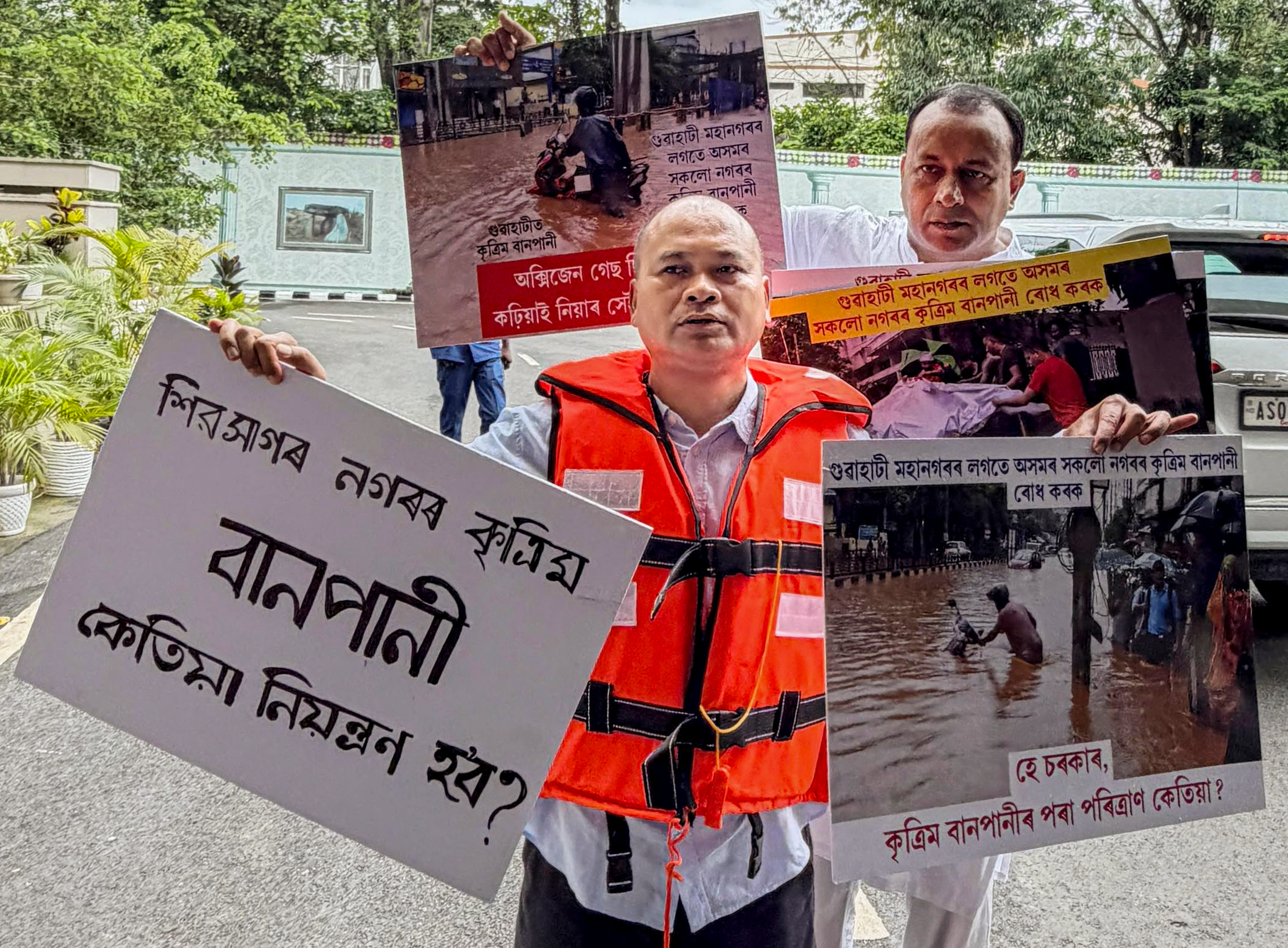
On the opening day of the Assam Assembly budget session earlier this month, Raijor Dal MLA Akhil Gogoi arrived wearing a life jacket. His protest was aimed at recurring floods and waterlogging in Guwahati as well as floods in his constituency Sivasagar.
“If it rains for five minutes, Guwahati stops working. Roads get submerged and damaged, bridges are affected, and people risk their lives every year due to artificial floods,” Gogoi told reporters.
He also accused the government of failing to fulfill its 2016 promise to permanently solve the flood problem in Guwahati.
“This life jacket is a warning to the government. Today’s protest is just the beginning. I will continue to raise the issue within the House and demand concrete action to end the artificial flood crisis in both Guwahati and Sivasagar,” he said.
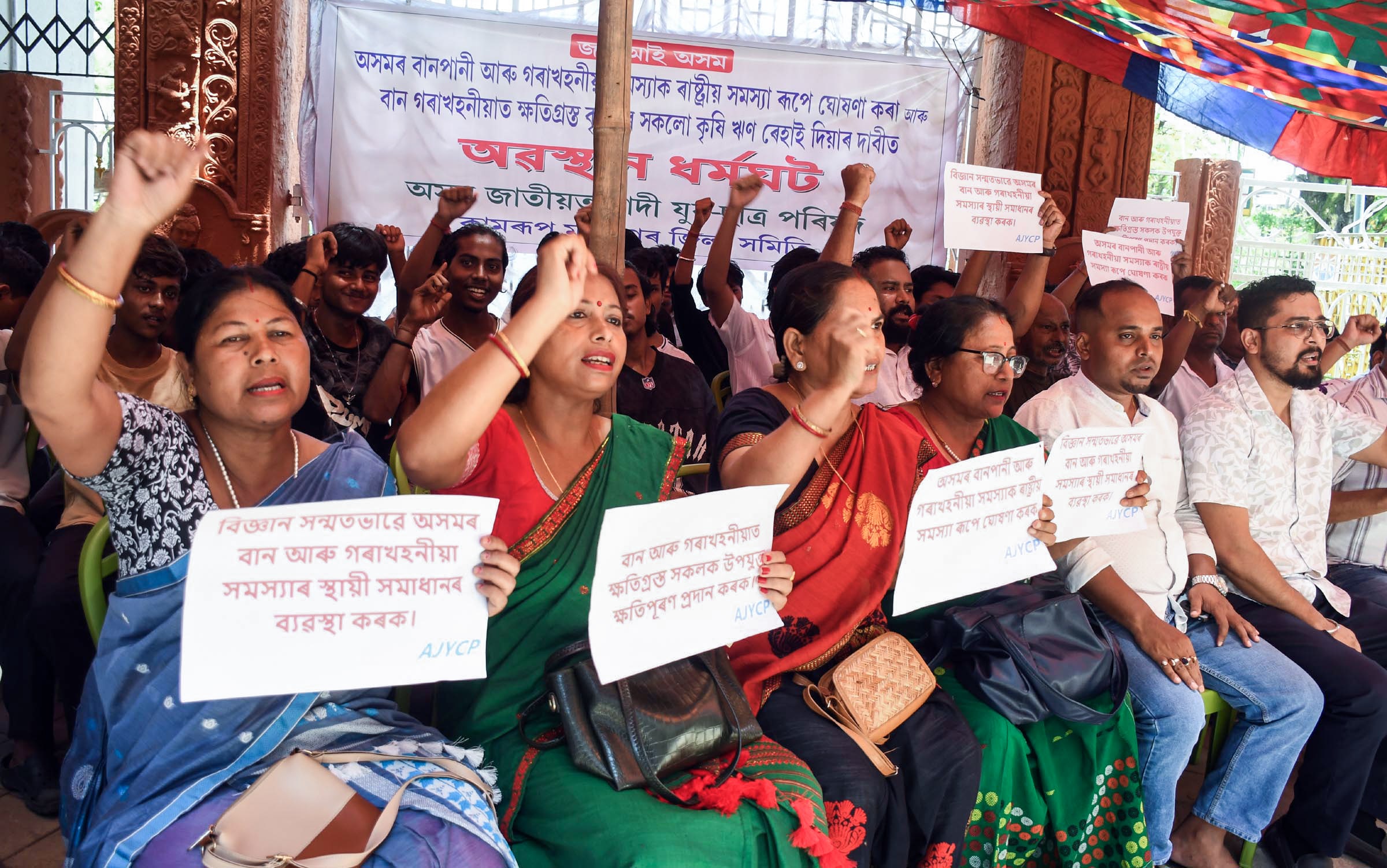
On the same day, the Asom Jatiyatabadi Yuva Chhatra Parishad (AJYCP) held three-hour demonstrations across the district headquarters, demanding that the Center declare Assam’s recurring flood and erosion crisis a national disaster.
Why does Assam flood so often?
The simple answer is geography. Assam is located on the floodplain of the Brahmaputra River, one of the largest sediment-bearing rivers in the world. The river starts on the Tibetan Plateau, flows through Arunachal Pradesh and Assam, and is joined by more than 50 tributaries before finally reaching the Bay of Bengal.
Every monsoon, huge amounts of water arrive as a result of heavy rainfall, melting snow and flow of tributaries from the Himalayas.
But experts say rainfall is only one part of the story.
Serious problem
Nearly 40% of Assam is vulnerable to floods, according to Rashtriya Barah Aayog. This is nearly four times the national average.
Floods have repeatedly struck the state annually over the past several decades, starting in the 1970s. Serious events were observed in 2018, 2020, 2021, 2022 and 2024.
Two days ago, floodwaters affected a district in Assam affecting 15 villages and 3,917 people in just 24 hours, according to ASDMA.
The Brahmaputra River carries a lot of sediment
Dhrubajyoti Saharia, professor of geography and floodplain researcher at Gauhati University, told HT that the Brahmaputra naturally flows through very small and unstable floodplains.
After Pasighat, the river slope becomes very gentle all the way to Dhubri, he explained. Because the river slows down, it cannot carry all the sediment it brings in from the mountains.
“It is one of the highest sediment-bearing rivers in the world,” he told HT.
As a result, huge amounts of sand and silt are deposited across the floodplains every year. More sediment is now coming down from the hills, Sahariah said.
Deforestation makes the problem worse
“One of the main reasons is severe deforestation,” he said.
Areas like Lakhimpur, Biswanath and Dhemaji are particularly vulnerable because rivers like Siang, Jayadal, Subansiri, Ranjandi and Dhikrung flow through them, according to Sahariya.
The hills upstream are composed of loose sandy material, making them highly vulnerable to landslides and soil erosion.
“Slight rains and heavy rains can lead to excessive landslides and excessive soil erosion. But they have increased due to deforestation,” he told HT.
It is believed that the authorities focused too much on flood control structures downstream while ignoring what was happening upstream.
Read also | Amit Shah confirms Center’s support for flood-hit Assam and Arunachal Pradesh
“I feel that, unlike working downstream, we should be working upstream, especially in soil conservation.”
He also pointed to reports of illegally felled tree trunks accumulating in dam reservoirs as another sign of widespread deforestation upstream.
Why does Assam get so much rain?
Sunit Das, chief scientist at the India Meteorological Department (IMD), told HT that Assam’s location naturally makes it one of the wettest regions in India.
“Assam receives most of its rainfall during the southwest monsoon season,” he said. “This is due to the combined effect of moisture intrusion from the Bay of Bengal due to southwesterly winds in the lower levels of the atmosphere, favorable topography, synoptic systems of active monsoons like cyclonic circulation, and presence of monsoon trough over the northeastern region,” he told HT.
Sahariya said that there is a strong relationship between the “La Nina” weather phenomenon and floods in Assam. However, he advised against blaming every flood entirely on climate change. “This year, we cannot say that climate change was responsible for this flood event.”
What climate change is doing is making floods more severe, he said. “Flood peaks… are higher… and greater destruction and extreme events are on the rise,” the professor said.
Why can’t dams alone solve the problem? ?
For decades, Assam has relied heavily on dams to control floods.
Since the 1950s, the state has built 423 dams along the Brahmaputra River and its tributaries. About 295 of them have already exceeded their expected lifespan, making abuses increasingly common.
Sharia says this approach has limits because the Brahmaputra River is naturally unstable.
“The Brahmaputra floodplains are very recent floodplains and are still unstable and very disturbing in nature.”
In simple terms, a river frequently changes its course, making permanent engineering solutions difficult.
“So this kind of direct structural measure may not always be possible.”
Is there a solution?
The Sahara votes in favor of basin-wide management that takes into account the entire river system rather than isolated projects. He also says flood management is not just about building structures.
It is believed that traditional floodplain communities have long adapted to annual flooding. “We need to train residents on how to live with floods.”
He pointed to communities like the Missing People, who have traditionally built homes suitable for flood-prone areas.
“But in a way we are moving away from this traditional technology. We are adopting new things to build houses or maybe we are building houses in the floodplain itself, but without adopting traditional floodplain measures,” he told HT.
Does building huge dams solve the flood problem?
Sahara believes that smaller dams may be more suitable. “I think small dams are a better solution than huge dams in this region.”
He says that if large dams are built, the best available technologies must be used because northeast India is in a very active seismic zone.
“Otherwise we would be in a very vulnerable situation with earthquakes… Large dams could lead to very serious damage.”
Flood toll
The average number of people affected by Assam annually rose from about 8.6 lakh people in the 1950s to more than 45 lakh by the early 2000s, according to data from the Asian Disaster Reduction Center (ADRC). Economic losses multiplied more than 120-fold.
At least 838 people died in floods between 2013 and 2022, according to the Assam State Disaster Management Authority (ASDMA). The year 2022 recorded 181 deaths, the highest in a decade.
Read also | Heavy rains trigger flash floods in Arunachal; High alert issued in Assam
The problem doesn’t end when the water is gone
Although this year’s floodwaters have largely receded, damage continues.
In Demaji, the Dhikhari River changed its course during floods, cutting off the settlement and destroying homes, farmland and public infrastructure. A railway bridge collapsed in the area.
Villagers in Lohit Khapulu district recently built a bamboo bridge themselves after damaged bridges continued to isolate communities and make access to schools and hospitals difficult.
“We have lost everything,” one villager told local outlet Northeast Now. “Our home, property and farmland have been destroyed. We are now living in a temporary shelter built on raised bamboo platforms and surviving on relief provided by the government.”
“The river was not flowing through this part of the village earlier,” another said. A local resident said: “After it changed its course, it swept away homes and livestock. Electricity also remained out of action due to damage to power poles and transmission lines.”

Anita Goswami is a Senior Content Producer at Hindustan Times, where she primarily covers Indian and international news. With four years of experience in the field, she has led coverage of Indian general elections, Assembly elections, and national polls in the US, Canada, Bangladesh and Nepal. Its reporting covers world wars and major events, including Operation Sindoor, the overthrow of Sheikh Hasina, and the Mahakumbh Mela. It verifies the facts and uses clear sources to ensure the accuracy of the reports. As a former Editor-in-Chief at Storytailors, she has managed teams to produce high-quality content for networks such as NDTV, Profit, CNBC-TV18, Upstox and News18. Her work has appeared on NDTV, Meaww and Global Pulse. Throughout her tenure, Anita has collaborated with and received mentoring from leading industry experts. When she’s not reading, Anita can be found outside or at a bakery. Areas of interest: Indian political history, international elections, historical policy analysis, global conflicts, cultural events, Formula 1, art, media ethics, reporting on social and political change over time.Read more