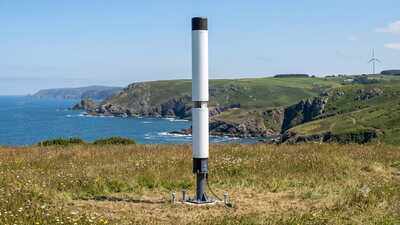
For decades, wind turbines have followed the same basic design: towering structures equipped with enormous rotating blades that convert wind into electricity. While manufacturers compete to build ever-larger turbines with blades spanning more than 100 metres, one Spanish company has taken a completely different approach.
Instead of rotating blades, its device is a thin vertical mast that sways in the wind to generate electricity. Developed by Vortex Bladeless, the technology weighs only a fraction of conventional turbines and has no rotating blades at all. Although current prototypes generate much less electricity than utility-scale wind turbines, researchers believe this concept could provide new possibilities for small-scale renewable energy in places where traditional turbines are impractical.
how Bladeless wind turbines Working without spinning blades?
According to the College of Engineering for Science and Technology, unlike traditional wind turbines that rely on rotating blades, the Vortex Bladeless device generates electricity through vibrations caused by the vortex. As wind flows around the vertical cylinder, it creates alternating vortices that cause the mast to sway from side to side.This phenomenon, known as a von Kármán vortex street, NASA reports, has traditionally been something engineers try to avoid because it can damage bridges, chimneys and towers.
Instead, Vortex Bladeless designed its turbine to harness these oscillations.The specially designed flexible rod allows the mast to resonate at certain wind speeds. The oscillating motion is then converted into electricity using an electric generator instead of a rotating gearbox or blades. With far fewer moving parts, the system aims to reduce mechanical wear and maintenance requirements.
Why engineers are developing bladeless wind turbines
Conventional wind turbines are highly efficient but also expensive to transport, install and maintain.
Their large blades require a lot of space and can generate noise, while some studies have shown that they may contribute to bird and bat collisions in certain locations.Bladeless turbines address many of these challenges. Because it has no rotating blades, the structure is lighter, quieter and mechanically simpler. The absence of gearboxes, bearings and temperature control systems also reduces the number of components that can fail over time.According to Vortex Bladeless, this technology is not intended to replace large wind farms. Instead, it is designed for distributed power generation, sensors, remote monitoring stations, off-grid installations and small buildings where conventional turbines may be impractical or uneconomical.
What are the limitations of bladeless wind turbines?
While the new design is very innovative, the product is still in its preliminary stage when it comes to marketing.The company’s largest operational turbine model produces only about 100 watts of power, while modern wind turbines generate millions of watts of power. Therefore, bladeless wind turbines cannot replace wind farms.There is more work being done to make this technology more efficient, durable and scalable. This technology could be used in the future to power smart city infrastructure, agricultural sensors, communications equipment and the Internet of Things (IoT).
Could bladeless wind turbines become part of the renewable energy future?
Experts increasingly believe that the future of clean energy will depend on a range of technologies rather than a single solution. Large wind turbines will continue to generate electricity for national grids, while other smaller inventions may be useful for some applications that cannot accommodate traditional methods.Bladeless turbines can be used alongside other sources such as solar panels, batteries and wind farms to harness wind energy in city and remote and environmentally sensitive areas.Although an invention in development, bladeless turbines show that engineers are thinking differently about the oldest renewable energy sources. With the help of vibrations, bladeless wind turbines could become another way to produce electricity using the oldest source of energy on Earth.