The Supreme Court refused
NEW DELHI: The Supreme Court on Wednesday refused to entertain a plea challenging the West Bengal government’s order to deny food grains to those who were deleted from the electoral roll during the recently concluded Special Intensive Review (SIR) exercise.
The Supreme Court asked the Court of Appeal, a resident of the Nadia district in West Bengal, to approach the Supreme Court in Calcutta, and also asked the Court of Appeal to decide his appeal against his exclusion from the electoral list within two months.
The petitioner, Mohibula Mondal, told the Supreme Court that he was only seeking clarification that the removal of his name from the electoral roll would have no impact on his entitlement to subsidized food grains under the Public Distribution System.
A bench headed by Chief Justice of India Surya Kant said: “We are aware that you have been removed from the electoral roll. But for any other services you are denied, you can approach the Supreme Court.”
Senior advocate Shadan Farasat, who appeared for the petitioner, said that while upholding the validity of the practice of SIR in Bihar, the Supreme Court in its recent judgment in League for Democratic Reforms v. Election Commission of India has categorically ruled that removal from the electoral roll “does not amount to a declaration that an individual is not a citizen of India”.
Firasat asked for clarification in this regard, saying: “If this court can implement this line of judgment, it will help us a lot. We are seeking clarification from this court in this sense because this problem will come here in the end.”
“We are sure that the high courts will not give us an opportunity to clarify. If the matter comes to us, we will not hesitate to clarify,” the bench, also comprising Justices Joymalia Bagchi and V Mohana, said.
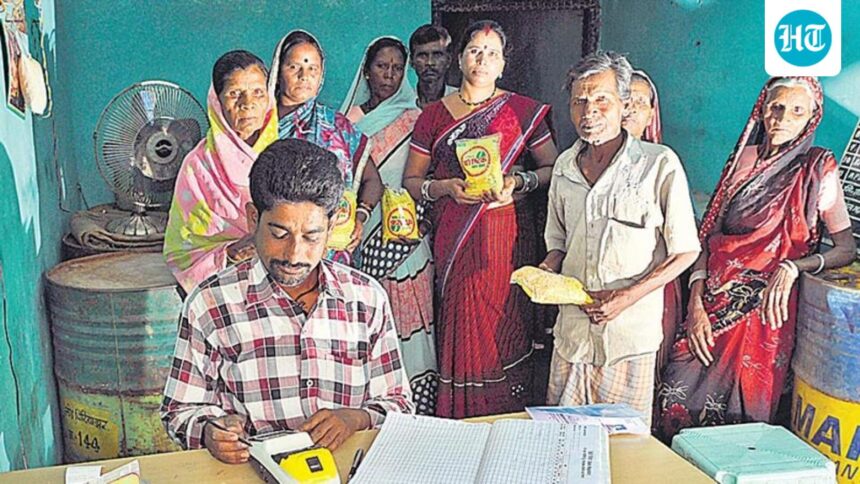
The petition, filed through advocate Srishti Agnihotri, challenged a June 4 order issued by the West Bengal Food and Supplies Department. According to the appeal, the order directed verification and deletion of PDS beneficiaries and consequent cancellation of ration cards only on the basis of SIR of electoral rolls conducted this year.
Mondal said that he had been holding a valid ration card since 2016, but later discovered that his name was excluded from the electoral list. He appealed the exclusion before the Court of Appeal.
The authority agreed to expedite the matter, and said: “Given that the petitioner’s appeal against the removal of his name from the electoral list is still pending before the court of appeal appointed by the court, we ask the court to decide on the appeal expeditiously, preferably within two months.”
The petition argued that removal from the electoral roll could not be treated as a determination of citizenship.
“The deletion from the electoral roll does not amount to a determination of nationality, nor can it amount to a determination of citizenship… If deletion under the SIR cannot even determine the nationality of the voter, then it certainly cannot, through administrative sleight of hand, amount to a determination that a starving family is not entitled to subsidized food grains.”
The petition further asserted that the right to food and the right to vote are governed by different standards. It considered that making the deletion of the electoral list a basis for canceling ration cards affects the basis of the right to life in dignity guaranteed by Article 21 of the Constitution.
She also said that the right to food is governed by the National Food Security Act (NFSA), which establishes a separate process for identifying eligible households and does not provide for the deletion of beneficiaries on the basis of a review of electoral rolls.
According to the petition, no notice or opportunity to be heard was given before the beneficiary names were cancelled. It also claimed that the June 4 order requires district inspectors to complete the verification process in just 11 days, raising the risk of mechanical decisions and mass cancellations without individual scrutiny.