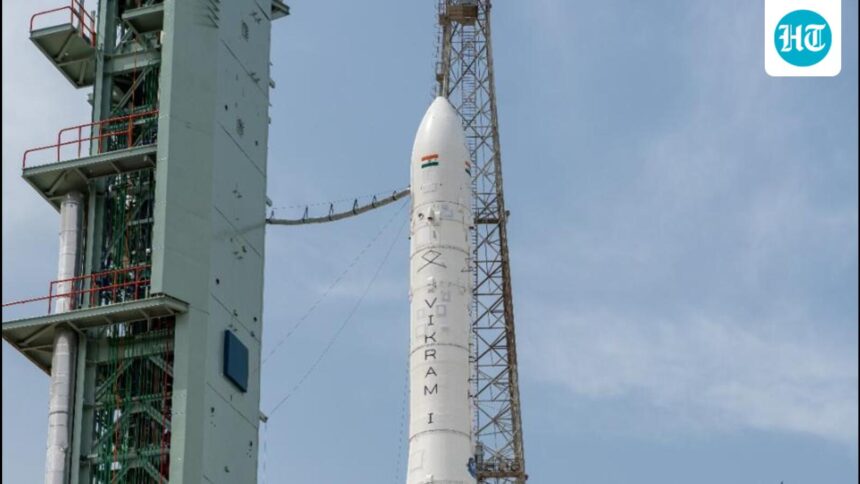
India’s first privately developed orbital rocket, Vikram-1, is scheduled to make its maiden test flight from the first launch pad at the Satish Dhawan Space Centre, Sriharikota, on July 18.
The indigenously developed Vikram-1 is scheduled to lift off at 11.30 am on July 18. “The launch of Vikram-1 after rigorous testing is a milestone in Indian spaceflight. This maiden test flight marks the beginning of Skyroot’s ambition to open space to everyone,” said Pawan Kumar Chandana, Co-Founder and CEO, Skyroot Aerospace.
All stages of Skyroot’s Vikram-1 were successfully integrated and stacked on the launch pad. Skyroot’s Launch Control Center completed final integrated checks of the vehicle on the launch pad, along with interface checks with all ground measurement stations and tracking radars.
“Relevant authorities have issued necessary air and sea notifications and officially identified restricted areas along the ascent and impact corridor of Vikram-1 for the launch day,” a media statement said, adding that the mission marks the Indian private sector’s access to the global launch business.
The mission will collect data across propulsion, stage separation, guidance, navigation, control and overall vehicle performance, supporting Skyroot’s evolution into a commercially operational launch vehicle.
Four technology demonstration payloads from Indian and international companies will be on board the first test flight. These include the Solaras S3 satellite developed by Grahaa Space, a Bengaluru-based space startup incubated at the Indian Institute of Space Science and Technology; a robotic arm to remove orbital debris called Embrace developed by Hyderabad-based startup Cosmoserve Space; Satellite Scope by Skyroot; and an in-orbit demonstration from DCUBED, a German manufacturer of NewSpace devices. Also flying alongside the payloads will be 18-karat gold microscopic sculptures carrying rockets by renowned Indian scientists Sir CV Raman, Dr Vikram Sarabhai and Dr APG Abdul Kalam, each smaller than a grain of rice, as well as Cosmos Diamonds’ artwork, ‘Cosmic Bloom’.
“On July 18, we are excited to see the performance of Vikram-1 in a real flight environment for the first time. This is our first test flight, and we will get valuable data from it. This will be the basis for Skyroot’s aspirations in setting the launch tempo,” Chandana said.
The seven-storey, multi-stage Vikram-1 launch vehicle is designed to carry small satellites weighing up to 350 kg into low Earth orbit, with its first mission targeting an altitude of 450 km with an orbital inclination of 60 degrees. The rocket is built with an all-carbon composite structure and is powered by internal propulsion systems, including 3D-printed engines and high-thrust solid-fuel boosters.
“The launch represents the hopes and hard work of nearly 1,000 people, contributions of over 400 suppliers, and nearly 3,000 days of determination to build a global offering from India,” said Naga Bharat Dhaka, Co-Founder and COO, Skyroot Aerospace. “Thanks to the data collected onboard from this mission, we will return to the ground to learn, improve and build further.”
The Aagaman mission will be the Hyderabad-based private space launch company’s second mission after the suborbital flight of Vikram-S, which was the first private rocket to reach space from Indian soil on November 18, 2022.