

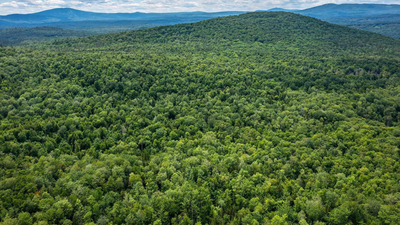
By the mid-19th century, much of New England had been stripped of the forests that once covered the region. Centuries of logging, expansion of plantations, and growth of settlements transformed vast forests into open fields and pastures.
However, over the next two centuries, an extraordinary environmental shift occurred. As the plantations were abandoned, people migrated west and nature gradually reclaimed the land, allowing the forests to regenerate on their own. Today, about 60 percent of New England is covered in forests again, a remarkable recovery that scientists describe as one of the world’s greatest examples of “Forest transition”Where landscapes recover naturally after widespread human disturbance.
How New England lost most of its forests
When European settlers arrived in New England during the 17th century, the region was covered in dense temperate forests extending across what is now Maine, New Hampshire, Vermont, Massachusetts, Connecticut, and Rhode Island. Timber was one of the colonies’ most valuable natural resources, providing lumber for homes, ships, furniture, fuel, and expanding industries.As settlements grew, forests were extensively cleared to create farmland and pastures.
By the mid-19th century, many parts of southern New England had lost the vast majority of their original forest cover. The stone walls that still run through today’s forests are a reminder that many of these wooded landscapes were once open agricultural fields.
The forests are starting to return
This remarkable recovery was driven not so much by tree planting as by comprehensive economic and social changes. The opening of the Erie Canal in 1825 connected New England to the fertile farmlands of the American Midwest, where crops could be grown more efficiently and transported inexpensively to eastern markets.At the same time, westward expansion encouraged thousands of farm families to leave New England in search of larger, more productive lands. Industrialization also created jobs in growing towns and cities, leading people away from agriculture. As the farms were abandoned, nature slowly reclaimed the unused land, beginning a recovery process that would last for generations.

Nature rebuilt forests almost on its own
Once the farmland was abandoned, the ecological caliphate took over.
Grasses and shrubs were the first to colonize neglected fields, followed by fast-growing pioneer trees such as eastern white pine, paper birch, and aspen. These early forests gradually created conditions for slower-growing hardwoods, including maple, oak, beech, and hemlock, to establish themselves.Over decades, these young forests have matured into complex forest ecosystems that support birds, mammals, insects and fungi.
Unlike many modern reforestation projects, much of New England’s recovery has occurred through natural regeneration, with little direct human intervention. Conservation measures and improved forest management later helped protect these recovering forests, but nature did most of the restoration itself.
Scientists call it one of the greatest forest restoration operations in history
Researchers often describe New England as one of the world’s clearest examples of forest transition, a process in which a region moves from widespread deforestation to extensive forest cover due to changing economic and social conditions.Today, forests cover approximately 60% of New England overall, with more than 80% or even 90% of the forest remaining in some northern regions. This recovery has restored important wildlife habitat, improved water quality, reduced soil erosion, and created one of the largest areas of continuous temperate forest in eastern North America.Scientists also point out that the area demonstrates how abandoned farmland can naturally recover when left undisturbed, providing valuable lessons for environmental restoration efforts around the world.
The recovery continues to face new challenges
Although New England’s forests have made an extraordinary comeback, they still face increasing pressure. Urban development, road expansion, invasive insects, plant diseases, and climate change are fragmenting forests and changing their composition. Rising temperatures are already affecting the distribution of tree species, while strong storms and prolonged dry periods pose additional risks.Forest managers are increasingly focusing on protecting large, connected landscapes, restoring degraded habitats, and improving resilience to climate change. Maintaining healthy forests is essential not only for wildlife but also for storing carbon, protecting freshwater supplies and supporting local economies that depend on sustainable forests and outdoor recreation.