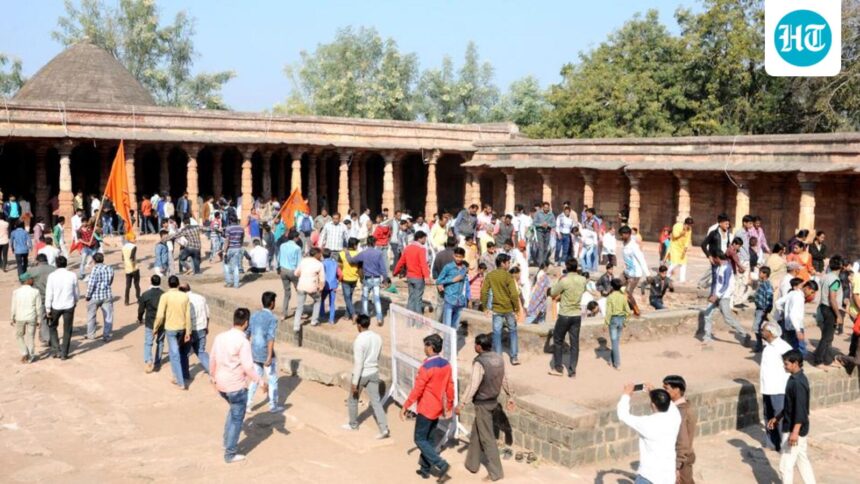
The Supreme Court on Tuesday refused to stay the Madhya Pradesh High Court ruling that declared the disputed Bhojshala Temple-Kamal Maula Mosque complex in Dhar a temple of Goddess Saraswati, and refused to restore Friday prayers at the site, even as it directed authorities to provide nearby space for Muslims to offer prayers as a temporary arrangement.
The bench, headed by Chief Justice of India Surya Kant and also comprising Justices Joymalia Bagchi and V Mohana, said the state administration and the Archaeological Survey of India (ASI) may allot a separate open space “adjacent to or close to” the disputed complex where members of the Muslim community can offer Friday prayers between 1 pm and 3 pm. The court also prohibited ASI from making any structural modifications to the site without its permission.
“We are inclined to adjudicate the issue of maintainability… Let us not pass any order which could lead to law and order issues or disturb the harmony,” the bench observed, adding that it would rather hear the main appeals than pass an interim order to restore the earlier arrangement.
The bench said it was aware that the Supreme Court ruling had already been partially implemented. “In this case, we have to protect the rights under the Supreme Court ruling until it is overturned on appeal. Without prejudice to either side, let the prayers be held at an adjacent site next to the declared temple.”
The court was hearing appeals filed by petitioner Gibran Ansari, Qazi Moinuddin, Mutawali of Kamal Moula Masjid, and Maulana Kamaluddin Charitable Society, challenging the Supreme Court’s declaration that the 11th-century Bhojshala-Kamal Moula complex is a Hindu temple, and its decision to quash the 2003 ASI order allowing Muslims to offer Friday prayers at the site.
Senior lawyer Huzaifa Ahmadi, who appeared for Ansari, said the Supreme Court decided the disputed issues of fact in the writ proceedings without trial or cross-examination of ASI experts. He said Muslims had been praying at the site for decades under a 2003 arrangement and were requesting the status quo ante be restored pending a Supreme Court decision.
Senior lawyer Abhishek Manu Singhvi, representing Moinuddin, urged the court to maintain the current balance, warning that reopening historical disputes could have wider consequences. Referring to the Constitution, he said that brotherhood and secularism are the values that should guide judicial intervention in such sensitive disputes.
Opposing the interim relief, Solicitor General Tushar Mehta, representing the Madhya Pradesh government, said the appeal had been filed almost two months after the Supreme Court ruling and restoring the earlier arrangement would create administrative difficulties after the new arrangement had already been implemented.
The court repeatedly emphasized the sensitivity of the dispute. “What is said in Courtroom One can have repercussions,” Kant noted, urging all parties to exercise restraint.
The Supreme Court decided that the Places of Worship (Special Provisions) Act, 1991, does not apply to the Bhoshala complex because it is a protected monument governed by the Ancient Monuments, Archaeological Sites and Monuments Act, 1958. The Supreme Court is now expected to examine, among other things, whether the High Court can determine the religious character of the site in judicial proceedings and whether the practice is prohibited under the 1991 Act.