

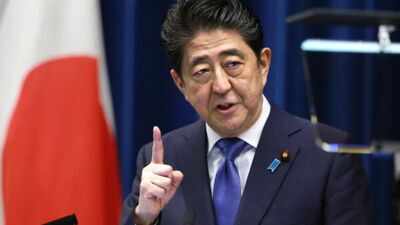
It is usually politicians who tell a country what its history means. Shinzo Abe, Japan’s longest-serving prime minister, said that was not actually their mission in the first place. “My opinion is that politicians should be humble in the face of history,” he said.
“When history is up for debate, it should be left in the hands of historians and experts.” Coming from someone who spent decades in a role that regularly required him to comment on Japan’s disputed past, this statement reads as a deliberate act of restraint rather than something easy to say, and is worth reading alongside his own record on exactly these questions, and not just as an independent principle.
Today’s quote by Shinzo Abe
“My opinion is that politicians should be humble in the face of history. When history is up for debate, it should be left in the hands of historians and experts.”
What did Shinzo Abe mean by this quote?
The quote is based on two related ideas. The first is humility, recognizing that no single leader, no matter how powerful, has complete authority to settle what has already happened in the past.
History includes incomplete records, competing viewpoints, and evidence that is constantly being revised as new material emerges.The second idea is experience. When historical events become truly disputed, Abe argues, the decision should fall to historians and researchers who spend their careers examining documents and comparing sources, not elected officials responding to the pressures of the moment.
This does not remove history from public life. It simply insists that public debate about the past remain tied to rigorous scientific research and not political interests.
Why this quote exists within a record is really disputed
Abe led Japan through major economic reform under what became known as Abenomics, and through real shifts in Japanese security policy, while historical questions about the 20th century, including Japan’s wartime behavior, remained a constant and sensitive backdrop to his time in office.
His government’s approach to these issues, including visits to Yasukuni Shrine, where convicted war criminals are among those honored, and statements about the history of war in Korea and China, has drawn real criticism from historians and neighboring governments who have argued that his own record has not always matched the humility that this quote describes.This tension deserves to be explicitly stated rather than overlooked.
Supporters saw that the leader was genuinely concerned about politicians exceeding the limits of historical knowledge. Critics saw a gap between this stated principle and his government’s handling of specific historical conflicts. Both readings can be done simultaneously, and the quote arguably becomes more interesting, not less, once this context is included.
Why it matters to historians to get the past right
History is not just remembering what happened. It involves comparing documents, weighing conflicting accounts, and revising conclusions as new evidence emerges—precisely the kind of patient, specialized work that the political news cycle rarely allows.
New discoveries continue to reshape understanding of major historical events, which is precisely why Abbey’s quote treats historical interpretation as an ongoing study rather than a stable political talking point.
Humility can enhance leadership rather than undermine it
Modern leadership is often expected to demonstrate complete certainty, but some of the most enduring political figures have been willing to acknowledge the limits of what they personally know. Deferring to historians over genuinely contested history is not the same as hesitation.
It is an acknowledgment that specialized knowledge exists for a reason, a principle that applies as much to business, science, and everyday decisions as it does to politics.
Other quotes by Shinzo Abe
- “Freedom, democracy, human rights and the rule of law are universal values.”
- “Japan must continue to proactively contribute to peace.”
- “The 20th century was a century in which human rights were violated in many parts of the world, and Japan also bears responsibility in this regard. I believe we have to look at our history with humility and reflect on our responsibility.”
- “I hope that the 21st century will be the first century in which there will be no violation of human rights.”
Why do these words still inspire millions?
History continues to shape debates about education, diplomacy and national identity around the world, and the temptation to bend the past to fit the argument of the present has not faded. Abe’s quote serves as a reminder that historical questions deserve patient, evidence-based study rather than convenient political interpretation, whether or not any individual leader, including Abe himself, always adheres to that standard in practice.