India on Monday launched its formal campaign for a non-permanent seat in the UN Security Council for the period 2028-2029.
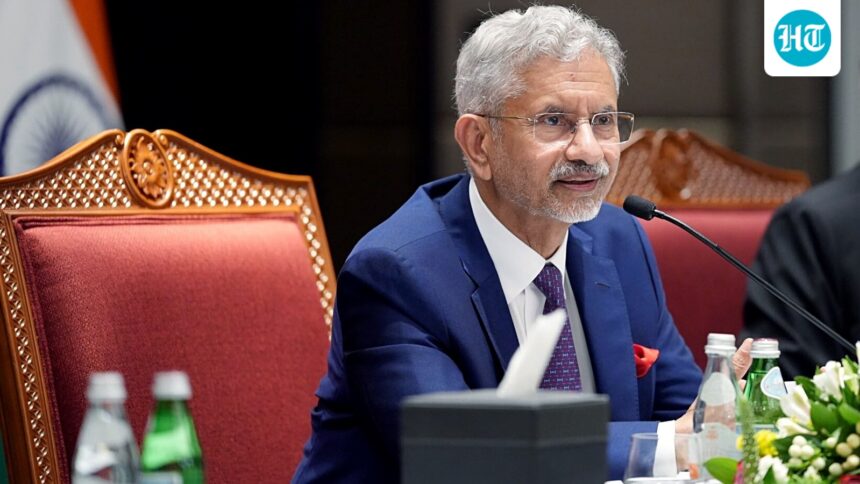
External Affairs Minister S Jaishankar launched India’s official campaign ‘Shanti: India for the UN Security Council 2028-29’. “Standards, Trust and Integrity” for the biennium at a special event at UN Headquarters attended by UN envoys, diplomats and officials.
India said its approach to the UN is rooted in “Shanti: Securing Inclusive Progress through Rules, Trust and Integrity”. India last sat at the UN table for 2021-2022.
Elections for the period 2028-29 are scheduled to be held in June next year, with India and Tajikistan competing for the only seat in the Asia-Pacific group category.
Read also | Jaishankar is on a four-nation West Asia tour as of today; USA and Belgium next stops
Jaishankar will also meet UN Secretary-General Antonio Guterres later in the day.
He paid an official visit to Qatar, Bahrain, Kuwait and Oman from July 5 to 10, and arrived in New York over the weekend. He will leave New York to attend the third meeting of the India-EU Trade and Technology Council and interact with his EU and Belgium counterparts in Brussels on July 14-15.
The UN Security Council elections will come amid major geopolitical shifts as the world continues to confront challenges such as the Ukrainian war, the conflict in Gaza and the US-Israel war against Iran.
Prime Minister Narendra Modi, in his speech to the Indonesian Parliament last week, said that the global order is changing rapidly, and in this context, “developing countries like ours seek equal participation and a greater role in global affairs. In this evolving global landscape, India firmly believes that reforms in the United Nations Security Council can no longer be postponed.”
India has been at the forefront of years-long efforts to achieve Security Council reform, including expanding its permanent and non-permanent categories, saying the 15-nation council, established in 1945, is not fit for purpose in the 21st century and does not reflect contemporary geopolitical realities.
Delhi has consistently maintained that it rightfully deserves a permanent seat at the horseshoe table.
India has called for the expansion of both the permanent and non-permanent categories of UN Security Council membership, warning that UN Security Council reform will come close to “failure” if only the non-permanent category of membership is expanded, as this will not “fundamentally” change the decision-making power structure of the five permanent members.
As the UN Security Council reform process has moved at a snail’s pace over the decades, India emphasized that the “nothing is agreed until everything is agreed” approach should not become a tool to derail progress.
“Advocates of the status quo have tried to use this argument to their advantage, thereby entrenching existing inequalities in the Security Council,” India’s Permanent Representative to the UN, Ambassador Harish Parvathanini, said last month.