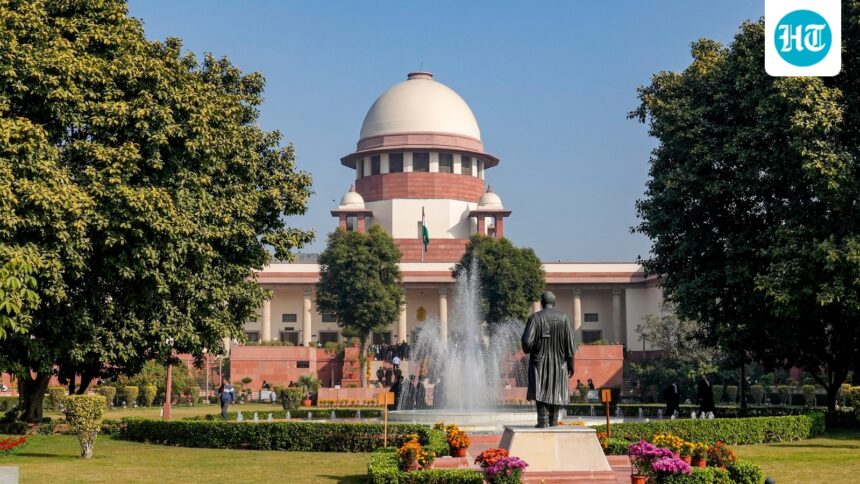
The Supreme Court on Monday asked how the state could prevent the elopement of a boy and a girl in a relationship, citing misuse of provisions of the POCSO Act against teenagers in voluntary sexual relations.

A bench of Justices B V Nagrathna and R Mahadevan observed that parents often resort to criminal proceedings to protect their so-called “honour” when teenage girls elope with their partners.
“How can the state prevent the escape of a girl and a boy? POCSO is sexual assault and exploitation of children,” the court said, adding that 15-18 years is a vulnerable age.
Read also: Former AAP leader Tahir Hussain has been convicted in the IB officer Ankit Sharma murder case
“It is an age of experimentation. The question is: Has this really become a POCSO issue?” The court said.
The Supreme Court made this observation while hearing a suo motu case relating to the right to privacy of teenagers.
The case began in the wake of the Calcutta High Court’s controversial 2023 judgment that called on teenage girls to “control” their sexual desires rather than getting involved in relationships.
The Supreme Court ruling was later overturned by the Supreme Court in 2024 after a suo motu case was registered on the right to privacy of teenagers and a slew of directions were passed.
Senior lawyer Madhavi Divan said that the case goes back to a minor eloping with a 25-year-old man.
Read also: ‘Dedicated Article 371 Framework’: Ladakh will get UT-level body and hill councils for all seven districts
She stated that the individual matter was generally closed after the court appointed a committee that dealt with the woman.
“A strong report has been made on the failure of the system in POCSO matters,” she said, adding that minors are entitled to some rehabilitation measures under the POCSO Act.
The judge asked her if the case was one of escape or kidnapping, and Deavan replied that the alleged victim wanted to be with the man and have a child with him.
The bench then said: “From 16 to 18 years they develop a relationship and go away. To protect their honor, parents attach criminal responsibility. We have to acquit them.”
Divan stressed that there is a need for a system to prevent misuse of the law and noted that teenagers in voluntary relationships are sent to prison under the POCSO Act.
Read also: BJP’s Narottam Mishra sees the downfall of the political coin: From acting as a watchdog, to crying over ticket denial in Datia
She stressed that “the victim girl has already settled with her husband and is happy. The broader issue is adopting measures for the well-being of teenagers and the protection of children,” stressing the need to raise awareness among young people.
The bench took the matter up for further hearing on July 17 and observed that such physical relations involving teenagers were happening before the age of consent was raised from 16 to 18 years in 2012.
“It is not that these cases are happening after 2012. These cases have been happening for a long time; child marriage was also there. When the age of consent became 18, it became illegal,” the council said, stressing that its guidance must remain practical.
The lawyer representing the Center informed that the Union government has made some recommendations and if accepted, the rules could be implemented on the ground across states and union territories.
Divan suggested that there should be a dashboard to monitor cases registered under the POCSO Act.
Every high court already has a child rights committee, and state governments can also undertake such monitoring, the bench said.