“Write in a way that can be easily understood.”
In 1962, a team of structural engineers encountered a serious problem with the newly built international terminal at an American airport. Signs directing passengers to baggage claim, exits and customs were full of complex formal language.
Tourists got lost, children became separated from their parents, and elderly travelers had difficulty understanding technical words. The solution came when a graphic designer removed unnecessary complexity, replacing long written instructions with simple, universal symbols and clear language. Almost immediately, the confusion disappeared.When information is removed from its complex layers, it becomes accessible to everyone. This is the basic idea behind an important rule for communicating with an audience: “Write in a way that makes it easy for young and old, men and women alike, and even children to understand.”The message challenges the belief that intelligence emerges through complex language. Instead, it offers complete clarity on both A practical responsibility and a moral duty. When communication is simple and direct, it connects different generations and eliminates barriers created by education level or social background. The idea remains powerful because it speaks to a basic human need: the ability to understand the rules, stories, and ideas that affect our lives without needing advanced education to decode them.
Uncle Ho’s revolutionary style
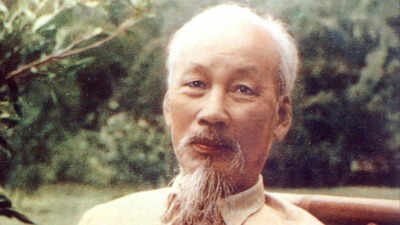
The author of these instructions is Ho Chi Minh, the revolutionary leader and president who led Vietnam through decades of anti-colonial struggle. During the 1940s and 1950s, while leading the resistance against French rule and later establishing the Democratic Republic of Vietnam, he faced a major challenge. More than 90% of Vietnam’s population cannot read or write, leaving them disconnected from advertising, education, and political slogans.Ho Chi Minh gave this writing advice to journalists, officials and speechwriters during media conferences in Hanoi, especially at the Second Congress of the Vietnamese Journalists Association in 1962.He realized that if the government continued using the complex, classical Chinese-style writing traditionally used by educated elites, the movement would fail. His audience included farmers working in rice fields, tired soldiers, grandmothers caring for families in rural villages, and children carrying messages along secret routes.
To unify these different groups, he wanted government publications to avoid complex political theories and use simple language instead.
He followed this principle himself, writing short articles in newspapers under different names Ko Quoc (National Rescue)Using everyday examples from agriculture and everyday life to explain complex topics such as economics and military strategy.
The power of clarity
The philosophy behind this approach is linked to ideas from classical communication and political thought.
He rejects the use of complex words to mask weak arguments, a practice criticized by the ancient Greek philosopher Socrates during his debates with the Sophists. Socrates believed that true knowledge should be clear and understandable enough for ordinary people to ask questions about it.Centuries later, a British writer George Orwell He developed a similar argument in his famous 1946 essay “Politics and the English Language.” Orwell explained that political confusion depends on exaggerated language that can make false ideas seem real and make empty promises sound like serious plans.When leaders and institutions simply communicate, they are exercising a form of public responsibility. Complex writing can hide errors, corruption, or poor preparation. Clear communication smooths out those cracks. It forces the writer to really understand the topic because explaining a complex idea in a way that a child can understand requires complete knowledge of the topic. It shifts the responsibility for understanding away from the reader and places it on the person creating the message.
Communicate in the big year 2026
This principle of providing access to information has become extremely important for modern organizations. In a world full of short videos, instant notifications, and endless online content, people have limited attention span. Whether in business, public health, or technology, organizations that communicate clearly are the ones that build trust.A clear example emerged during the rapid release of public safety information about regional electricity improvements over the winter.
Cities that posted technical ads filled with details about electrical systems and power distribution faced frustration from residents and a decline in cooperation. In contrast, communities that shared simple messages explaining exactly which areas would lose power, how long the power outages would last, and how to protect food supplies experienced fewer problems.The same idea is visible in global business. When technology companies create user interfaces and instruction manuals, the goal is simple, easy-to-use design, similar to the approach used by companies like Nintendo and IKEA.
Their instructions are based on pictures, clear steps, and simple words, allowing an eight-year-old or an eighty-year-old grandparent to understand how to use the products without the need for customer support.In education, the most successful teaching methods often reject memorization of complex textbook language, and instead use methods such as the Feynman technique, named after Nobel Prize-winning physicist Richard Feynman.
If you can’t explain something to a first-year college student, you probably don’t fully understand it, he said. Teachers use this idea by asking students to explain scientific topics using simple language, forcing them to go beyond memorized terminology and demonstrate real understanding.In 1947, while reviewing early drafts of the Universal Declaration of Human Rights, French philosopher Jacques Maritain observed that the document would only have real power if it could be read aloud in the village square and understood by a worker returning from the fields. The power of a message is measured not by how complex it is, but by how deeply it reaches ordinary people.