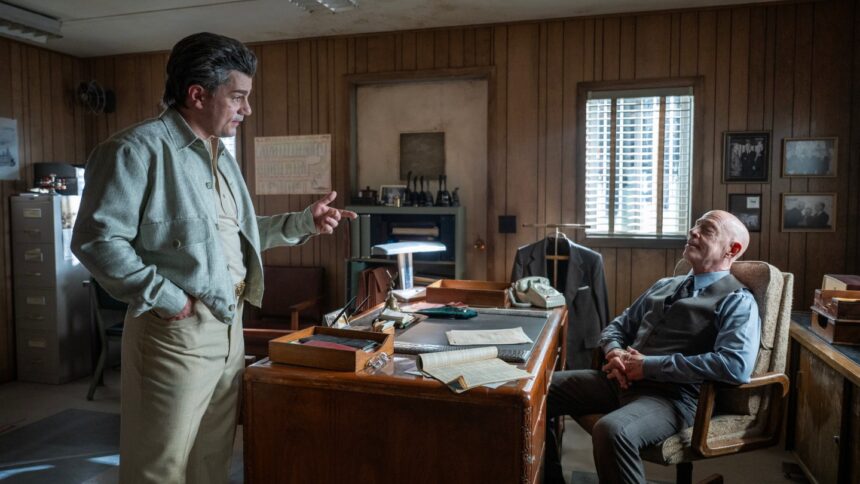
On a textual level, MGM+ West It’s all about people who refuse to abide by the rules. Inside Irish and Italian criminal organizations in 1980s New York, low-level gang members threaten rivals who have been explicitly instructed to leave them alone. The middle level trafficked drugs under the noses of the bosses who banned it. The best laid plans are derailed by reckless outbursts of anger or fear.
However, on a metatextual level, the entire season is an eight-hour exercise in coloring within the lines, without a bit of pleasing shading to provide the illusion of depth. Despite good performances from JK Simmons and Titus Welliver, the best that can be said about Chris Brancato and Michael Banes’ latest gangster drama (Godfather of Harlem) is that it’s too competent to be tolerable, even if it’s also too unimaginative to be interesting.
West
Bottom line Too sleek for me to hate it, too boring for me to like it.
Broadcast date: Sunday, July 12 (MGM+)
ejaculate: J. K. Simmons, Tom Britney, Titus Welliver, Sarah Bolger, Stanley Morgan, Hamish Alan Headley, Allen Leech, Jessica Frances Dukes, Vincent Walsh, Hilary McCormack
Creators: Chris Brancato, Michael Panis
The Alan Taylor-directed premiere opens in a moment of relative peace for Irish-American Westerns (a real group operating in mid-century Manhattan, you don’t need to know that to follow the series) and the Italian-American Gambino crime family (also real, and much more famous). After years of tit-for-tat violence, leaders Eamonn Sweeney (Simmons) and Paul Castellano (Ron Lea) call a truce, not out of good faith but out of the businessman’s understanding that both factions are poised to make big money building on Hell’s Kitchen’s Javits Center, if only they can stop standing in each other’s way.
But their followers are less thrilled by this detente, and less interested in following its rules. The brutal efforts required to keep the men in line come at the cost of sowing discontent within the ranks – including among their increasingly disillusioned disciples, Jimmy Rourke (Tom Britney) and John Gotti (Hamish Alan Headley). Meanwhile, the Feds start moving in, led by FBI agent Birdie Polk (Jessica Frances Dukes) with the reluctant help of dirty NYPD officer Glenn Keenan (Welliver).
With so much plot to get through, Brancato and Banis deserve credit for keeping the tone smooth and the pace balanced. The narrative beats move deliberately enough so that the casual viewer doesn’t get lost in the weeds, but quickly enough that the attentive viewer always has some new wrinkle to look forward to. The mood is one of brutal frankness but not self-indulgence – this is not the kind of show that pretends to have big smart things to say about the false promise of the American dream or the devastating effects of revenge, but just a show that thinks it’s okay for tough guys to point guns at each other.
All of this is set against a version of New York that feels impressively lived-in, from the grimy streets to the cramped apartments to the bars that look run-down even before the many thugs take guns and bats to them. As with the rest of the show, we don’t see anything we haven’t seen in countless other gritty period dramas, but it speaks to the care and effort of production designer Rocco Matteo. If all you’re looking for is a generic crime drama to look pretty on your flat screen while you cook dinner or answer emails, you could do worse. West.
But maybe you can do better too. West“The most glaring problem is its characters, or indeed the lack thereof: almost everyone on screen comes across as a hackneyed cliché rather than an individual with any distinct personality or inner life.
Our hero, Jimmy, always does the right thing not because there’s any intelligible reason why he seems smarter or nicer than everyone else in his orbit, but because “good” and “smart” are exactly what heroes are. (“Hero” is a relative term in a setting where everyone has at least a few murders under their belt.) He has a perfect love affair with his girlfriend, Bridget (the lovable Sarah Bolger), not because there seems to be anything specific about their relationship, but because that’s what heroes deserve.
Bridget has her own subplot involving a secret history with the IRA, which is perhaps its only element West This doesn’t sound straight out of a “how to write a gangster drama” checklist. But it’s so separate from the rest of the plot that I don’t know why I brought it up in the first place, or rather why the writers did it.
Jimmy’s best friend is Mickey (Stanley Morgan), who is almost a parody of the “reckless gangster” stereotype. His contribution is predictably unpredictable, by which I mean his ability to control himself waxes and wanes as the show needs to shake up Jimmy’s meticulous plans or inject some tension into a high-stakes negotiation. Their other friends can be forgotten, and are mainly there to fill screen space or be killed.
Their most hated enemy is John Gotti, and if he feels familiar, it’s less because Gotti, the actual historical figure, is so famous and more because WestHis version is a polished version of every Italian gangster you’ve seen in every movie. You know that scene where a powerful gangster pretends to be deeply offended by something a less powerful man said, just to make him sweat a little before bursting into raucous laughter? That’s how we got to know him, because of course he is.
A few members of the cast manage to suggest an inside tone beyond what the script dictates, and it won’t surprise you who they are. Sweeney may not be one of Simmons’ most interesting roles, but the actor brings enough sarcasm or boredom to his line readings to make the character feel alive. Welliver carries Keenan with a heaviness that hints at some deep personal pain, though the exact cause of this sadness becomes less interesting the more we learn about him.
Or maybe it’s not that his backstory isn’t sad enough as much as the fact that by the time we get the full scope of him, West It didn’t give us enough reason to invest in it – or anything else. There will be no complicated emotions to process here, no greater themes to dissect, nor even any memorable quirks or simple lines to remember. The best gangster dramas, from Coppola to Scorsese to David Chase, offer lively style, compelling characters and ambitious ideas in addition to the usual bag of body parts and revenge plots. West It settles on retracing the familiar tropes upon which it is built.