The only known way to catch them unharmed was to remove them from the dense grassy cover and place them in a line of nets. To gain an advantage, it was necessary for some of the hunters to be mounted on the elephants, while others walked alongside to herd the little trotters with loud noises.

In 1996, a team captured six dwarf pigs from Manas National Park in Assam state and took them to a newly built breeding center at Basista, on the outskirts of Guwahati.
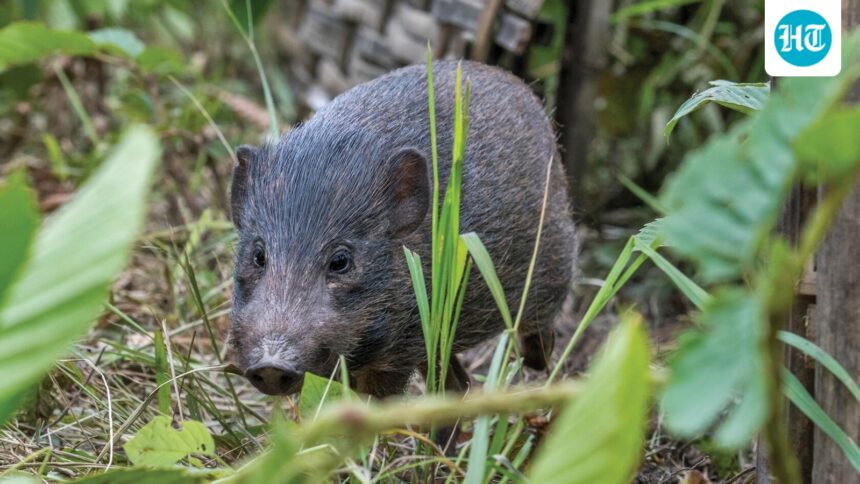
The shy, dark brown wild boar, barely larger than a house cat, was so elusive that experts assumed for two decades that the species was already extinct. Capture at the time was a roll of the dice, so that conservationists could one day release the world’s smallest pigs back into the wild.
Three decades later, this gamble has become one of India’s quietest conservation successes. Union Environment Minister Bhupinder Yadav announced this week that the pygmy warthog will be added to the list of “critically endangered” species under a centrally sponsored scheme – Integrated Development of Wildlife Habitats (CSS-IDWH) – which may help unlock funding for their protection.
Environmentalists say the species — the only representative of the genus Porculula, first described by naturalist Brian Houghton Hodgson in 1847 — would have been wiped out by its extinction of an entire evolutionary lineage of wild boar.
Brown pig to disappear
Adult pygmy pigs (Burcula salvania) They are only 60-65 cm long and about 25 cm at the shoulder. Males weigh 8-9 kg, which is 10-15 times lighter than a wild boar, and newborns weigh only about 150-200 grams.
They live in small family units of four to six individuals – one or two adult females with their young, and occasionally an adult male – which is unusual among warthogs in that they build and use grass nests all year round, not just for giving birth. Litters are usually born just before the monsoon and number three or four young after a gestation period of five months.
Known locally asBass loom orTakuri Bora In Assamese, and in the Uma Thakhri language of Bodo, the dwarf pig proved to be evolutionarily distinct, so much so that genetic studies later confirmed what Hodgson had suggested in the 19th century, that the species belonged to a genus of its own.
Read also: Sikkim: Eurasian lynx captured on camera for the first time; The second record is in the eastern Himalayas
Why does a piglet matter?
It’s not about its size.
In the wet grasslands of the Terai and the sub-Himalayan rotary belt, the pygmy warthog serves as what the Durrell Wildlife Conservation Trust calls an indicator species – one whose decline indicates a problem in the ecosystem. The same grasslands that support them are also critically important habitat for greater rhinoceros, leopards, eastern prasinga, wild water buffalo, hare and Bengal florican, noted a 2023 paper published in the journal GUINEIS by scientists Dhritiman Das, Junmani Kalita, and Parag Jyoti Deka. This makes the pig’s fate an indicator of the health of one of the richest and most endangered habitat types on the Indian subcontinent. The newspaper added that wet grasslands act as a buffer zone for seasonal floods and lead to an increase in groundwater levels on which agricultural communities depend.
Deka is the project director of India’s dwarf pig conservation programme, and Kalita and Das are also heavily involved.
Pigs play another major role. As the tubers, insects and eggs root, they inadvertently aerate the grassland soil and help disperse seeds, the environmental journal Down to Earth reported in a December 2025 article.
The imminent collapse and the long road back
The pygmy warthog once lived in a narrow belt extending from southeastern Uttarakhand and the Terai of Nepal through Bihar and northern Bengal to central Assam. But by the 1960s, there were fears that the species would become extinct.
A 1971 rediscovery near the Barnadi Wildlife Sanctuary and in Manas provided brief hope, and surveys in the late 1970s found small populations elsewhere in Assam’s reserve forests. But uncontrolled burning in the dry season, coupled with the conversion of grasslands into farmland and settlements, livestock grazing, hay harvesting, flood control schemes, hunting and ethnic conflict, have wiped out one population after another. Barnadi’s pigs disappeared in the early 1990s, and by 1993, the species could only survive in scattered pockets of Manas.
In 1995, the Pygmy Pig Conservation Program (PHCP) was established by the Durrell Trust, the IUCN/SSC Wild Boar Specialist Group, the Assam Forest Department, and the Union Environment Ministry, and was later joined by the non-profits EcoSystems-India and Aaranyak.
Under the programme, they began breeding the species in captivity in Basista and eventually reintroducing it into the wild.
A second breeding center and “pre-release” facility has been set up specifically for this purpose near Nameri National Park in Assam, where captive-born pigs spend five to six months in semi-natural pens to re-learn how to forage and survive in the wild.
Reintroductions began in the Sonai Rupai Wildlife Sanctuary in 2008, followed by the Orang National Park (2011), the Barnadi Wildlife Sanctuary (2016) and, in a symbolic repatriation, the Bhuyanpara range in Manas from 2020.
Between 2008 and 2023, 170 pigs were released into captivity across these four sites in Assam, the GUINEIS study said.
Exact numbers are unknown because the animals are very secretive, and any monitoring relies on camera traps, nest surveys and radio transmitters installed on some of the pigs released after capture.
Read also: Study identifies climate-resilient coral reefs around the world, calls for better protection
Field surveys estimated the reintroduced population of the Orange at more than 120 in the years after its release, and more than 250 by early 2026, according to Down To Earth. In Manas, there may be an estimated 100-150 pigs, and about 70 to 90 pigs are kept at all times at the breeding center in Basista.
Based on India’s conservation story, the International Union for Conservation of Nature (IUCN) upgraded the Global Red List status of the pygmy pig from ‘Critically Endangered’ to ‘Endangered’ in 2016.
What still threatens them?
While the efforts led to clear gains, the 2023 assessment gave the pygmy warthog a recovery score of just 8%, and it was classified as “critically depleted,” the GUINEIS study noted. The mark was a reminder that captive breeding has kept the species alive, but their numbers cannot flourish on a large scale until the grasslands are restored.
Another threat is African swine fever, which reached Assam in 2020 and is capable of wiping out pigs. Because of this, biosecurity in captivity centers has become an existential concern.
For species already once saved from the edge, the next chapter may depend less on saving individual pigs than on saving the grasslands that they, and dozens of other threatened species, still call home.