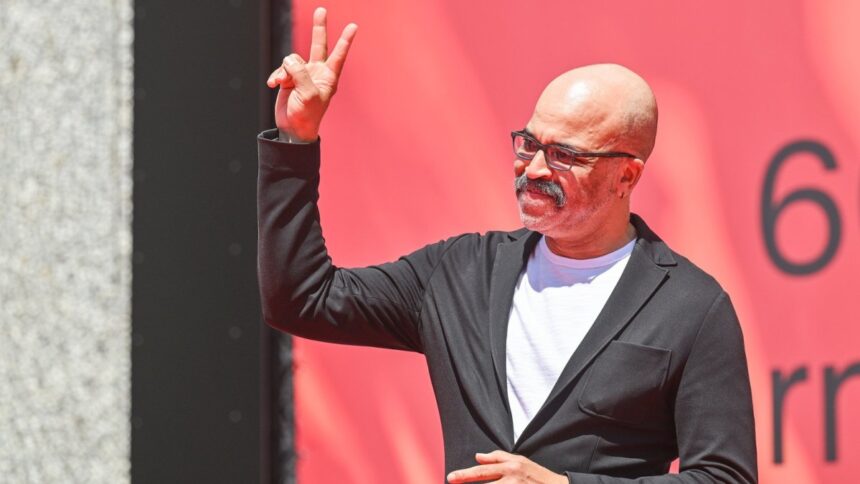
the Batman Wes Anderson’s film series and the way politics is becoming more and more like entertainment were among the topics that American actor Jeffrey Wright discussed with the press at the 60th Karlovy Vary International Film Festival on Friday.
In a roundtable conversation with members of the press, a reporter asked Wright how and when he knew he wanted to become an actor after graduating with a degree in political science, noting that the two fields seemed very different. “So you think politics and theater are two completely different things,” Wright replied. “I’m not so sure. I think our politics is becoming increasingly show business – to the detriment of everyone involved.”
He was asked why he joined Batman As Commissioner James Gordon and how this blockbuster fits in with his other work, Wright shared: “I try to keep an open mind about whatever interests me — for example, Batman, and I say in the plural because I’m in the middle of shooting the second movie right now.”
He continued: “I think so.” [director] Matt Reeves’ interpretation of the franchise is truly fresh, narratively rich, but also cinematically rich. I don’t think he views this as a trashy comic book, but he views it as an opportunity to explore contemporary themes through a really dynamic medium which is Batman privilege. He’s also a huge fan of the franchise, very passionate about it, and it’s deeply meaningful to him.
Wright also suggested: “These films, the first and the ones we’re working on now, are films from an era that he and I, because we’re of a certain age, just revere, and these are the films of American cinema of the 1970s – the Sidney Lumet films and the films that Dustin Hoffman could have been a part of,” Wright also suggested. [Francis Ford] Coppola and [Martin] Scorsese. He tries to use all of these things as touchstones in these films that, in other hands, might not have any cinematic connection to this kind of filmmaking.
He added, “I don’t want to be part of a big franchise just for the sake of being part of a big franchise. But if it resonates with me in terms of the themes and the process and the narrative, then I’m in. It could be a big franchise. It could be a standalone movie. It doesn’t matter to me!”
What about his collaboration with Wes Anderson in his films? Phoenician plan, Asteroid city and French mission? Wright was clearly eager to delve into the subject. “I love working with Wes. I love his movies. I love his aesthetic. I love the parameters he works within,” he said. “All films operate within a certain set of parameters, but his films are very specific to his mind and his vision, and I love that he works in complete disregard for anyone else’s opinions. It’s authentically himself. It’s his own kind of thing. He also has a sense of theatricality about him, a little bit surreal, which I appreciate, and the sarcasm I just get.”
Wright also praised Anderson as a “fantastic writer,” recalling how the two creators had lunch, and the writer-director then sent him his script clips for French mission After a few weeks. “From the first time I read it, it was seared into my mind – like grill marks on a steak. I thought, ‘Wow!’ I immediately heard the music, heard the intention, and loved it.” “It’s great when you find collaborators that you know you identify with. He invited me back to work with him again on a couple of films after that one, which is really gratifying. I always feel really fulfilled creatively and intellectually working with him.”
Earlier in the day, Wright celebrated the importance of “true freedom” in the United States and abroad during a brief public appearance and received a standing ovation for a screening of the film. Basquiat (1996) about the American artist Jean Michel Basquiat. The star also presented it personally at the 32nd edition of Karlovy Vary. At the Czech festival’s closing ceremony on Saturday, Wright will receive the KVIFF President’s Award.
This year’s double anniversary edition of KVIFF brought a parade of stars to the picturesque spa town, including Jesse Eisenberg (Social network, Real pain), Juliette Binoche (The English Patient, Three colors: blue, In I am in motion), Maggie Gyllenhaal (Bride!, Missing daughter), Harvey Keitel (I mean the streets, Reservoir dogs), legendary cinematographer Robert Richardson and Dustin Hoffman (The graduate, rain man).
It was Hoffman who came up repeatedly in the conversation with Wright, who said the legendary star was a major influence on his life and career. “When I saw Midnight CowboyI was like, ‘Wow, this is a crazy place, that New York.’ I want to go there. When I saw him in Babylon or Marathon manAnd I saw the way he worked, the craft that was so clear, the thoughtfulness, the theatricality that resonated through his work, and I said, “If I’m going to be an actor, this is a model of how to do it” because it made sense and was compelling to me. I’ve been influenced by many shows and many actors, but I don’t think there’s anyone whose work has influenced me more than Dustin Hoffman.