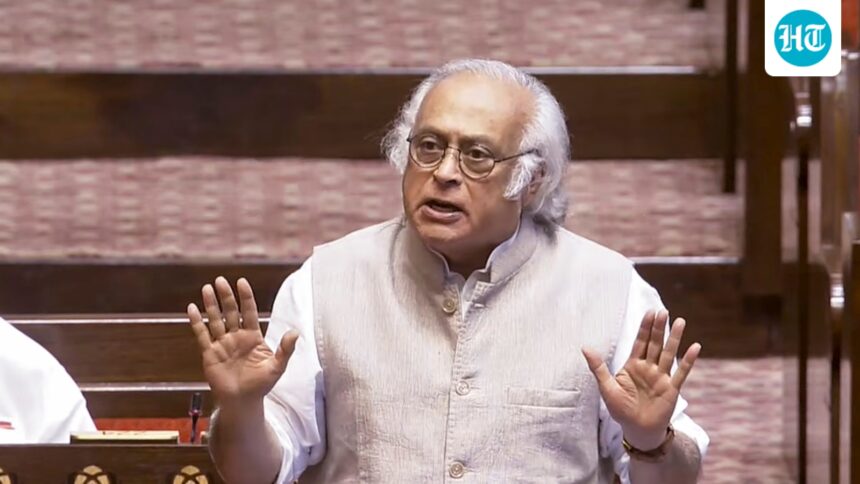
The Congress on Friday criticized the BJP for projecting Australian uranium sales to India as an achievement for Prime Minister Narendra Modi and pointed out that in December 2011, Australian Prime Minister Julia Gillard got her party’s approval to sell uranium to India in the wake of the Indo-US nuclear agreement.

The opposition party’s assertion came after BJP IT chief Amit Malviya said that in 2010, Australia had refused to sell uranium to India, but under Modi’s leadership, the two countries entered into an agreement to export uranium.
Read| India and Australia conclude major uranium deal and boost defense in the Indo-Pacific region
Rejecting the BJP’s assertions, Congress general secretary Jairam Ramesh said: “The BJP ecosystem is overworked to show that Australia’s uranium sales to India represent a Modi achievement. On December 4, 2011, Australian Prime Minister Julia Gillard got her party’s approval to sell uranium to India in the wake of the October 2008 Indo-US nuclear agreement.”
“The BJP trolls, including some of its MPs, also need to do their homework better,” he said, sharing a screenshot of media reports from December 2011 that said the Australian Labor Party had backed plans to open up uranium sales to India.
Earlier, Malviya said: “In 2010, Australia refused to sell uranium to India, citing our non-signatory status to the Nuclear Non-Proliferation Treaty. Today, under the leadership of Prime Minister Narendra Modi, India and Australia have concluded an agreement to export uranium.”
“It is not just about uranium. It reflects India’s changing global position. From looking at it through the prism of constraints to treating it as a reliable strategic partner,” Malviya said on Channel X.
Ramesh had said on Thursday that the Congress creates turning points while the BJP specializes in “tipping points”. His criticism of the ruling party came after India and Australia concluded an agreement on civil nuclear energy.
Ramesh said the India-Australia agreement was only made possible by the US-India Nuclear Cooperation Agreement that finally became law on October 8, 2008, which the BJP had “opposed all along”.
On Thursday, India and Australia concluded a set of landmark agreements spanning civil nuclear power, maritime security and critical mineral sectors, as Prime Minister Modi and his Australian counterpart Anthony Albanese reinforced the vital role of the bilateral partnership in ensuring peace in the Indo-Pacific region.
Read also| From defense and nuclear energy to trade: Prime Minister Modi concludes his visit to Australia with 18 findings | Full list
Following the Modi-Albany meeting, the two sides also unveiled an India-Australia joint declaration on defense and security, a joint statement on energy relations and a roadmap for cooperation in cyber, biotechnology and supply chains.
The civil nuclear power agreement would facilitate the commercial supply of uranium from Australia to India to assist nuclear power projects in New Delhi.