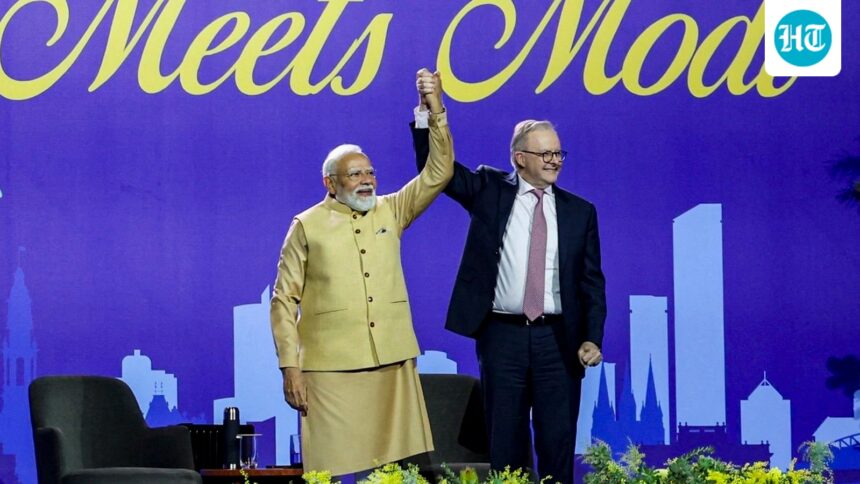
From nuclear power and uranium supplies to deeper maritime security cooperation in the Indo-Pacific region, here’s a look at the total results announced.

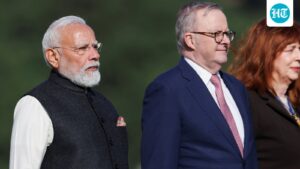
Prime Minister Narendra Modi and his Australian counterpart, Prime Minister Anthony Albanese, on Thursday announced a series of deals and memorandums of understanding to strengthen Indo-Australian relations.
As the Indian Prime Minister concluded his visit to Australia, the Ministry of External Affairs announced that 18 outcomes had been achieved during his two-day visit to the ocean nation.
From nuclear power and uranium supplies to deeper maritime security cooperation in the Indo-Pacific region, here’s a look at the total results announced.
Read also | PM Modi explains how Indo-Australian diplomacy is ‘like a game of cricket’, prompting laughter from Albanians
PM Modi’s visit to Australia: Complete list of outcomes
- Joint Declaration on Defense and Security Cooperation (JDDSC) – The JDDSC will build on force interoperability, capacity building, maritime domain, defense industrial cooperation, cybersecurity and technology, counter-terrorism, and humanitarian assistance and disaster relief. This declaration is also a renewal of the existing Joint Declaration on Security, which entered into force in 2009.
- Maritime Security Cooperation Roadmap (MSCR) – A major deal to strengthen Indo-Pacific relations, the roadmap focuses on enhancing cooperation by enhancing information sharing, capacity development, and operational coordination.
- Besides the MSCR, a memorandum of understanding was also signed between the Indian Coast Guard (ICG) and the Australian Maritime Border Command (MBC).
- The India-Australia Joint Statement on Energy Security renews and deepens the commitment of both countries towards energy security amid geopolitical tensions.
- Administrative arrangements for India-Australia civil nuclear agreement finalized – The nuclear power agreement is also among the major deals announced, as this will allow the supply of uranium from Australia to India. It also relies on the civil nuclear agreement between India and Australia signed in 2014.
- Australia-India Partnership for Cyber, Biotechnology and Supply Chains (PACTS) – PACTS focuses on the 2020 Framework Arrangement on Cyber and Cyber Technologies Cooperation and calls for cooperation to strengthen critical supply chains and cyber security.
- Australian universities set up campuses in India – During the summit, Flinders University and Victoria University will set up campuses in Bengaluru and Gurugram, respectively.
- Return of Indian artefacts – Prime Minister Modi’s visit also led to the recovery of three Indian artefacts dating back to the 11th and 12th centuries. These are – the sacred bull Nandi, the vehicle of Shiva; Trident with auspicious Kali. and the six-headed Skanda (Kartikeya).
- A Memorandum of Understanding was also signed between the Ministry of Skill Development and Entrepreneurship (MSDE) and Technical and Further Education (TAFE), Government of Western Australia, for the establishment of a Center of Excellence in Mining, Mining Equipment, Technology and Services at the National Skills Training Institute (NSTI), Bhubaneswar.
- A call for an Indian military instructor has also been extended for the period 2028-29, which will lead to the posting of an instructor at the Australian Defense College.
Read also | PM Modi, Albanian announce uranium supply, defense and other deals to deepen India-Australia ties
- Activation of Rooftop Solar Training Academy – Under this, around 2,000 women and youth will be trained as solar technicians/installers/assistants. This deal also supports the PM Surya Ghar Yojana which will be launched in 2024.
- A Letter of Intent (LoI) between the National Council for Vocational Education and Training (NCVET) and the Australian Skills Quality Authority (ASQA), which will advocate for the importance of quality assurance in technical and vocational education and training (TVET) through joint workshops and staff exchanges.
- The Memorandum of Understanding under the Australia-Canada-India Partnership in Technology and Innovation (ACITI) aims to strengthen trilateral cooperation in the field of emerging technologies and innovation.
- The Memorandum of Understanding between GeoScience Australia (GA) and the Geological Survey of India (GSI) builds on the 2015 Scientific and Technical Cooperation Memorandum of Understanding. This will allow for exploration methodologies, capacity building and skills development.
- An Access Agreement between the Traditional Knowledge Digital Library was also announced between the Council for Scientific and Industrial Research (CSIR) and Intellectual Property Australia.
- Furthermore, the MoU between CSIR and the University of Melbourne aims to pave the way for future collaboration in research programs towards identifying drug targets. The MoU will also focus on trainee and faculty exchange programmes.
- A memorandum of understanding was also signed between the Satyajit Ray Film and Television Institute (SRFTI), Kolkata, with Griffith Film School, South Brisbane, Australia, for cooperation in the field of cinema and allied fields, in addition to joint projects in this sector.

Follow the latest breaking news, key developments and agenda-setting stories from India and around the world with Hindustan Times Newsdesk. Operating around the clock, the bureau brings together experienced editors, reporters and correspondents to deliver fast, accurate and contextual reporting across topics affecting public policy, governance, business, society and international affairs. The HT Newsdesk covers politics, elections, government policy, economics, business, markets, science and technology, environment, law and order, infrastructure, education, climate issues and geopolitics, while closely tracking developments across countries, institutions and global capitals. The team also leads coverage of major breaking news events, policy announcements, court proceedings, natural disasters, public emergencies and significant international developments. Reports published by the News Desk are based on information gathered from reporters on the ground, official statements, government agencies, court records, regulatory files, recognized institutions and other official sources. Stories undergo editorial review and verification to ensure accuracy, fairness and appropriateness, and are updated as events develop and additional information becomes available. Whether covering a major policy decision in New Delhi, an economic policy shift affecting millions, a landmark court ruling or a major global event, the HT News Desk aims to provide readers with trusted, fact-based journalism that provides not only the latest developments but also the context and analysis needed to understand their wider implications.Read more