

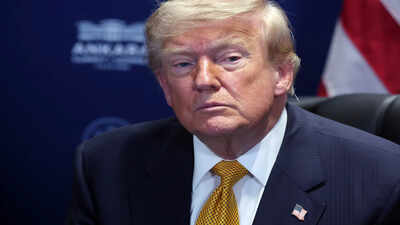
Trump calls for an end to all trade with Spain, describing it as “desperate”
US President Donald Trump ordered his Treasury secretary to cut off all trade with Spain on Wednesday, calling the NATO ally a “lost cause”, a “terrible partner”, “hopeless” and “bad people” in a joint news conference with NATO Secretary General Mark Rutte in Ankara.“I don’t want to deal with them,” Trump said. “Don’t even talk to them.” “They make a lot of money with us, and we will see them making a lot less. I don’t want any business with them.”Treasurer Scott Besent, sitting in the room, replied: “Yes, sir.”Spain responded calmly to Trump’s aggression. A government spokesman said that Madrid is dealing with these statements “calmly and naturally,” noting that the two countries have maintained an “excellent” relationship and that the United States is in fact achieving a trade surplus with Spain.
The spokesman added that “economic relations are built by private companies, not by governments.”The European Union has also responded to the threats, saying it will “always” protect member states’ interests.European Union trade spokesman Olof Gehl said, “We expect the United States to respect its commitments under this joint statement as we have respected our commitments,” referring to a trade agreement signed last year between Brussels and Washington.
Why Spain and why now?
Trump’s outburst was based on three main grievances.
Defense spending: Spain is the only NATO member that did not commit last year to spending 5 percent of gross domestic product on defense by 2035, a goal that Trump has been pushing through the alliance. Spain will spend 2.1 percent of GDP on defense in 2025, up from 1.4 percent in 2021, but far less than Washington wants. Rutte tried to negotiate with Trump about this matter, saying: “You made Spain pay 2%. They took a big step last year.” But Trump remained unchanged.Iran war: Spain has refused to allow the US military to use its bases or airspace for US bombing campaigns against Iran, a decision that Prime Minister Pedro Sánchez made explicitly and publicly. Spain denied the use of the Ruta and Morón bases to Washington. A US official told Reuters in April that an internal Pentagon email detailed potential retaliatory measures against NATO allies who did not support the campaign against Iran.
Spain was near the top of that list.Prime Minister Pedro Sanchez: In contrast to most European leaders who have tried to soften their stances toward Trump, Sanchez has seen criticism of the US president play well at the domestic level, and has continued to do so on numerous occasions. Spain has also been one of the EU’s harshest critics of Israel, with Sanchez repeatedly accusing Israel of committing “genocide” in Gaza.
What is the future threat?
This is not the first time Trump has made this threat. In March, he said he ordered Becente to “cut off all trade with Spain” after Sanchez’s decision on Iranian bases.
This did not result in an actual trade interruption. Wednesday’s statements may follow the same pattern, i.e. a public announcement with significant diplomatic and market impact, and significant legal and practical hurdles to implementation.Spain is a member of the European Union, which has unified authority over the foreign trade of all 27 member states. Trade policy with the US is a matter for Brussels, not Madrid, meaning Trump cannot technically impose an embargo on Spain without imposing a ban on the EU as well.Trump suggested that US presidents have the authority to impose a complete ban on goods coming from any country. Legal and trade experts have questioned how far this power can extend against an EU member state without provoking a wider trans-Atlantic confrontation.Spain is not the only target. At the same Ankara summit, Trump threatened to withdraw all American soldiers from Europe if NATO members did not increase defense spending, and maintained his claim that Greenland, part of the Kingdom of Denmark, should be under US control.Trump has consistently used trade threats as a diplomatic tactic against allies who do not commit to military spending or foreign policy. It has varied whether the lever produces compliance or merely friction. In the case of Spain, Sánchez’s domestic popularity has risen in proportion to his willingness to respond.