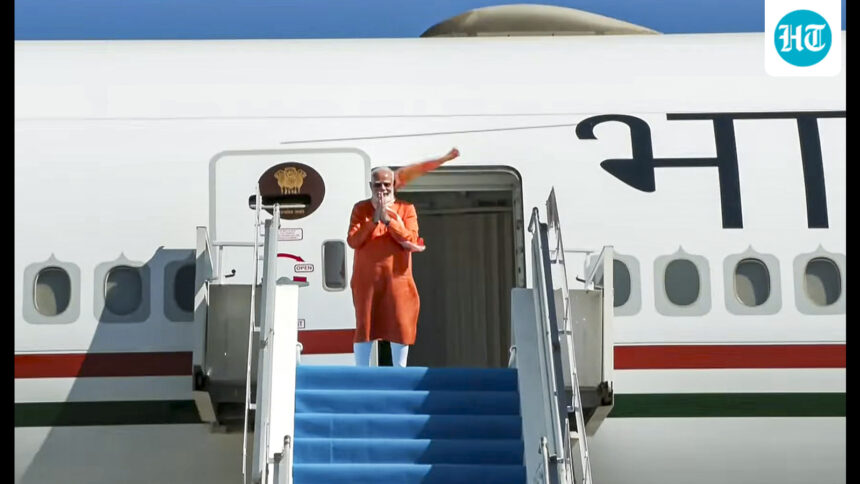
Prime Minister Modi’s visit to Australia from July 9-10 and to New Zealand from July 10-11 comes at a time when the Indo-Pacific region has become the epicenter of global politics and economics. Supply chains are being redrawn, technological competition is intensifying, energy systems are being fundamentally transformed, and maritime security has gained unprecedented importance. India today is looking for reliable partners who can contribute to its economic transformation, technological progress and national security without compromising its strategic independence. Australia and New Zealand fit naturally into this vision. Both are stable democracies, important maritime states, and increasingly influential participants in shaping the future of the Indo-Pacific region.

Over the past decade, Australia has emerged as one of India’s closest strategic partners. The relationship has gained depth through the Quad, expanding defense cooperation, growing convergence on regional security issues and a shared desire to maintain an open and rules-based maritime order. Greater cooperation in maritime domain awareness, maritime interoperability and coordinated patrols would enhance security across the Indian Ocean and adjacent waters. Collaboration between the defense and aerospace industries could also contribute to India’s goal of developing a stronger domestic manufacturing base while reducing dependence on external suppliers.
No less important is the increasing economic integration between the two countries. Australia has abundant reserves of important minerals that have become indispensable for electric mobility, semiconductor manufacturing, battery storage and renewable energy. For India, ensuring access to these resources is key to achieving its ambitions for advanced manufacturing and the transition to clean energy. Cooperation on uranium supplies for India’s civil nuclear programme, hydrogen and renewable energy technologies will further diversify an already widening partnership. The two sides are expected to update the 2009 Joint Declaration on Defense and Security Cooperation, agree on an implementable roadmap for maritime security cooperation, and sign several sector-specific memorandums of understanding on clean energy, technology transfer, education, mobility and skills, as well as economic cooperation.
Read also:Missiles and minerals represent a new phase in Indo-Indonesian relations; BrahMos and Astra deals sealed
The volume of bilateral trade exceeded 25 billion US dollars annually, supported by the economic and trade cooperation agreement between India and Australia, and investments from both sides reached 48 billion US dollars. Australian investments continue to create opportunities in infrastructure, mining, education, financial services and clean energy. The next logical step is to reach comprehensive trade arrangements that create greater certainty for companies on both sides, remove more trade barriers, and encourage greater investment flows.
If Australia represents the strategic pillar of India’s engagement in the Pacific region, New Zealand offers the opportunity to build a modern economic partnership. Modi’s visit – the first by an Indian prime minister in decades – recognizes that the relationship has fallen far short of its potential despite strong political goodwill. The recently concluded India-New Zealand Free Trade Agreement provides the framework necessary to change this reality. Bilateral trade, currently at about US$2.4 billion, is modest for two complementary economies. India offers one of the world’s fastest growing consumer markets, while New Zealand has strengths in agriculture, food processing, forestry, education, biotechnology and innovation. As part of the bilateral FTA, New Zealand pledged to facilitate and encourage investments worth US$20 billion in India over 15 years.
Therefore, the agreements expected during the visit in the areas of agriculture, forestry, education, research and innovation are important because they look beyond traditional trade. India’s agricultural modernization, food security goals, and climate adaptation efforts could benefit from New Zealand’s experience, while close academic and research partnerships could create long-term institutional links between the two countries.
21st century partnerships are increasingly defined by cooperation on artificial intelligence, quantum technologies, digital infrastructure, resilient supply chains, advanced manufacturing, and the transition to low-carbon economies. No less important are the human bridges that strengthened these relationships. Nearly one million people of Indian origin now live in Australia, while New Zealand’s Indian community, now numbering 292,000, continues to grow in size and influence. Their contributions to business, education, healthcare, technology and public life have turned them into important strategic assets. Modi’s interactions with the diaspora will strengthen these ties. 140,000 Indian students attend Australian universities, while 22,000 Indian students study in New Zealand. 450,000 Indian tourists experienced Australia’s diversity while 90,000 tourists enjoyed New Zealand’s stunning scenery last year. However, tourism, education and mobility remain underutilized areas capable of generating economic gains along with stronger community ties.
There is no doubt that the warm relationship between Modi and Australian Prime Minister Anthony Albanese has accelerated the pace of bilateral engagement. His meeting with New Zealand Prime Minister Christopher Luxon offers the opportunity to inject similar political momentum into a relationship that is entering a new phase. India’s engagement with Australia and New Zealand is about building economic resilience, technological capabilities and strategic partnerships that will strengthen India’s role as a leading nation in the Indo-Pacific region in the coming decades.
Anil Wadhwa is a former Secretary, East, Ministry of External Affairs, and Indian Ambassador to Italy, Thailand, Oman and Poland. He is the author of the CII’s Australian Economic Strategy Report.