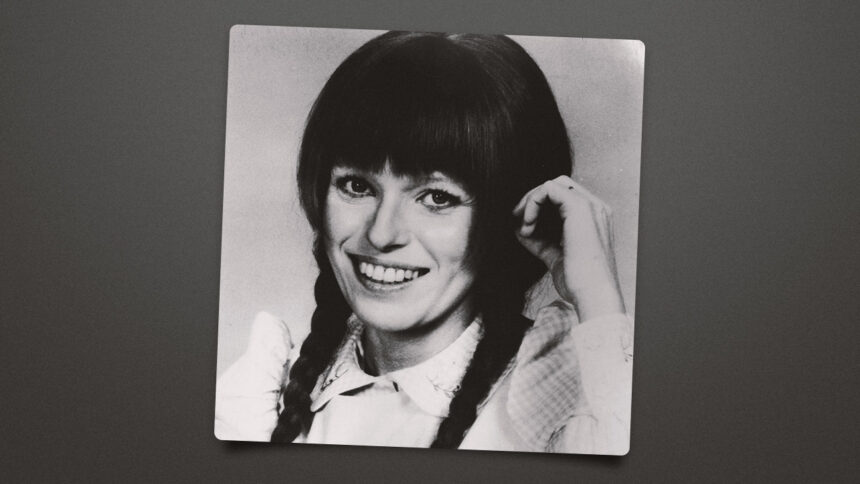
Louise Laserthe demure, soft-spoken comedic actress best known as Woody Allen’s leading lady and as the title character in the satirical television series. Mary Hartman, Mary HartmanHe died. She was 87 years old.
Laser She died Monday of natural causes at her home in Manhattan on the Upper East Side, her friend Susan Charlotte said Hollywood Reporter.
With her reserved demeanor, calm voice, and toothy smile, Laserwho was married to Allen from 1966 to 1970, proved a perfect counterbalance to his neurotic film persona.
She was with him at the beginning of his film career in the quirky 1966 classic What’s up Tiger Lily?, When Allen took on a Japanese spy mystery film, he threw out the soundtrack and scored everything new a dialogue This is a nonsensical story about the search for the best egg salad recipe in the world. Laser She provided the voice of the heroine Suki Yaki.
Laser She then played her husband’s love interest Take the money and run (1969) and Banana (1971). It was their last film together Everything you wanted to know about sex* but were afraid to ask (1972) – Allen’s best-selling comic strip The sixties How to guide.
But what reinforced it Lazer Her stardom was her leading role in the groundbreaking 1976-1977 series Mary Hartman, Mary Hartman. Produced and developed by Norman Lear and created by Jerry AdelmanDaniel Gregory Brown, Anne Markus and Jill Barnett, the show was a low-key but cutting parody of soap operas that distorted American consumerism. The joke began with its title, to poke fun at the idea that everything in daytime dramas is repeated twice.
The comedy was released in syndication, and was shown five nights a week – unheard of at the time. Overall, the industry didn’t know what to make of the program. when Laser It was nominated for an Emmy Award in 1976, and its category was “Special Classification for Outstanding Program and Individual Achievement.”
What everyone knew was that he was funny. With a fun and simple style, Mary Hartman, Mary Hartman It crossed boundaries, addressing topics such as adultery, homosexuality, venereal disease, eroticism, serial murder, religious cults, and UFOs. And in the middle of it all, he was Laser Like Mary. With her feminine braids, white Peter Pan collar blouse and blue dress, she embodied an innocent, sarcastic version of an American housewife.
Consumed by such mundane matters as Swanson’s TV dinner and the waxy yellow buildup on her floor in FernwoodOhio, quoted Mary credulity Follower The seventies A suburban woman, a victim of the ideals of commercial culture. Laser He infused the character with a noble dignity and a quiet sense of desperation that continued to slowly build throughout the series’ 325 episodes, highlighted by Mary’s collapse at the end of the first season. David Susskind displays.
“I always thought it was a really good show because it touched on so many aspects of everything.” Laser He said in a 2013 interview with interview magazine. “It’s kind of up and down and in and out, and before you know it, there you are. And then it piques your interest in rich subjects, you know what I mean? People always say it was ahead of its time. I never thought it was ahead of its time. I always thought it was.” to “His time.”
Decades later, she took a recurring role as a suicidal artist on HBO girls.
Louise Jane Laser He was born on April 11, 1939 in New York. Her father S. Jay Laserwas a famous tax expert who wrote the book Income tax guide for everyone. Nevertheless Laser She studied political science at Brandeis University in Waltham, Massachusetts, and couldn’t resist the lure of theatre, joining the school’s musical productions alongside the likes of Margo Howard and Stuart Damon.
After three years of university study, Laser She took what she described as “psychological leave” and returned to New York. At the age of 21, she began studying acting with Sanford Meissner and performing in Greenwich Village cafes and bars. Around that time, I met Allen.
“When we met, I was meeting a friend of his. It was one of those things, ‘Well, if you think you’re complicated, you should meet so-and-so.’ And it was Woody.” Laser It was mentioned in a 2013 interview on Toast Website. “Immediately, immediately, we were supposed to be in the same kindergarten. We just connected. He was with someone… Oh, he was married[to] [toHarleen Rosen]that’s right. I was with his friend. We went out like once or twice. And I don’t know who I am or where I am, I don’t know. So, I met up with him, and it was very clear throughout the night that there were four of us there, and none of us talked to anyone else.
Laser She gained attention in 1962 when she was chosen to replace Barbara Streisand On Broadway in the musical comedy I can get it for you wholesale (She was her replacement.) In the same year, she appeared on the TV show the Laughterwritten by Allen. She appeared in a 1964 episode of doctors He made an uncredited appearance in the 1965 film written by Allen What is new kitten? When Allen’s career took off in 1966, so did he Lazer.
In 1976, she told Louis Armstrong about the people magazine that she and Allen remain friends over the phone and that she considers him her “key relationship” and “big major influence” during her life. She also said the name on her driver’s license read Louise Jane Allen. Laser He never married again.
Before being cast as Hartmann, Laser Stay busy through The seventies With unforgettable television stints The Mary Tyler Moore Show, Bob Newhart displays, love story, McCloud and Medical Center. She was also seen in 1973 in this movie slid And in TV movies Coffee, tea or me? and Isn’t this shocking?
In the spring of 1976, Laser She was arrested after an incident at a Beverly Hills store led to the discovery of cocaine in her bag. The actress said the people It was a small sum given to her by a fan months ago. “I’m not a Coke user, and I didn’t use that stuff,” she said. “But you can’t plead your innocence if you’ve earned it.”
Shortly after the arrest, she hosted the final episode of the first season of the series Saturday Night Live. Her behavior was extremely erratic, reportedly driven by a substance abuse problem, and she became the first artist to be banned from hosting again by producer Lorne Michaels.
But instead of letting her anxiety get the better of her, Laser She turned her into her TV character. the com. plotline It was her idea for Marie Hartmann to have a mental breakdown. The operation proved to be curative.
As Armstrong wrote in the people. As for Louise? “It felt amazing.” Laser I confess. I had a nervous breakdown while playing, with no consequences. She laughs hard, then adds, “For a while there, I wasn’t sure.” One of Lazer “She completely broke down after that scene, because she had to finish it herself,” the friends explain. ”
after Mary Hartman Her career ended in 1977. Laser He kept busy with recurring roles taxi and It’s a living. She wrote and starred in the 1978 TV movie Just you and me. She appeared in an uncredited cameo in Allen’s 1980 film Stardust Memories.
Other distinctive appearances included Simon (1980), In God we are Consider$t (1980), Crime wave (1985), Blood rage (1987), Give up (1989), Raw awakening (1989), He sings (1989), Frankenhooker (1990), Modern love (1990), The night we didn’t get Never fear it (1993), happiness (1998) and Men of mystery (1999).
Recently, she was seen in… Requiem for a Dream (2000), Queenie He loves (2001), Wolves of Wall Street (2002), National Lampoon Gold Diggers (2003) and It drives me crazy (2012).
Laser is survived by his partner, Michael Citrinetti;