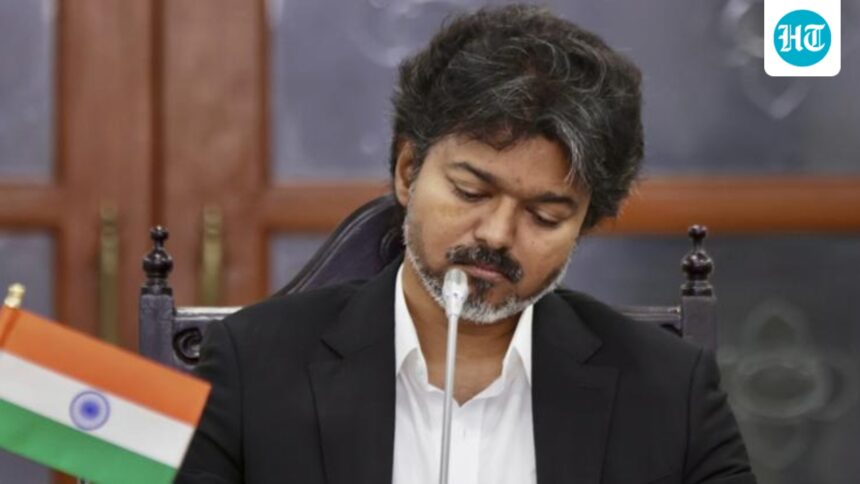
The Supreme Court on Tuesday rejected the Dravida Munnetra Kazhagam (DMK)’s attempt to seek judicial restraint on Tamil Nadu Chief Minister C Joseph Vijay and other Tamil Vetri Kazhagam (TVK) leaders from making public statements on the Karur stampede. She noted that the court cannot be turned into a “political forum” to settle political battles.

A bench of Justices KV Viswanathan and Alok Arad refused to entertain the application, repeatedly emphasizing that it would neither curtail freedom of expression nor issue directions inconsistent with its earlier orders directing a court-monitored Central Bureau of Investigation (CBI) probe into the tragedy.
In the face of strong observations from the bench, senior advocate Ranjit Kumar, representing DMK Rajya Sabha member RS Bharathi, withdrew the application, with freedom to pursue any further remedy. “Mr. Ranjit Kumar seeks to withdraw this application to pursue any other remedy that may be available to the applicant. The Bench ordered that the application be dismissed as withdrawn in accordance with the above conditions.”
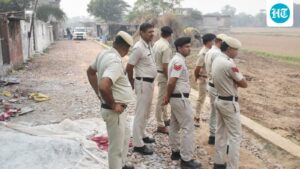
The Karur stampede occurred on September 27 last year during a TVK rally attended by Vijay. The tragedy claimed the lives of 41 people and left more than 100 injured.
Bharati made the request ahead of a meeting proposed by Vijay on July 10 with the families of the victims. The state government is expected to distribute compassionate appointment letters and announce other relief measures.
The application has taken issue with public statements allegedly made by state minister Aadhav Arjuna, one of the accused in the case, in which he alleged that the previous DMK government was responsible for the deaths and that “the score was to be settled”.
Referring to the Supreme Court’s earlier order transferring the investigation to the CBI, Kumar stated that the accused were building a public narrative while the investigation remained pending. “There is a narrative being built by the accused…they are making statements in the press,” Kumar told the bench.
The bench questioned the merits of the petition. When Kumar said the statements could influence witnesses, the court asked whether the petitioner wanted the Supreme Court to regulate the Prime Minister’s visit to the families of the victims and his public messages. “Do you want the Prime Minister’s visit and messages to be regulated by the Supreme Court?” He asked.
While Kumar tried to clarify that he was not seeking to curb freedom of expression, Justice Viswanathan responded that the appropriate response to political speech was more expression, not judicial censorship. Justice Viswanathan commented, “How does the Supreme Court get the support of a political rival? … 41 people have died… What is the sequence? Just stop and think.”
The bench observed that if any statement amounts to contempt of court, the petitioner is free to initiate appropriate proceedings separately. “You said you would file for contempt. If the speech contained contempt, you said you would file that,” the court noted.
The bench rejected the request for an injunction, saying: “Do you want to issue an injunction on freedom of expression? You are making your own speech. How can the Supreme Court, in a matter that the CBI has been appointed to investigate, issue its orders one after another on the statements of a political rival?”
The bench was not persuaded by the argument that the proposed distribution of compassionate appointment letters could influence the investigation. “Compassionate appointment orders have been handed out. How will that reflect on the investigation?”
Kumar sought to rely on the minister’s letter and said that Vijay was playing a “dual role” while being politically linked to the incident.
Justice Viswanathan pointed out that Vijay was not an accused. “The Prime Minister is not an accused in the FIR registered…”
The court noted that although some ministers were charged in this criminal case, this does not justify dragging the Supreme Court into a political conflict. “The accused are some ministers. Not the prime minister.”
Kumar then requested that the court at least allow this case to be referred to the three-member supervisory committee monitoring the CBI investigation. The court refused to consider the request, warning that its implications may not have been fully considered.
“…It is better not to press it here. This has implications that may not even have been thought of at your end…and we are inclined to reject it,” Justice Viswanathan said. Following these observations, Kumar agreed to withdraw the petition while remaining free to pursue other remedies, including submitting the case to the supervisory committee.
The application was made after TVK formed the government in Tamil Nadu this year. The DMK alleged that an “exceptional situation” had arisen as several people accused in the Karur stampede case had become ministers, creating a risk of influencing witnesses during the court-monitored CBI investigation.
The petition said that although the party did not oppose compensation or compassionate appointments to the families of the victims, such measures should be taken only with the safeguards ordered by the Supreme Court and after consultation with the CBI to maintain the integrity of the investigation.
It cited Arjuna’s July 2 speech, in which he allegedly accused the previous DMK government of causing the deaths and declared that the “account” would be settled, saying such public statements could damage the ongoing investigation.
Last year, while transferring the investigation to the CBI, the Supreme Court had observed that the incident appeared, prima facie, to have resulted from failures on the part of the Tamil Nadu Police in crowd management and in granting permission for the march. The court noted that the political connotations surrounding the incident had eroded confidence in the state investigation, necessitating an independent investigation monitored by a three-member committee headed by former Supreme Court judge Ajay Rastogi.