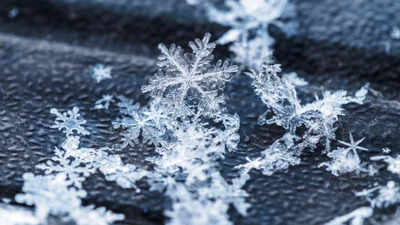
No snowflake lands in the same position twice:
When snow starts falling, it rarely feels like a pattern. It is as if interruption, softness and silence arrive in countless forms at once. And in that quiet chaos lies a familiar wintry theme often repeated in folk tales and popular meditations: No snowflake lands the same way twice. It is not an officially recorded scientific law or an ancient proverb that can be traced to a single author.
Instead, it belongs to a broader family of modern popular proverbs that borrow from nature to express something deeply human: repetition is an illusion, and each moment bears its own form.
Origins and development of a people
phrase No two snowflakes are alike It has been widely documented in science communication that the exact phrase “a snowflake never lands on itself twice” has been widely documented. The latter seems to be a poetic extension of that idea, often circulating in contemporary winter storytelling, speculative writing, and informal cultural commentary rather than a single canonical text.The scientific basis behind this feeling is often traced to the work of American photographer and amateur meteorologist Wilson A. Bentley, also known as the “Bentley Snowflake”. In the late 19th and early 20th centuries, Bentley developed a technique for photographing ice crystals under a microscope. His work was later archived and referenced by institutions such as the Smithsonian, and produced thousands of images showing highly complex and diverse ice structures.
He famously concluded that no snowflakes he observed were exactly alike.This observation was later reinforced in popular science writings and by meteorological organizations such as the National Oceanic and Atmospheric Administration (NOAA), which explain that while snowflakes can share broad structural similarities, the precise combination of temperature, humidity, and atmospheric conditions makes exact duplications extremely unlikely.From this scientific foundation, the popular style phrase evolved into something more philosophical: Not only are snowflakes unique, but even their “arrival” can never be replicated in exactly the same way.
The science behind the uniqueness of the snowflake
Snowflakes form when water vapor in clouds freezes into ice crystals around small particles such as dust or pollen. When a crystal falls through the atmosphere, it passes through layers of air with slightly different temperatures and humidity levels.
Each transformation changes how the crystal grows.At the molecular level, ice crystals arrange themselves in a hexagonal lattice. But the patterns of branching that emerge depend on very small differences in environmental conditions. A fraction of a degree in temperature or a slight change in humidity can change the shape of the developing crystal.This is where the idea of perfect redundancy breaks down. Even if snowflakes start forming under nearly identical conditions, their paths through the cloud are not identical.
They move differently, collide with different molecules, and are subject to subtle fluctuations that affect their growth.Scientists generally agree that while identical patterns may theoretically occur in simplified or artificially controlled environments, in natural atmospheric conditions the likelihood of snowflakes forming the same complex structure is very low. That’s why organizations like the National Oceanic and Atmospheric Administration (NOAA) describe snowflakes as inherently unique, even if absolute uniqueness at the molecular level is a precise scientific claim rather than a strict absolute.
What this saying really means
Beyond meteorology, the phrase has a broader interpretive meaning. It is often used as a euphemism for impermanence and individualism. The basic idea is simple: repetition does not equal similarity.In everyday life, routines may seem repetitive. Moves, conversations, and seasonal cycles can overlap with each other. But even in repetition, circumstances change. The conversation is shaped by the mood. The decision is shaped by context.
The moment is shaped by everything that preceded it.The snowflake metaphor captures this subtle transformation. This suggests that even when life appears cyclical, it is in fact constantly rearranging itself.Philosophically, this is consistent with ideas found in practical philosophy and some branches of Eastern thought, where reality is understood not as fixed things that repeat, but as continuous change. The snowflake becomes a small, visible example of that idea: organized, but never static.
Why winter culture resonates
In countries with long winters, especially Canada, snow is not just about the weather. It is the environment, the routine, and the memory. It shapes how cities function, how people travel, and how seasons are experienced emotionally.In this context, the snowflake becomes a natural symbol. It is visual, familiar and endlessly diverse. Winter cultures often use images of snow in storytelling precisely because they are both universal and detailed at the same time.
No two storms look alike, even when they follow similar patterns.phrase No snowflake lands the same way twice It fits into this cultural space because it reflects lived experience. Anyone who has walked through falling snow knows that conditions are constantly changing. The wind changes direction. Light alters perception. Accumulation changes the texture. The idea becomes less a poetic abstraction and more an observational reality about how winter is experienced moment to moment.
Modern usage and interpretation
In contemporary usage, the phrase has moved beyond meteorology and winter imagery into a broader cultural language. It appears in reflective writing, motivational contexts, and discussions about individualism.In modern psychology and education, similar ideas are used to emphasize that people are shaped by unique sets of experience. However, unlike some simplistic motivational explanations, the snowflake metaphor retains its basis in naturalistic observation.
Its strength does not lie in exaggeration, but in self-control: it does not claim perfection or destiny, only difference.At the same time, scholars and educators often caution against overextending the metaphor. While snowflakes are indeed very variable, the leap from physical uniqueness to human exceptionalism can become misleading if taken too literally. The value of the phrase is not as scientific evidence of uniqueness, but rather as a reminder of the diversity in complex systems.
A quiet lesson in impermanence
What makes a statement last is not just its image, but its accuracy as a remark about change. Snow does not fall as a uniform event. They arrive in the form of countless small events shaped by changing weather conditions.From there, the phrase becomes less about the snow itself and more about the snow itself. It calls for a slower way of observing the world. Even familiar patterns, when examined closely, reveal differences.This is why the idea still appears in writing and speech today. It offers a simple way of expressing something that is difficult to capture in everyday language: repetition is never perfect, and similarity is often an assumption rather than a fact.
conclusion
No snowflake lands the same way twice It is not a fixed historical ideal with a single point of origin. It is a modern popular expression based on real scientific observation and extended to cultural meaning.
From Wilson Bentley’s early photographic studies of ice crystals to modern meteorological interpretations by organizations like the National Oceanic and Atmospheric Administration (NOAA), basic science supports the idea of extreme variability in snowflake composition.But its enduring appeal is not scientific alone. It stays because it translates this contrast into something intuitive. In every snowfall, there is structure without repetition, pattern without replica. And in that quiet winter lies the truth behind this phrase’s continued prevalence: it captures, in simple terms, the complexity of change itself.