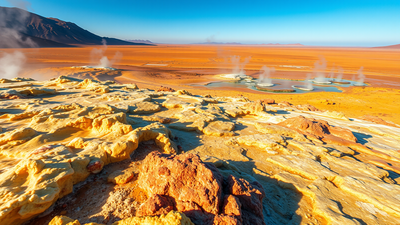
There are few places on the planet that look less like Earth than the Danakil Depression, a scorching, submerged expanse of northeastern Ethiopia, where the Earth glows with acid, glows in shades of yellow and green, and lies low enough to hold some of the hottest average temperatures ever recorded anywhere on the planet’s surface.
Streaks of sulfur, iron oxide and copper salt paint the landscape in colors that look more like an alien movie set than anything found in nature, while nearby volcanoes spew lava into glowing lakes and hydrothermal springs release gases at temperatures well above boiling point. This is not an accident of geology alone; The Danakil Depression is located in one of the most geologically active regions on Earth, a place where the planet’s crust is actively tearing itself apart, and scientists have increasingly turned to it as one of the closest natural analogues to the surface of Mars.
Where three Tectonic plates They pull the earth away
The Danakil Depression forms part of the broader Afar Triangle, an area where the African, Arabian, and Somali tectonic plates meet and slowly drift away from each other. This ongoing rifting process causes the Earth’s crust beneath the region to gradually expand and thin, and geologists consider the region a rare and active window into how new oceans are born. Scientists believe that the Red Sea will eventually overflow into this widening rift and create an entirely new body of water millions of years from now.
Constant tectonic movement also maintains intense volcanic activity in the area, and it is home to several active volcanoes, including Erta Ali, famous for hosting one of the very few permanent lava lakes anywhere on Earth.
The chemistry behind strange colors
At the heart of the depression lies Dallol, a hydrothermal field widely regarded as one of the most extreme environments on the planet, located more than a hundred meters below sea level. According to a study published in Scientific Reports, hot springs in the area reach temperatures between 90 and 109 degrees Celsius while registering a pH near zero, making them almost as acidic as battery acid, and some pools within the depression have been measured at a more extreme pH of negative 1.5.
The bright colors that give Dallol its otherworldly appearance come directly from this chemistry: various dissolved minerals crystallize from the hot salt water, iron oxides create rusty red spots, sulfur deposits produce bright yellow scales, and traces of copper salts dye the swimming pools a stunning green.
Why life can still survive here
Despite conditions that would kill almost any familiar organism within minutes, researchers have found real evidence of microbial life within Dallol’s extremely hot, highly acidic pools.
The same study identified very small nano-sized archaea, likely belonging to a group called Nanohaloarchaea, trapped and preserved within mineral deposits that form around hydrothermal vents.
These organisms are examples of what scientists call polyextremophiles, life forms that are able to withstand not just one extreme but several at once, in this case extreme heat, extreme acidity and extremely high salt concentrations simultaneously.
Researchers involved in the work note that finding life that survives such a demanding mix of pressures holds real significance for understanding how far the limits of habitability can extend, both here on Earth and perhaps on other worlds.
Why do scientists keep comparing it to Mars?
This connection to the search for extraterrestrial life is precisely why the Danakil Depression has attracted frequent visits from astrobiologists over the past decade. According to NASA’s Astrobiology Program, researchers view the depression as a terrestrial situation that is unusually close to the kind of hostile, mineral-rich, acidic conditions that may have existed early in the life of Mars, making it an ideal natural laboratory for testing how scientists might one day detect signs of past or present life on the red planet.
By studying how organisms manage to survive, or in some cases fail to survive, Dallol’s harsher baths are helping researchers refine the kind of biological signatures future Mars missions should look for, since not every corner of this extreme landscape turns out to be equally hospitable to even the toughest known microbes.
The landscape is still being actively written
Unlike most dramatic landscapes, which tend to form gradually over enormous geological timescales and then remain largely static, the Danakil Depression is still actively changing today.
New salt ridges and hydrothermal springs appear on what can truly be a daily basis as fluids continue to rise from the bottom of the volcano, while previous geological events, including a major earthquake in 2005, have been directly linked to the reactivation of dormant springs and the creation of entirely new features like the hypersaline Gaitali Pool.
This combination of rare active geology, truly extreme chemistry, and its usefulness as a scientific indicator of another planet has earned the Danakil Depression a place among the very few sites recognized internationally for its outstanding geological heritage value, a strange and hostile corner of Ethiopia that continues to rewrite its landscape in real time.