

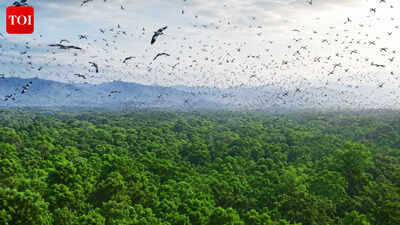
During the mid-20th century, large swaths of Israel were transformed through one of the country’s most ambitious reforestation programmes. Millions of pine trees have been planted to stabilize soil, control erosion, and create forests in previously open natural areas.
At first, the initiative looked like an environmental success, with barren hillsides transformed into lush forests. However, decades later, ecologists discovered that the trees themselves were only part of the story. The naturally regenerating dense Mediterranean shrubs under the pine canopy have proven most influential in determining the bird species that have settled in these forests. Their findings revealed that it was not just the presence of trees, but the structure and diversity of understory plants, that shaped entire bird communities.
The research has transformed how scientists understand forest restoration and biodiversity conservation in Mediterranean ecosystems.
Israel has planted millions of pine trees, but scientists say the real story is unfolding beneath them
After the establishment of the State of Israel in 1948, large-scale afforestation became a national priority. Led primarily by the JNF, millions of fast-growing pines, especially Aleppo pine (Pinus halepensis), were planted across degraded hillsides and semi-arid landscapes.
The program aims to reduce soil erosion, restore vegetation, improve water retention, and create new forests in areas that have witnessed centuries of grazing, firewood gathering, and land degradation. Pines were favored because they could settle relatively quickly in the Mediterranean climate and survive in nutrient-poor soil.However, over time, many of these forests began to develop a naturally regenerating understory of native Mediterranean shrubs, including species such as mastic (Pistacia lentiscus), buckthorn (Rhamnus lycioides), and oak (Quercus calliprinos).
These shrubs gradually increased the structural complexity of the forests, creating new habitats for wildlife.
How did Mediterranean shrubs determine which birds moved into the forests?
Research by ecologists from the Center for Research in Environmental Applications and Forestry (CREAF) found in ‘Which bird species respond most to forest structural diversity?’ Implications for biodiversity indicators in Mediterranean forests suggest that the composition and density of the shrub layer under the pine canopy had a greater impact on bird communities than the pine trees themselves. While the increased space provided shade and nesting opportunities for some species, the shrubs provided food, shelter and protection from predators, creating suitable habitat for a wide range of birds.Studies have shown that forests with a rich and diverse understory support much higher bird diversity than pine plantations with sparse ground vegetation. Insectivorous birds took advantage of the abundance of insects living among the native shrubs, while fruitful Mediterranean plants provided food for many resident and migratory species.The researchers found that shrub-rich pine plantations support many shrub-associated forests and birds, including some species such as:
| Scientific name | Common name | Why do they benefit from the pine canopy? |
| Dendrocopus major | Great Spotted Woodpecker | It feeds on insects found in tree trunks and nests in hollows dug in mature trees. |
| Driocobus Martius | Black woodpecker | The largest woodpecker in Europe, it depends on large trees for nesting and searching for food. |
| Phylloscopus collybita | Chiffchaff co | It feeds among leaves and tree branches, especially during the breeding season. |
| Regulus Regulus | Goldcrest | It is closely associated with coniferous forests, and feeds on small insects among the pine needles. |
| SITA Europe | Eurasian Nuthatch | It climbs tree trunks in search of insects and builds nests in tree cavities. |
| Sylvia Boren | Garden warbler | It uses forests with dense vegetation for breeding and searching for food. |
| Turdus philomelus | Thrush song | It takes advantage of forest cover while foraging on the forest floor. |
Research has shown that birds respond strongly to habitat structure and not just to the number of trees.
Even forests with similar pine cover can host very different bird communities depending on how the local shrub layer develops beneath them.These findings have been supported by long-term ecological studies conducted by researchers in Israel and published in peer-reviewed journals examining Mediterranean forest restoration and biodiversity.
What does this discovery mean for modern forest restoration?
The results have reshaped conservation thinking outside Israel.
Modern restoration projects increasingly realize that planting trees alone does not automatically restore biodiversity. Instead, successful forests depend on allowing native plants to regenerate naturally, creating multiple layers of habitat that support insects, mammals, reptiles and birds.Today, ecologists view forest ecosystems as complex communities in which canopy trees, shrubs, grasses, and soil organisms play interconnected roles.
In Mediterranean regions in particular, maintaining diverse forests has become an important goal to improve ecosystem resilience, support wildlife and help forests adapt to climate change.Instead of measuring success simply by the number of trees planted, restoration scientists now focus more on habitat quality and ecological diversity. Israel’s pine forests provide a lasting example that sometimes the plants growing under trees can have the greatest impact on the wildlife that ultimately calls the forest home.