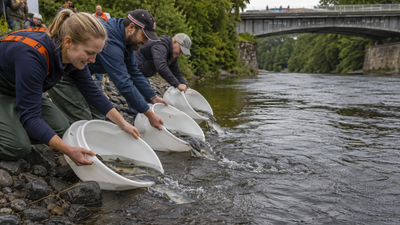
Every spring, visitors who gather outside Stockholm’s Royal Palace witness an extraordinary sight as thousands of tiny fish flow into the city’s waterways through large tubes. At first glance, the event appears to be a public celebration, but behind it lies a decades-long conservation program aimed at protecting one of Sweden’s most important urban ecosystems.
The annual release of salmon and sea trout has become one of Stockholm’s most distinctive environmental traditions, combining ecological restoration with sustainable recreational fishing. By boosting fish populations in the heart of the Swedish capital, the initiative supports biodiversity while helping to restore the natural balance of local waters. Scientists and fisheries experts say the program shows how carefully managed conservation efforts can help wildlife thrive even within a densely populated city.
Why are thousands of salmon and sea trout released into Stockholm’s waters every spring?
According to Radio Sweden, the city of Stockholm released about 10,000 juvenile sea trout, along with thousands of juvenile Atlantic salmon, into the Stockholm Ström, the stretch of water that flows past the Royal Palace and the Swedish Parliament. This tradition dates back to 1973, making it one of the city’s oldest environmental initiatives.According to Deep Sea reports, the fish are raised in hatcheries before being transported to the city and released into the water at the beginning of spring, when conditions are favorable for their migration and growth.
The event attracts residents, school children and tourists, many of whom gather to watch thousands of fish disappear into the currents within minutes.According to Oliver Karloff, a fisheries advisor for the city of Stockholm, the program exists because natural reproduction alone is no longer enough to maintain healthy fish populations.“A lot of infrastructure makes it difficult for them to spread.
“If we don’t continue this, wild animals will not be able to maintain a healthy level.”The initiative thus supplements wild stocks while helping to preserve one of the few fisheries in European capitals.
How annual fish releases help restore Stockholm’s aquatic ecosystem
Although recreational fishing remains an important goal, the program has evolved into a broader environmental restoration effort. Trout and salmon are predatory fish, meaning they help regulate populations of smaller species and contribute to a healthier, more balanced aquatic food web.In recent years, through studies such as “Juveniles and adults of threespine sticklebacks show different habitat use in shallow Baltic Sea bays”, fisheries experts have expressed concern about the rapid increase in threespine stickleback populations in parts of the Baltic Sea. When predator numbers decline, sticklebacks can reproduce rapidly, affecting insects, small fish, and other organisms that support the broader ecosystem.By increasing trout and salmon populations, Stockholm hopes to boost the presence of natural predators and improve biodiversity in urban waterways.
Fisheries officials describe the releases as one component of a larger conservation strategy that also includes restoring habitat, improving water quality and protecting breeding areas.The program also highlights the remarkable environmental recovery of Stockholm’s waters. Decades ago, pollution severely affected aquatic life in parts of the city. Today, improved wastewater treatment and environmental management have allowed migratory fish to once again live in the waterways that run through the center of the Swedish capital.
What happens to salmon and trout after they are released?
Once released, the young fish begin to adapt to their natural environment before eventually migrating to the Baltic Sea. Trout may later return to freshwater streams around Stockholm to spawn, while Atlantic salmon follow longer migration routes before returning to spawn in the rivers in which they originated.Not all fish survive the journey. Like all wild populations, they face predation, disease and changing environmental conditions.
However, fisheries biologists say that releasing large numbers of healthy juveniles greatly increases the likelihood that enough individuals will reach adulthood and reproduce.The program also supports one of Stockholm’s unique attractions: the opportunity to catch migratory salmon and trout within walking distance of the Royal Palace and Parliament. Few capital cities offer world-class sport fishing in the middle of an urban centre, making Stockholm’s waterways world-class.More than fifty years after the first editions began, the annual event continues to show how long-term conservation can benefit both wildlife and people. Rather than simply adding more fish to the water, the initiative aims to rebuild ecological resilience, boost local predator populations, and ensure future generations can continue to experience the healthy rivers that flow through the heart of the city.