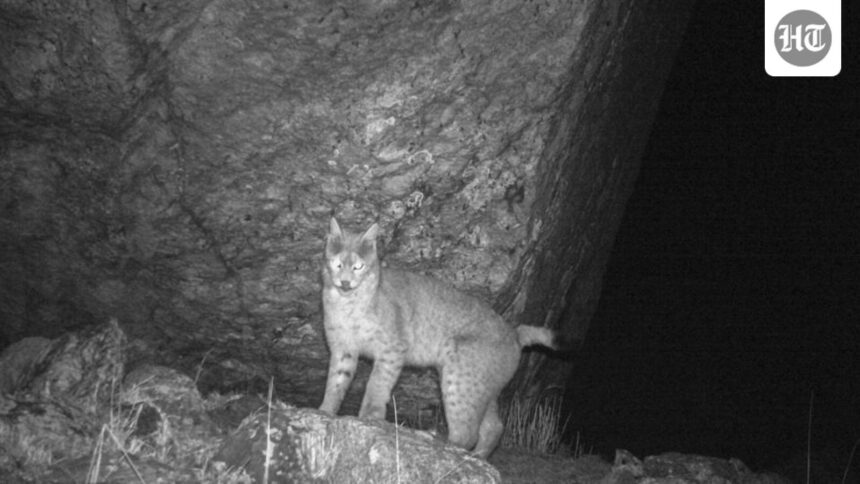
The Eurasian lynx (Lynx lynx) has been photographed for the first time in Sikkim, marking only the second photographic record of this species in the entire eastern Himalayan region. The image, dated January 2026 but shared on Wednesday, is from a camera trap deployed at an altitude of 5,250 meters on the Tso Lamu Plateau in Mangan District as part of a long-term snow leopard and grassland monitoring program by WWF India and the Sikkim Forest Department.

The only previous documented record of this species in the eastern Himalayas came last year with the first-ever photographic record from Arunachal Pradesh, by WWF India and the Arunachal Department of Environment, Forest and Climate Change. In India, the western Himalayan region, usually Ladakh, is the heartland of the Eurasian lynx, with key habitats including Hemis National Park, Changthang Wildlife Sanctuary, Tso-Kar Basin, Nubra Valley, and Rangdum Valley in Kargil.
Although anecdotal reports of the Eurasian lynx in Sikkim have circulated in the region for years, this discovery provides the first confirmed photographic evidence of its presence in the state, WWF India officials said.
“The record was obtained as part of a long-term snow leopard and grassland monitoring program jointly led by the Department of Forests and Environment, the Government of Sikkim and WWF India. The program monitors population trends and seasonal distribution of snow leopards and associated species at high altitudes, and assesses the ecological status of grasslands across the Himalayas,” WWF India said in a statement on Wednesday.
The Eurasian Lynx is a medium-sized wild cat with distinctive ear tufts and a short tail, and is well adapted to cold environments and high altitudes. WWF India said the Tso Lamu Plateau, a high-altitude cold desert ecosystem characterized by extreme climate conditions and low human density, clearly supports a wider range of trans-Himalayan wildlife than previously documented.
The same monitoring recorded snow leopard, Pallas’ cat, Tibetan wolf, Tibetan sand fox, Tibetan deer, Tibetan argali and southern kiang, making it a locally important habitat.
Uday Gurung, Chief Conservator of Forests (Wildlife), Sikkim, said the photo confirmation was a proud moment for Sikkim. “It highlights the ecological importance of our upland grasslands and reinforces our commitment to protecting these fragile ecosystems. Lachin Dzomsa’s collaboration in facilitating access to these remote areas has been important to this work.”
The survey identified conservation opportunities, such as implementing wildlife-friendly traffic management, establishing sustainable waste management systems, conducting regular sterilization and vaccination campaigns for the increasing numbers of freely grazing dogs, and sanitary camps for livestock.
“Following our 2025 record in Arunachal Pradesh, the Sikkim record confirms that the Eurasian lynx has a broader presence in the eastern Himalayas than previously known. What we are documenting at Tso Lamu is not a single species event, but a high-altitude ecosystem of exceptional conservation value. Regular, long-term monitoring across this landscape is essential if we are to understand and protect what is here,” Rishi Kumar said. Sharma, Head of Himalayas Programme, WWF India.