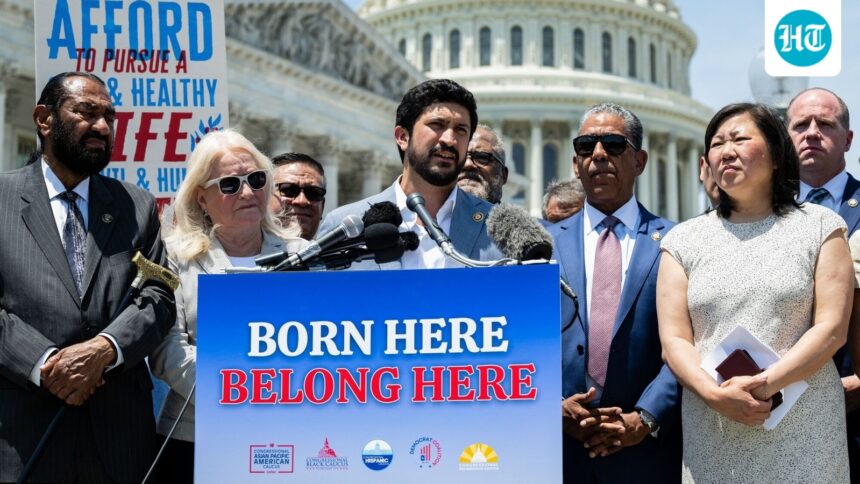
The U.S. Supreme Court on Tuesday rejected President Donald Trump’s attempt to end the 150-year-old birthright policy, thus upholding that nearly all children born on U.S. soil are citizens.

Trump’s executive order, aimed at preventing children born to undocumented immigrants and temporary alien residents from automatically becoming Americans, was among a series of orders he issued shortly after taking office for his second term in 2025.
With the order overturned by a 6-3 vote, Chief Justice John Roberts concluded that birthright citizenship always depends primarily on place of birth — not on the parents’ immigration status or place of residence, the Associated Press reported.
Read also: Two people died of suffocation during World Cup celebrations in Mexico City
Roberts was quoted as saying: “Citizenship, then and now, was the right to rights – to participate freely in our political community. The framers of the Fourteenth Amendment expanded that promise to include ‘every person born free in this land.’ “We have kept that promise today.”
“We didn’t make any new progress today,” Roberts said.
American Indian groups welcome the court order
Advocacy groups and Indian-American lawmakers welcomed the new ruling, which is seen as a relief for dozens of immigrants in the United States.
PTI news agency quoted Chintan Patel, executive director of the civic organization Indian American Impact, as saying that the Supreme Court ruling is a “profound affirmation of who belongs in America.”
Read also: The United States lifts sanctions on four Indian companies linked to the Russia-related actions
“Migrant families from India and South Asia are among those most directly threatened by Trump’s executive order — communities struggling with long visa backlogs and uncertain immigration timelines, as children are often born here long before their parents have a clear path to survival,” Patel was quoted as saying.
Ajay Jain Bhutoria, a prominent leader in the Indian-American community, called the ruling a “tremendous victory.”
“The Supreme Court’s 5-4 ruling protects the birthright citizenship of immigrant families who built their lives here. As America prepares to celebrate its 250th anniversary, this decision honors our history as a nation strengthened by immigrants,” he told PTI.
Indian American lawmakers Raja Krishnamurthy, Pramila Jayapal and Suhas Subramaniam welcomed the Supreme Court ruling, calling Trump’s executive order a “blatant and unconstitutional attempt to strip citizenship from immigrant children across the country.”
How does this affect Indians?
The US Supreme Court’s ruling upholding birthright citizenship ends more than a year and a half of suspense for millions of Indian immigrants living in the United States. Nearly half of the Indian immigrant population (51%) in the United States are natural citizens, according to a Pew Research Center fact sheet.
Read also: The dentist who mocked Ketan Agarwal’s death has been suspended for 5 years by his dental body
Nearly 5.2 million people in the United States identify as Indian in 2023, according to US Census Bureau data, cited by the Pew Research Center. It highlights that 60% of Indian immigrants have lived in the United States for more than 10 years and 51% of them are naturalized US citizens.
Children born to Indian citizens living in the country on temporary work visas or tourist visas will now be able to obtain US citizenship, much to the relief of Indian H1 B visa holders. Indian citizens accounted for 71% of all H-1B visas in 2024.
However, the Justice Department said it would “prioritize prosecutions of birth tourism schemes across the country.” Among other tools, the department can prosecute people who lie on their visa applications about why they came to the United States, Bloomberg reported.
Birth tourism refers to the practice in which a woman travels to the United States to give birth to a child in the country, who will automatically obtain US citizenship.